

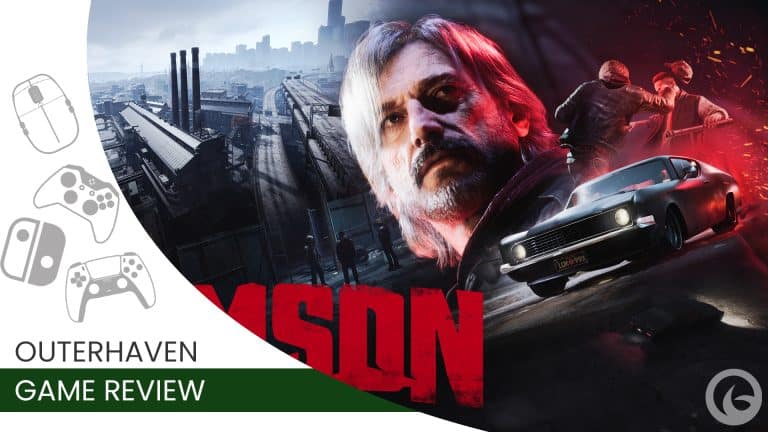
Samson: A Tyndalston Story had my attention immediately. Not just because it’s a new open-world game, but because it comes from Liquid Swords, the studio founded by Christofer Sundberg, the creator of Just Cause and former founder of Avalanche Studios.
That kind of pedigree sets expectations high, especially when Liquid Swords is positioning Samson as a “no-nonsense” alternative to today’s bloated open-world games. Less filler, more focus, and a tighter overall experience. It’s a bold pitch for a genre known for excess. The real question is whether Samson actually delivers on that promise or falls into the same traps it’s trying to avoid. That’s what I’m breaking down in The Outerhaven’s review of Samson.
Game Name: Samson: A Tyndalston Story
Platform(s): PC
Reviewed On: PC
Publisher(s): Liquid Swords
Developer(s): Liquid Swords
Release Date: March 8th, 2026

What Is Samson?
Yes, Samson is an open-world action-adventure game, but don’t let that label immediately set expectations for a sprawling 100-hour experience. Instead, Liquid Swords has taken a far more focused approach, with the main story clocking in at around 10–20 hours depending on your playstyle.
Set within the compact open-world of Tyndalston, Samson feels closer in design philosophy to early 2000s action-adventure titles like Driver and Grand Theft Auto III than it does to its modern contemporaries. It’s a deliberately tighter experience, one that prioritizes pacing and momentum over sheer scale.
That focused scope is, in many ways, Samson’s greatest strength. By avoiding unnecessary bloat, the game maintains a consistent sense of direction across most of its systems. However, that same restraint can occasionally work against it. With less content to dilute weaker elements, certain limitations become more noticeable than they might in a larger, more expansive title.
Who Is Samson And What’s His Story?
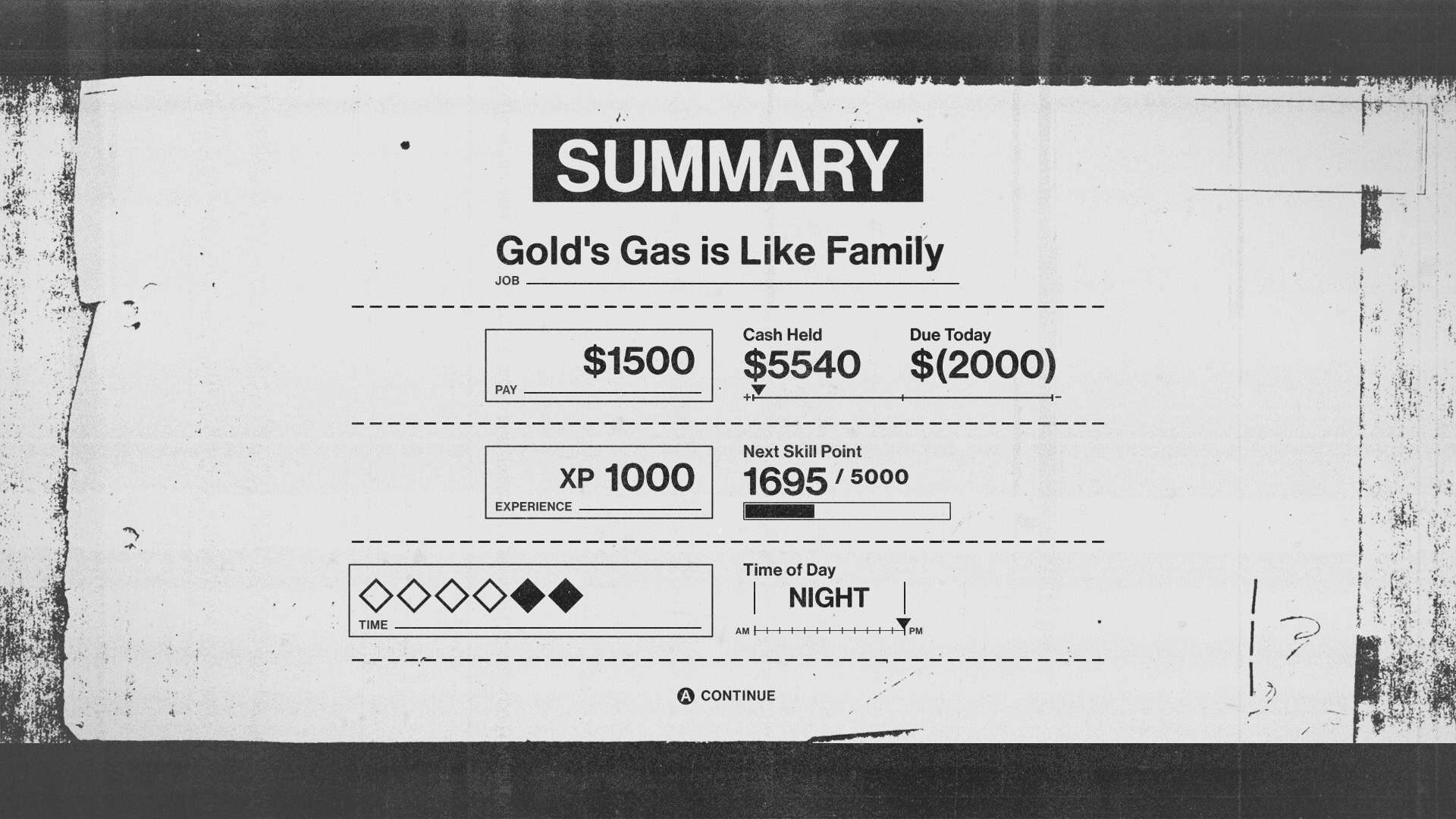
You play as Samson McCray, a legendary getaway driver who returns to his hometown of Tyndalston after time spent in St. Louis leaves him with a debt to pay following a job gone sideways. Of course, it’s not as simple as settling down with a normal job. Samson is forced to pay back thousands of dollars every day to a St. Louis gang in order to protect his sister, Oonagh, who is being held there until the debt is cleared.
In an effort to earn money quickly, Samson reconnects with an associate named Carter, who offers him a place to stay and helps line up “jobs” around the city. These jobs become the foundation of your experience, as you work to dig Samson out of the situation he finds himself in. This is where your adventure truly begins. Without diving into spoilers, things escalate quickly, and what starts as a straightforward attempt to repay a debt soon spirals into something far more complicated.
Hard-Hitting Action
If you’ve played open-world titles like GTA IV or Mafia III, then Samson’s gameplay will feel somewhat familiar. However, there are some key differences that help it stand on its own, even in areas where it doesn’t quite match the polish of those larger-budget titles.
As mentioned earlier, Samson’s core gameplay loop revolves around heading out each day to complete “jobs” in order to earn money and pay off your debt. These jobs range from following targets and collecting debts to street races and getaway driving. What makes this loop more interesting is how each day is structured.
Days are divided into three time periods: noon, evening, and night. In each period, you’re given a limited number of action points, usually two, which are used to take on jobs. Once you’ve spent your action points, time automatically advances. This system becomes more important as certain jobs are only available at specific times of day, while others require more action points to complete.
On top of this, main story missions, referred to as chapters, also consume action points. This means you’re constantly balancing progression with efficiency, forcing you to plan ahead. It’s a simple system on paper, but it plays a major role in shaping how you approach the game, reinforcing Samson’s more focused design philosophy.

Brutally Effective Combat
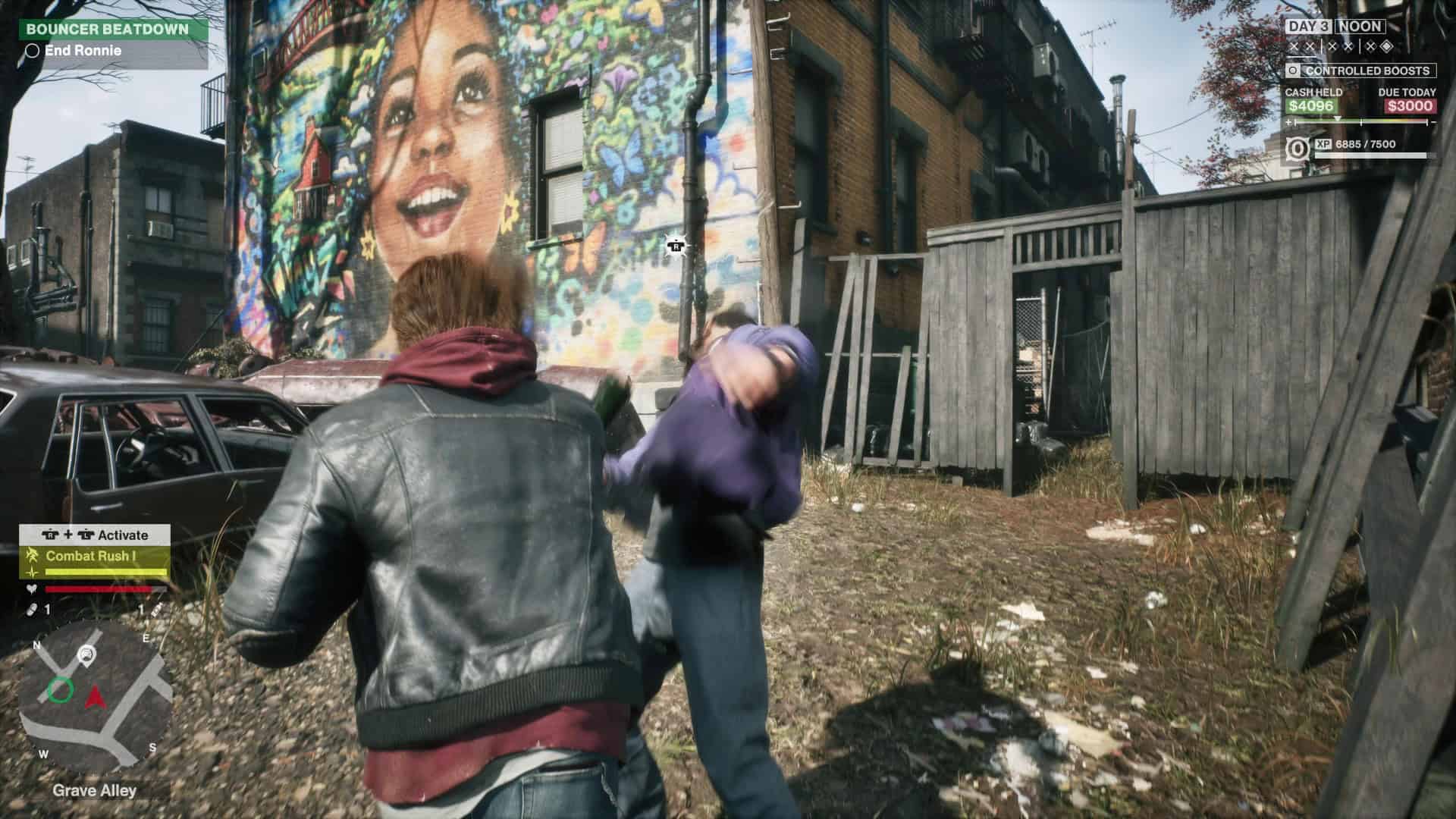
Regardless of which jobs you’re tackling, one thing is consistent: combat is never far away. Whether you’re ramming cars off the road in Mad Max-style vehicular combat or fighting on foot, Samson delivers a combat system that is simple, sometimes repetitive, but undeniably effective.
On foot, combat revolves around light and heavy attacks, mapped to the right bumper and right trigger. Heavy attacks deal more damage but are noticeably slower, encouraging a balance between speed and impact. You can fight with your fists or pick up weapons from the environment with the press of a button, adding some variety to encounters.
Enemies feature both a health bar and a stun meter. Depleting the stun meter allows you to perform a finisher by clicking in the right stick, similar to more recent God of War titles. These finishers can also restore health once certain skills are unlocked, adding an extra layer of risk and reward.
Healing is handled through painkillers, which can be used at any time and expanded through progression. Yes, it’s a system that immediately brings Max Payne to mind, and it works just as reliably here.
Samson also features an adrenaline meter that builds as you deal damage. Once full, activating it significantly increases your damage output for a short time. It’s a straightforward mechanic, but one that adds bursts of intensity to combat and helps maintain momentum during larger encounters.
While none of these systems are particularly groundbreaking, they come together to create combat that feels impactful and satisfying. It may lack the depth of some genre leaders, but in keeping with Samson’s overall design, it avoids unnecessary complexity in favor of something direct, responsive, and consistently fun.
Combat feels fantastic. It’s a little slower-paced, but that weight behind every action makes each hit land with real impact. The result is a visceral, satisfying experience, even with its relatively limited depth.
The only real drawback is that this is one area where Samson’s focused scope begins to work against it. While the strong impact helps carry the system, the lack of variety in weapons and abilities means combat can start to feel repetitive over time. With a broader range of tools or mechanics, this is an area that could have reached a much higher level.
Hitting The Road
One of the best weapons at Samson’s disposal is his car. It’s not just a tool for making deliveries around Tyndalston, it can also be used as a literal battering ram to take out enemies on the road. Before getting to that, though, the obvious question is how does driving actually feel in Samson?
This obviously isn’t a racing sim, so don’t go in expecting especially deep driving mechanics. That said, driving carries the same weight as combat. Vehicles feel heavy and powerful, while still remaining agile enough to make chases and escapes enjoyable. There is a learning curve, largely because Samson doesn’t simply copy the competition, but it never becomes overly difficult once you get the hang of it.
One mechanic I particularly liked is “kicking it down,” which involves shifting down through the gears to improve acceleration. That already gives driving more character than you might expect, and it becomes even more engaging once nitro is added into the mix. If you run out of nitro, you can refill it either by hitting billboards around town or by spending some of your hard-earned Tyndalston cash at a garage. Just be sure to take care of your car, because it is one of your main tools for making money in Samson. Damage impacts performance, and repairs can end up costing thousands.
When taking on Takedown-style jobs, you’ll be chasing down and destroying one or more enemy vehicles at a time. You can do this by ramming them from behind or by pulling alongside them and tapping X while holding the left stick in their direction to perform a side slam. These side slams are powerful, but they also carry real risk, as missing can seriously damage your own vehicle. During one Takedown, I actually totalled my car and had to quickly steal a civilian vehicle before my targets got too far away. It was hilarious, chaotic, and genuinely tense all at once.
Building Your Samson
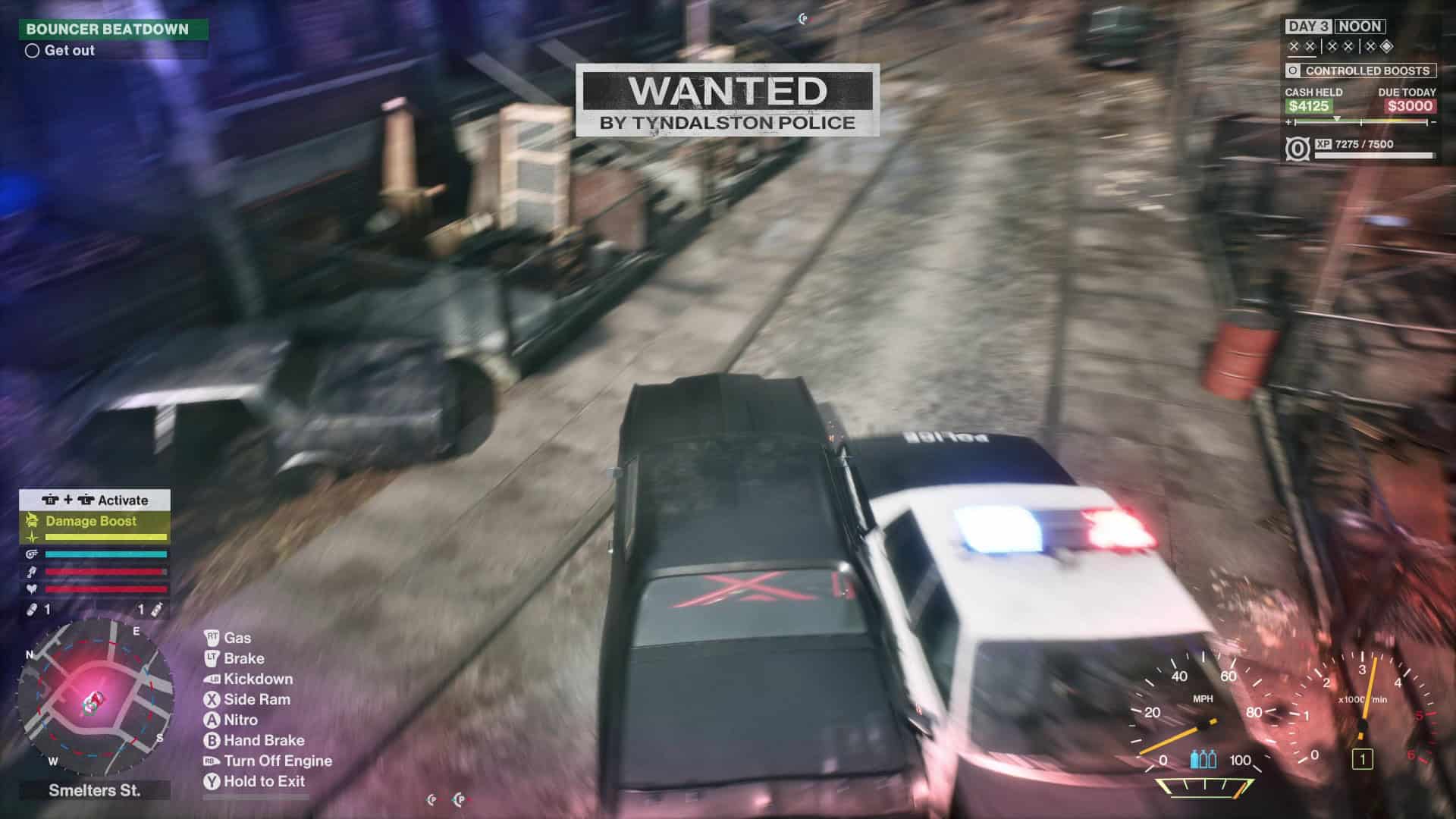
You can shape Samson to an extent through the skill system mentioned earlier, as there are four different skill paths: Instinct, Tactics, Aggression, and Cunning. Each tree leans toward a particular playstyle, and while many of the skills are passive in nature, their impact on gameplay and the wider loop of Samson can be significant.
For example, some skills allow you to earn additional action points if you pay off more than your daily due, while others reduce how much money you lose if you get knocked out. That is especially important because, if you are knocked out at any point, you lose all the money you are currently carrying and automatically advance to the next time of day. In other words, getting careless can be costly in more ways than one.
You earn skills by leveling up Samson, which is done by completing jobs and discovering locations throughout the world. You can also find combat magazines scattered around the map that permanently make Samson stronger, giving exploration a more tangible gameplay reward beyond simply earning money.
Gritty But Not Grimey
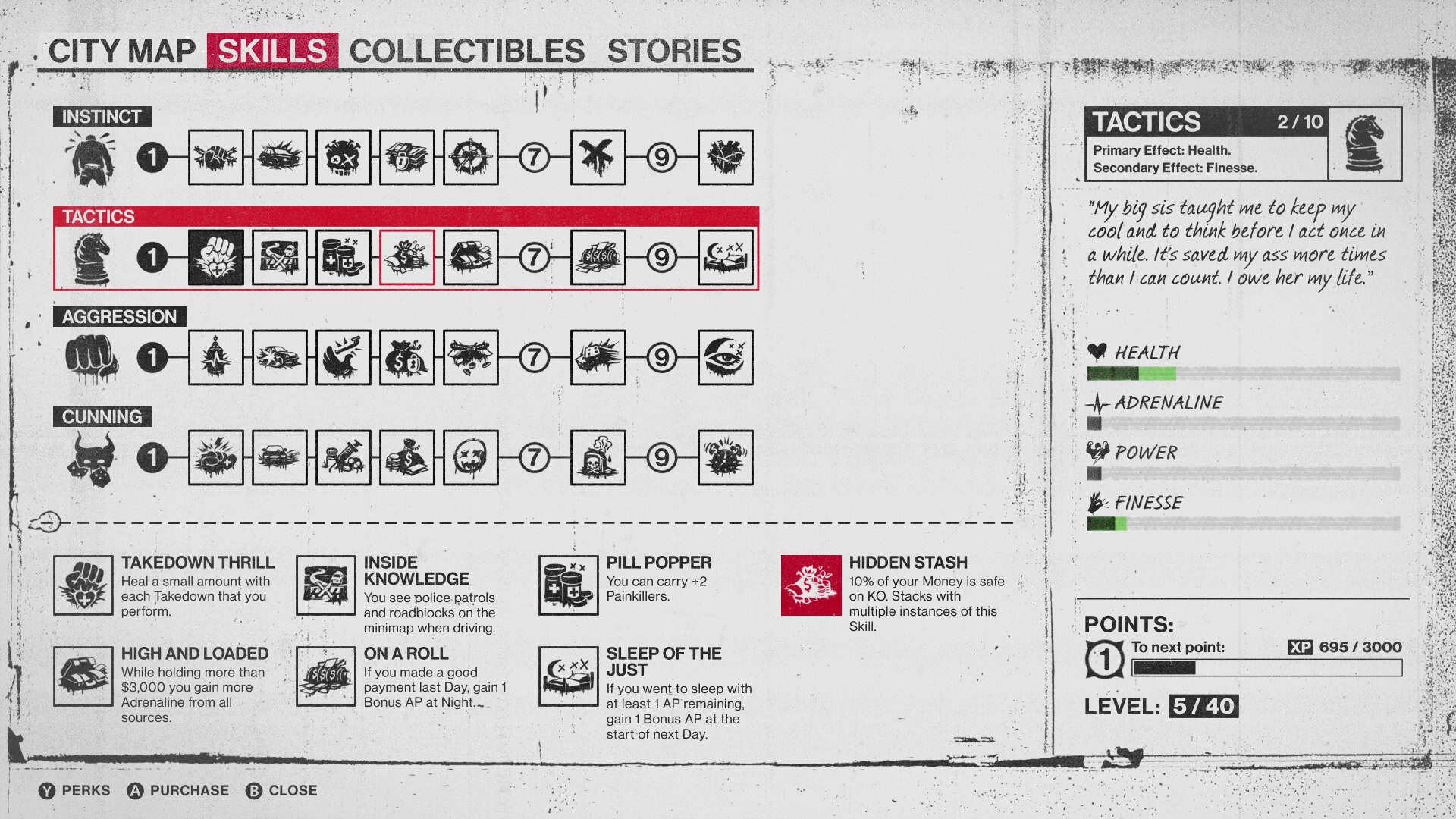
When it comes to presentation, Samson has a gritty quality across the board that we rarely see in games these days. Like most modern open-world titles, Samson aims for a grounded, realistic look in both its characters and world. What makes it stand out is its color palette of browns and greys, combined with its 90s urban setting, giving it a distinct visual identity that I haven’t really seen since GTA IV nearly 20 years ago.
What surprised me most is that, despite these gritty visuals, the game never feels dirty or grimy in its presentation. Everything is crystal clear, exactly what you’d expect from a modern AAA title. That’s particularly impressive for a game of this scale and budget, and it’s another example of how a more focused scope can elevate the overall experience.
Audio is no different. The score is consistently strong, matching both the environment and time period extremely well. Voice acting across the main cast is equally solid, capturing the tone of a gritty 90s crime story. Even smaller moments, like phone calls, carry emotional weight and help reinforce the stakes of what’s happening.
The writing isn’t anything groundbreaking, but it fits the tone perfectly. It feels like a classic 90s action movie, and in this context, that works in its favor. The only real drawback in Samson’s presentation comes from its facial animations. They aren’t necessarily bad, but they lack the nuance you’d expect from bigger-budget productions. At times, this can be slightly distracting, but it never significantly detracts from the overall experience.
Headroom For A Lot More Performance
At launch, Samson is only available on PC, and after some initial testing, it quickly became clear why. My first impression raised a bit of a red flag. On my Ryzen 9 9950X3D and NVIDIA RTX 5090-powered system, the game defaulted to 4K Ultra settings with DLSS and Frame Generation enabled. Seeing this immediately made me question how well the game would perform natively.
After switching DLSS to its Native (DLAA) mode, enabling ray reconstruction, and disabling Frame Generation, things became much clearer. At 4K native with Ultra settings and ray reconstruction enabled, Samson delivered a mostly stable 30 FPS experience. While that’s lower than I would expect from a system of this caliber, further investigation revealed a major factor: strand-based hair was enabled by default, which is a highly demanding setting.
Disabling strand-based hair while keeping everything else the same resulted in a significant uplift, pushing performance into the high 40s to mid-50 FPS range. On a VRR-capable display, this becomes a far more playable experience. Even so, this still falls short of what I would typically expect at native 4K on high-end hardware.
Further Performance Testing
With that in mind, I continued testing with strand-based hair re-enabled, simply because of how much it improves character visuals. During this process, I noticed something unusual: CPU utilization was surprisingly low. While it’s not uncommon for games to underutilize modern CPUs, the combination of low CPU and GPU usage suggests that Samson isn’t fully leveraging available hardware resources.
This leads into another oddity. Switching to DLSS Quality at 4K Ultra settings, with ray reconstruction and strand-based hair enabled, effectively doubled performance compared to native resolution. However, moving down to DLSS Balanced or Performance only resulted in marginal gains of 1–3 FPS. That’s not typical behavior, as DLSS presets usually provide more substantial scaling between modes.
Given these results, DLSS Quality proved to be the optimal setting for my playthrough. At 4K Ultra with ray reconstruction and strand-based hair enabled, it consistently delivered 60+ FPS while maintaining the best overall image quality.
Jordan’s PC Specs: AMD 9950X3D, RTX 5090 Founders Edition, 96GB DDR5 6000MHz Corsair RAM
In the end, I was left feeling like there is a lot of headroom for additional performance in Samson, and I am slightly concerned for those with older hardware. That being said, the game has already receive multiple patches before launch. So, there is every chance that your experience of performance could be vastly different to mine, even on the same hardware.
On The Bright Side
On the positive side, Samson has been relatively bug-free in my experience. You may occasionally encounter a minor collision issue or an enemy failing to react, but these moments were rare enough that they never became distracting or frustrating. That’s more than can be said for some bigger budget titles.
Final Thoughts
Samson is exactly what it set out to be. Its limited scope and scale will undoubtedly turn some people away, particularly because that restraint can make its weaker elements more noticeable. Even so, there is something genuinely refreshing about its simple, no-nonsense approach in an era where so many open-world games feel determined to be as large and time-consuming as possible.
Samson does not have the polish, depth, or variety of the biggest names in the genre, but it makes up for that with weighty combat, satisfying driving, a strong sense of style, and a focused structure that keeps things moving at a steady pace. If you miss the kind of action game that is more concerned with delivering a fun, hard-hitting experience than chasing endless scale, Samson is absolutely worth your time.
If you enjoyed this review, explore more of our in-depth video game reviews across PlayStation 4, PlayStation 5, Xbox One, Xbox Series X, Nintendo Switch, Nintendo Switch 2, and PC.
Review Disclosure Statement: A copy of Game was provided to us for review purposes by Publisher. For more information on how we review video games and other media/technology, please review our Review Guideline/Scoring Policy for more info.
Samson’s hard-hitting combat and slimmed down scale help it stand out against much bigger budget competition. It proves that sometimes having limitations is a good thing. If you miss the kind of action game that is more concerned with delivering a fun, hard-hitting experience than chasing endless scale, Samson is absolutely worth your time.
Pros
- Impactful Combat
- Action Points Make Planning Important
- Debt Makes Side Content Matter
- Writing and Performances Perfectly Match The Setting and Tone
- Driving Has Weight and Is Different From The Competition
- The Game Respects Your Time
- Despite Some Repetitiveness The Game Remains Fun Throughout
Cons
- Additional Optimization Is Needed To Make The Best Of High-End PC Hardware
- Combat Can Become Repetitive
- Facial Animations Lower Quality Than The Rest Of Presentation
-
Samson Review - Impactful Combat And A Tight Focus Help It Shine
