


With Square Enix embracing real-time combat for Final Fantasy, why shouldn’t it do so with Team Asano titles? The Adventures of Elliot: The Millennium Tales sees the developer blend its signature HD-2D visuals with the action RPG genre. Team Asano previously worked on such beloved turn-based titles as Octopath Traveler and Bravely Default.
But ironically, while Final Fantasy has eschewed turn-based combat to feel more contemporary, The Adventures of Elliot feels decidedly retro, calling back to such titles as A Link to the Past and Secret of Mana in its gameplay and presentation. We had the opportunity to play The Adventures of Elliot for this review and see how the action RPG carves its own expansive adventure.
Game Name: The Adventures of Elliot: The Millennium Tales
Platforms: Nintendo Switch 2, PlayStation 5, Xbox Series X|S, PC
Reviewed On: PlayStation 5
Time to Completion: 16 hours for first play
Developers: Square Enix (Team Asano), Claytechworks
Publisher: Square Enix
Release Date: June 18th, 2026
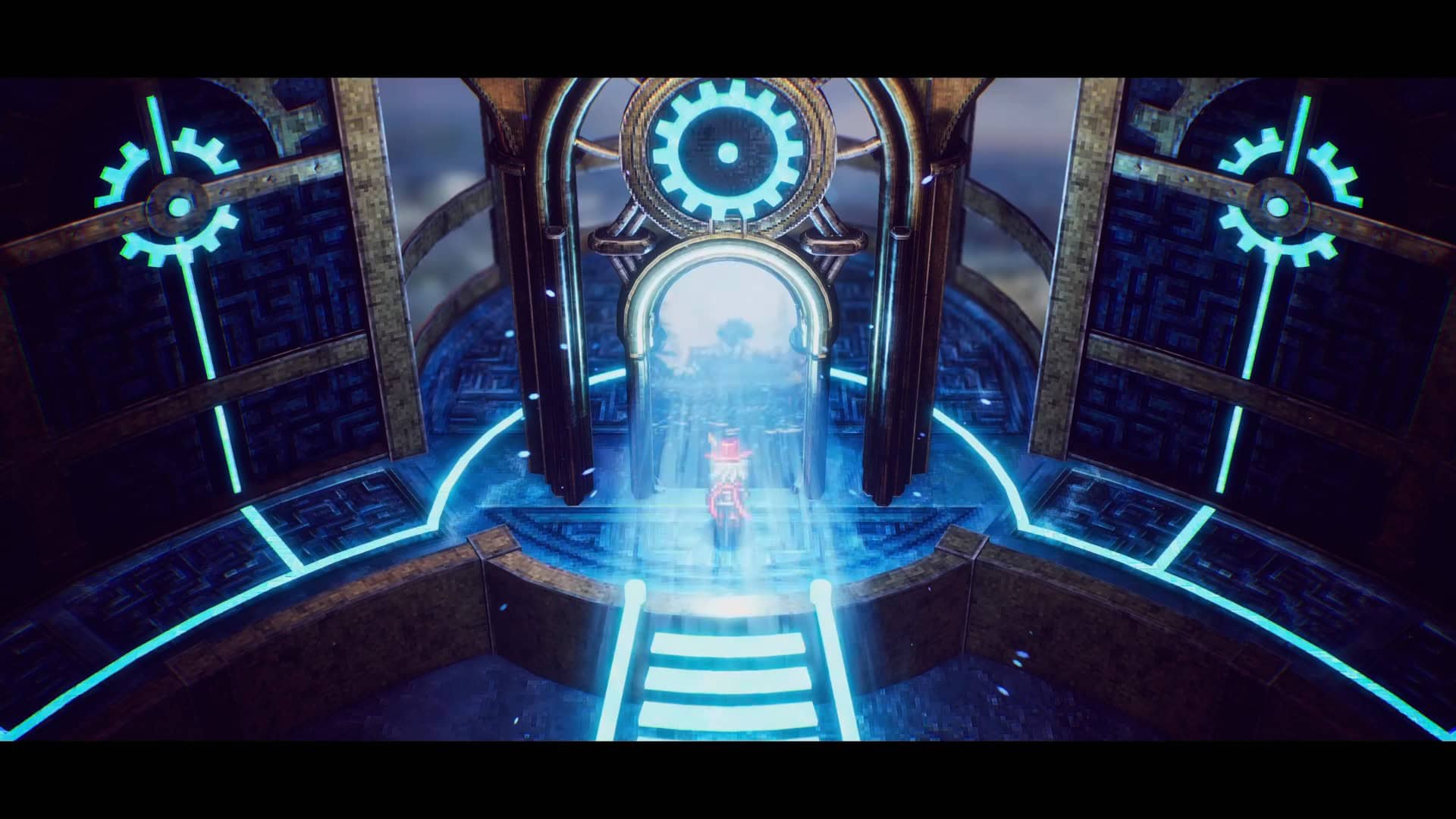
The Adventures of Elliot: The Millennium Tales sums up its premise in its title alone. You’re Elliot, a young man adventuring in a magical kingdom. But when a curse afflicts the land, you must travel through time – across millennia – to get to the source of the curse’s power.
Let’s Do the Time Warp
Sure, there’s a little more to it than that. But the story is still fairly uncomplicated. In the Age of Safekeeping, people live in a kingdom protected from roaming beasts by the namesake Spell of Safekeeping. The kingdom’s Princess Heuria continuously casts the spell, as she’s the only person able to do so. Generally, people are happy, including upbeat adventurer Elliot. But of course, this can’t last. A shady royal advisor betrays the Princess and her father, King Hichard. This villain promises to expand the kingdom at any cost, and then time-travels away. Elliot is sent after him. And so kicks off the journey that sees Elliot visiting various time periods to save the kingdom.
Of course, you could say the real adventure is the friends we meet along the timeline. Each age – there are four of them – sees Elliot enter a new era with its own characters and their tales. The characters themselves are only slightly more dimensional than their 2D sprites. Across four eras, there are many people after all. But their interweaving stories with ramifications throughout history – painting pictures of how each civilization rose and fell – prove intriguing and compelling. At a certain point, greater themes develop around mutual understanding and building bridges between communities.
The game is not without smaller charming moments either. At one point, Elliot is tasked with collecting cats. It’s entirely optional. But since the map is littered with litters of the furry felines, it’s easy to spot them while questing. Once you interact, each cat delivers a unique meow—clearly a different human just saying “meow.” It gets me every time. I wish The Adventures of Elliot had embraced having even more quirky moments like this. Though the cats do play a role in the game’s “true” ending.

The Side Adventures of Elliot
Interestingly, I actually found many of the side quests more compelling than the main storyline. While the main quest is a bit Link-by-numbers, the side content includes tales with more personal touches. One highlight involves traveling back through time to get to the root of a family motto. Others involve interacting with a morally ambiguous researcher. They’re not groundbreaking, but they’re more relatable than “we’ve gotta save the kingdom, Princess!” which drives the plot for much of the 15-20 hour campaign.
While I didn’t explore every cave or dungeon in my playthrough, I did take on side quests wherever I found them. Many of them do boil down to fetch quests or “defeat X-number of beasts in this area.” But they never drag on. And they often brought me to areas of the map I otherwise might not have visited.
And believe me, there’s a lot to explore. Wherever – or whenever – Elliot ends up, there’s different terrain with new caves, ruins, and dungeons to check out. The world of Philabieldia always features a kingdom/city/dinky town in the lower right-hand corner. But surrounding that are lush forests, arid deserts, frozen tundras, and other biomes, some of which change depending on the time period you visit. The 2D visuals are enchanting. I appreciated small environmental touches like some ages depicting springtime, others autumn, and so on.
Adding Action to the Adventure
But you can’t always stop to smell the flowers or watch the leaves fall. Beasts roam the area, regardless of the age you’re in. There’s a decent enough variety of these critters, from charging chicken-folk to self-replicating snails.
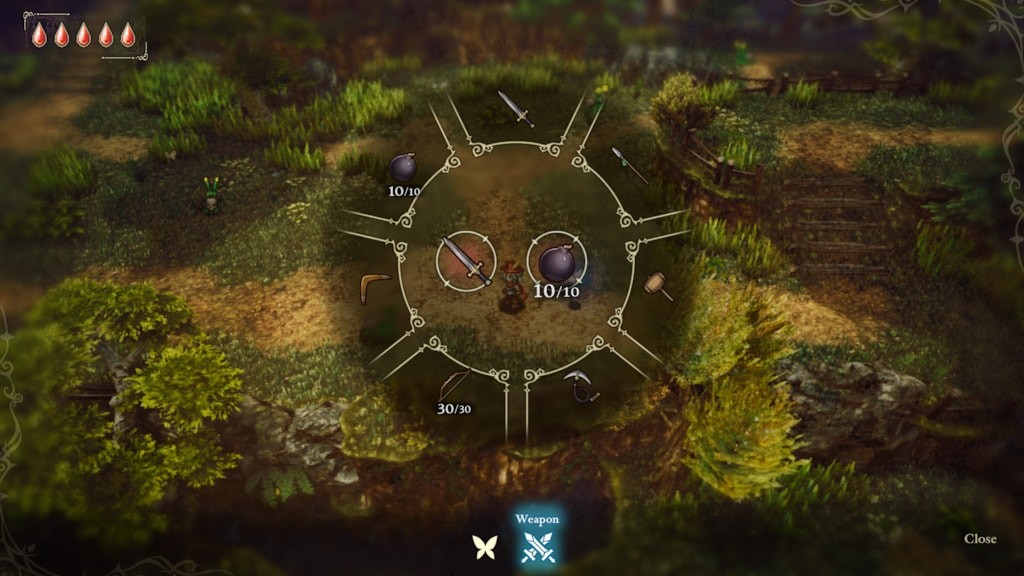
Thankfully, Elliot is no stranger to variety either. Over the course of the early campaign, you’ll gain access to seven unique weapon types. These consist of swords, bows, boomerangs, bombs, spears, hammers, and chains and sickles. Each one plays quite differently, encouraging players to switch things up and see what works best for them.
Aside from giving players a choice on how to fight, the weapon variety also covers up a small shortcoming. In Team Asano’s turn-based HD-2D titles, it didn’t matter that 2D characters fought in a 3D world. But in an action-adventure game, depth perception is important. As such, some of Elliot’s weapons do better than others in hitting enemies’ hit boxes. With its slashing attacks and generous range, the sword quickly became my favorite for hitting nearby enemies reliably.
For each weapon, Elliot can use a charged-up special attack as well. For the chains and sickles, for example, the regular attack spins in a circle, hitting all enemies a chain’s distance away from Elliot. Meanwhile, the special attack is a chain-shot that can grab a faraway enemy and pull it close. You can equip any two weapons at a time. Personally, I found it advantageous to always have one melee weapon as well as a ranged one for backup, like the bow or boomerang.
Decisions, Decisions
If the variety of weapon types themselves isn’t enough, The Adventures of Elliot has various kinds of each weapon type to find. Whenever you find a better weapon, it’s automatically equipped. Lest you worry that choice is removed, better weapons of a certain type don’t function differently from one another. A new sword will have better overall stats and look different, for example. That’s all.
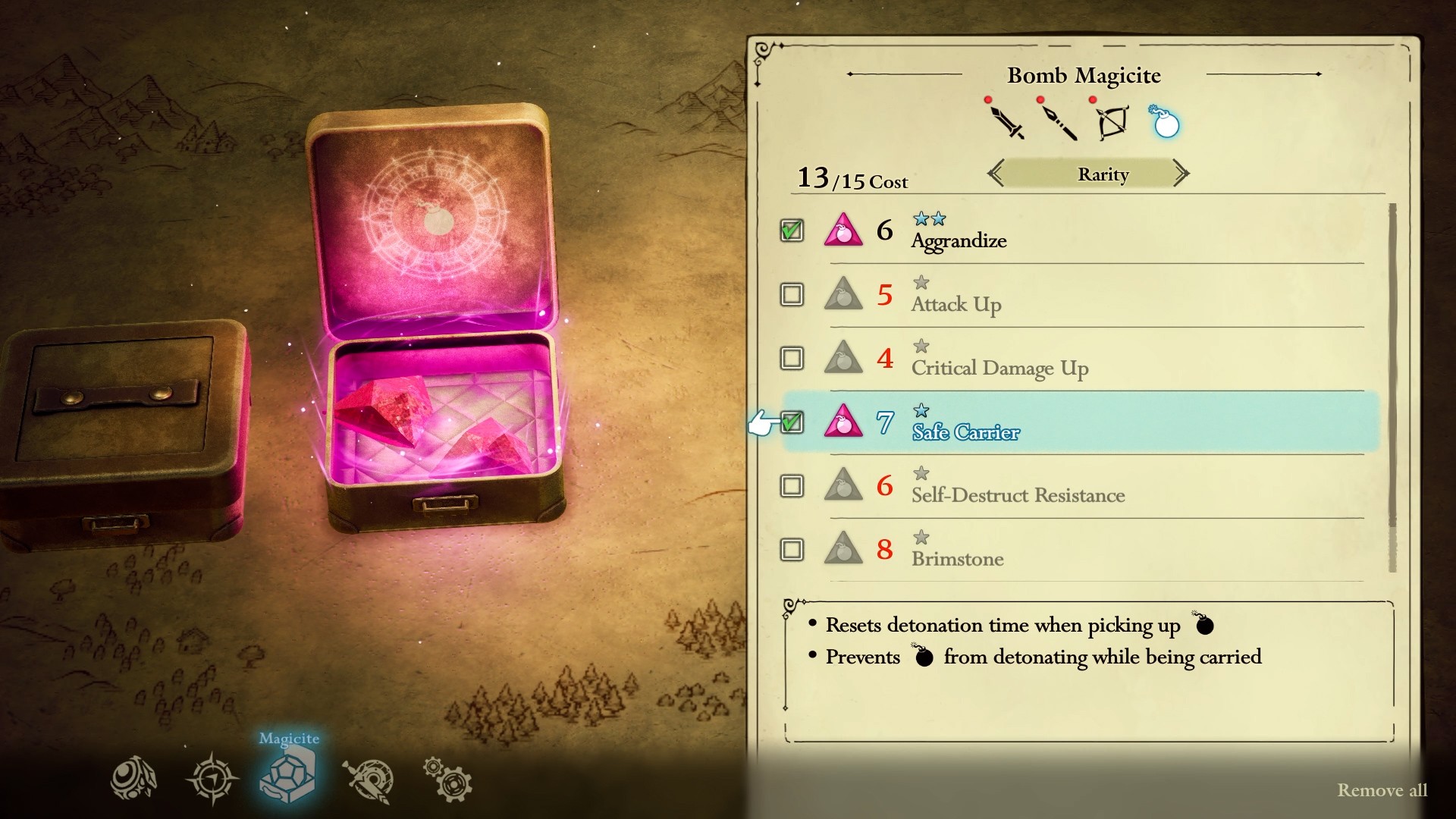
Instead, the customization within weapon trees comes from Magicite. Familiar to Final Fantasy players, in The Adventures of Elliot, Magicite gets equipped onto a weapon directly. Each one only applies to a given weapon type, but may be re-equipped or removed. These can apply abilities ranging from stronger special attacks that damage Elliot if they miss to critical hit rate increases. Magicite is what really facilitates making a “build” for Elliot.
In addition to the two equipped weapons, which may be switched up at any time through a weapon wheel, Elliot also has access to a trusty shield. The shield can block any attack. However, it has a stamina bar. So you can’t block forever. Blocked attacks will drain the bar, while lowering the shield will recharge it. This gets players to block judiciously, adding an extra layer of strategy to the combat.

A Multi-Purpose Fairy Friend
And if all that combat variety still isn’t enough, we haven’t even gotten to Elliot’s companion. At a certain point early on, Elliot meets Faie, a talking fairy. Gameplay isn’t the only thing that may remind players of The Legend of Zelda. Faie has a lot to say. But worry not, you can toggle her to be less chatty in the menu. It’s not what she says that really matters; it’s everything she can do.
Faie is not just a conversation buddy; she’s a whole playable character in her own right. Players control Elliot with the left stick and can move Faie with the right. Faie not only deals damage to enemies she bumps into, but she unlocks a whole host of unique abilities.
Visiting Shrines of the Mystic grants Faie powers. Some of these powers will be new, such as the ability to summon fire or create a duplicate of Elliot. Meanwhile, others can upgrade existing powers further. For example, one shrine unlocks a warp ability while another unlocks a warp upgrade, rendering Elliot invisible for a short while.
The shrines themselves consist of puzzle rooms that players complete by using the newfound ability. This is a great example of learning-by-doing in game design, as it both serves as a tutorial and a challenge. You know that by the time you complete a shrine, you’ll grasp exactly what your new ability does. These shrines ended up being some of my favorite parts of the game.

Faie with a Friend
The Adventures of Elliot may be played in single-player or local co-op. How does this work? In co-op, one player controls Elliot while the other controls Faie. In single player, one player controls both characters through Elliot. It’s a testament to Team Asano’s design that controlling two characters at once feels fairly intuitive. It helps that rather than have companion AI, Faie floats passively around Elliot while not directly controlled by the right thumb stick. If Faie happens to bump into an enemy, she’ll damage it.
That said, controlling two different characters at once can still sometimes feel like patting your head while rubbing your stomach. Boss battles benefit from both characters actively fighting together. With both having various abilities to switch to and from and cooldown meters to manage, it can engage players fully but also get hectic. Switching abilities using the wheel does pause the game, but can mess up the flow of the action. Mostly I just stuck to one ability for Faie and two weapons for Elliot for each boss battle, choosing to switch them up between fights instead. The boss battles are epic though, consisting of gargantuan beasts with a range of attacks.

Et Tul, Elliot?
Combat in Elliot has a few other quirks, but these are quite interesting and useful. On normal difficulty, The Adventures of Elliot isn’t a tough game. But it adds an extra layer of challenge through combat streaks. Whenever Elliot defeats an enemy without taking any damage, the streak increases. And a higher streak means that enemies drop more gems (called tul) and items when defeated. It’s a nice little risk-reward feedback loop.
Tul may be used to buy items for Elliot such as potions and weapons. But most weapons you’ll find in the field, and you can only carry as many potions as you have vials for. Ah, you may think, so at a certain point, why collect tul at all?
Well, The Adventures of Elliot has a unique answer for that. Aside from buying items, tul may also be used to bribe Faie into bringing you back to life if you die. I’m not sure about the ramifications of that, but it’s a neat trick to get players to think about budgeting. And don’t think you can do this ad nauseam. Each time you die without finding a save point, the cost of revival increases. This really got me to pay attention to my tul purse in a way I wouldn’t have done otherwise.
Qualities of Life
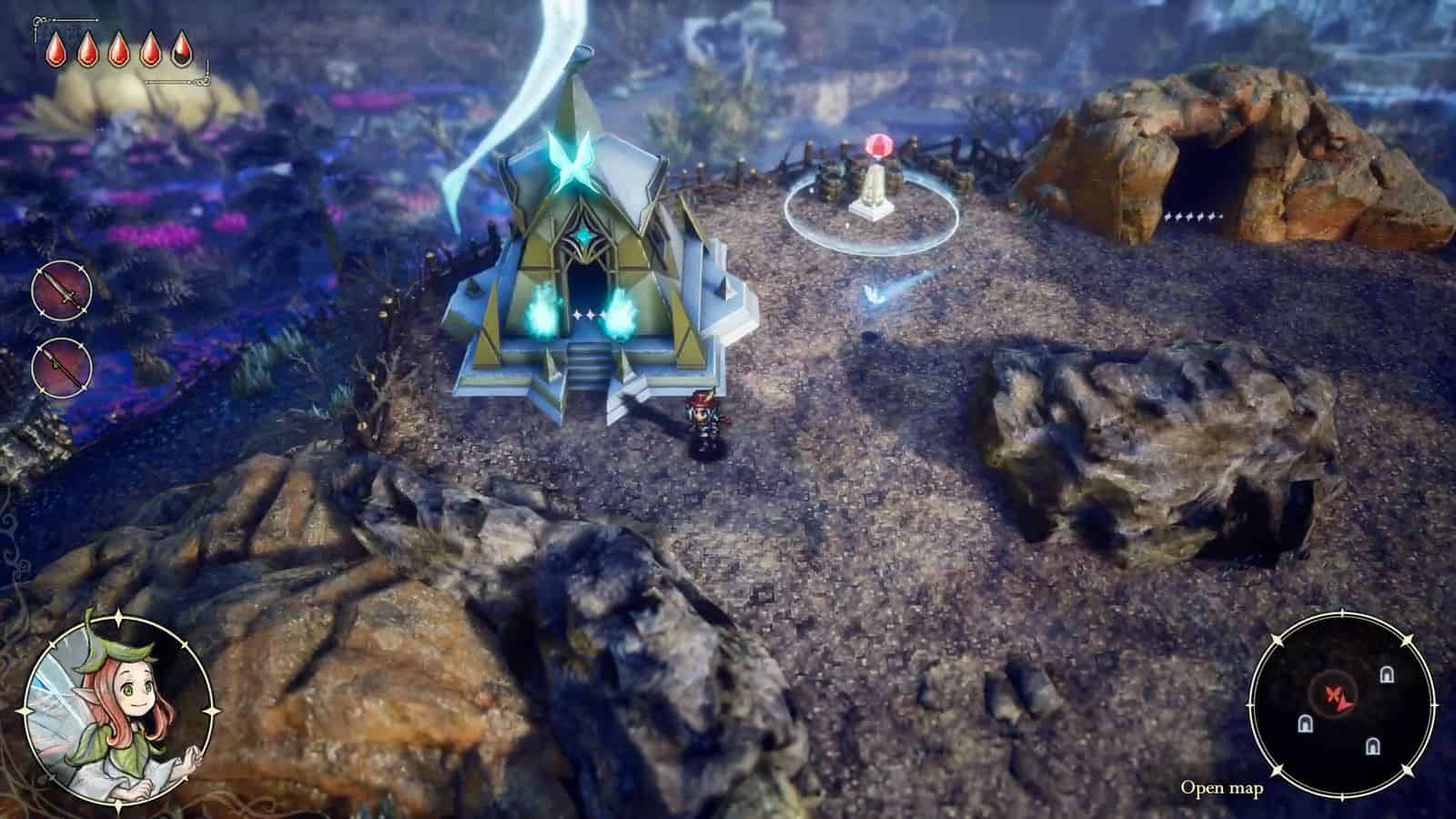
As you might expect from a retro-style action-adventure, The Adventures of Elliot uses a heart system for life. You start out with just a few hearts. But finding Shards of Life increases life permanently. These often appear in treasure chests, especially those towards the ends of Ruins. Four of them upgrade into a full health piece.
Exploring the map can uncover many secrets. Trials, for instance, involve fighting waves of enemies for nice rewards. Magic Springs grant Faie the ability to use her magic for longer without recharging. Eventually, the map will become dotted with all kinds of places to check out at your leisure.
And I do mean at your leisure, as The Adventures of Elliot makes traversal incredibly easy. While you do have to find a Doorway of Time to uncover a new age, once you do, you can zip around across time and space by selecting any adventuring guidepost. And these guideposts are littered generously around the maps; you just have to stop at one first to utilize it.
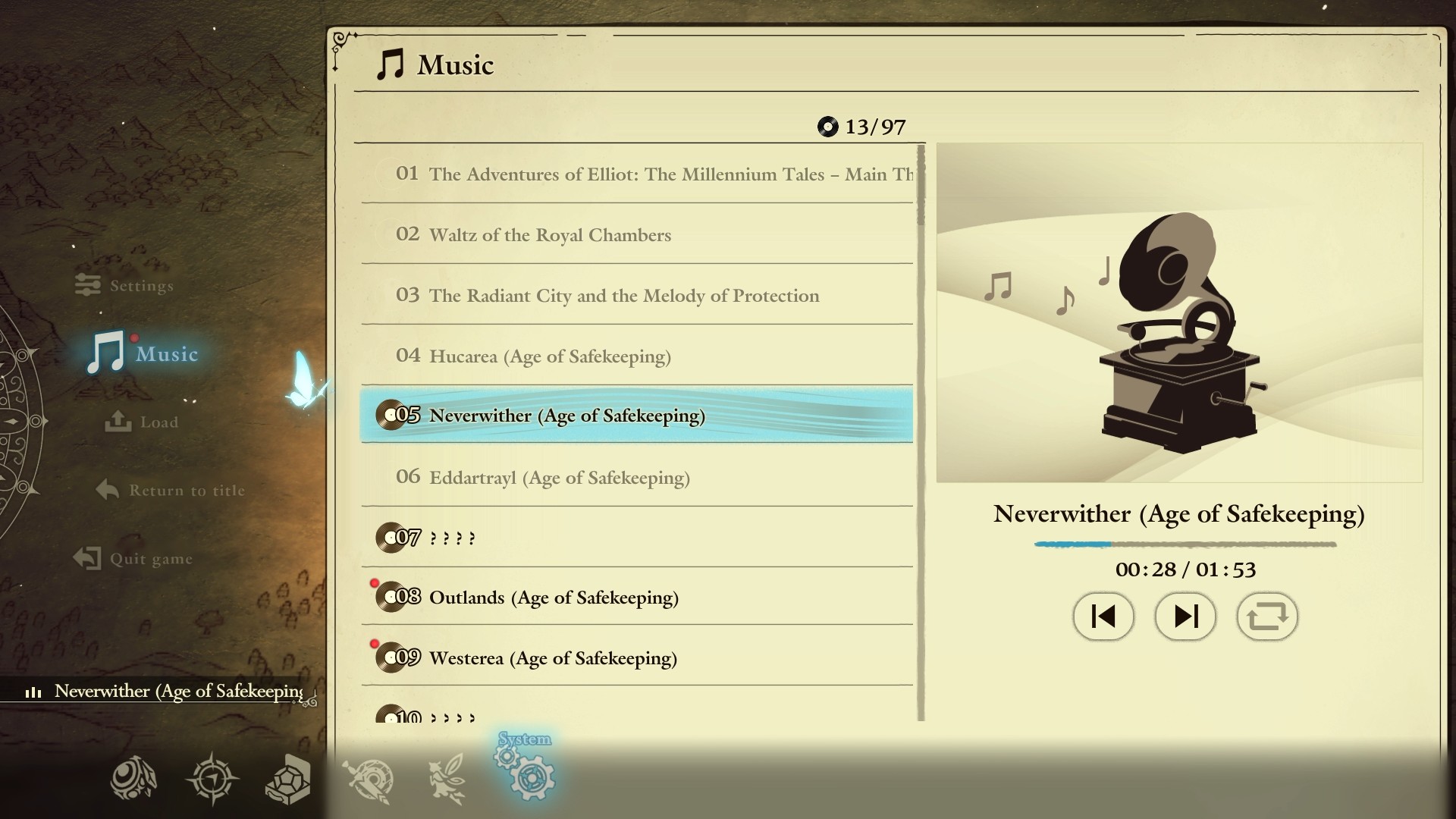
The Sound of Adventure
After hearing so much of The Adventures of Elliot soundtrack, I understand why it’s a big part of the collector’s edition. It’s genuinely a highlight of the game. Thanks to the music, battles feel more epic, environments feel more wondrous, and emotional moments hit harder. Sure, some of the tracks repeat, but I didn’t mind at all. I’d take a few tracks that don’t miss over a larger, hit-or-miss soundtrack any day.
Meanwhile, the voice actors demonstrate awareness of the characters’ familiar fantasy archetypes. Phillip Reich delivers a fittingly earnest performance as the good-natured Elliot. Brenna Larsen speaks with a cheerfully supportive tone that softens Faie’s chattiness. Brent Mukai and Sura Siu convey regality as King Hichard and Princess Heuria, respectively. And the rest of the ensemble highlights the stylized quality of each side character through inflection and dialect.

The Adventures of Elliot Feline Final Thoughts
Like its namesake hero, The Adventures of Elliot isn’t too complex or noteworthy but is content to do what it does really well. It’s a great game for players looking to get into action RPGs as well as genre veterans nostalgic for SNES-style games. It works for both of these types of people as it employs what I’d call “gameplay scaffolding.” You can easily navigate through the main campaign with little resistance. Or you can build up the difficulty as you see fit by engaging with the game’s various optional mechanics and challenges. There’s a lot to explore, and The Adventures of Elliot is happy to let you explore as much as you like.
If you enjoyed this review, explore more of our in-depth video game reviews across PlayStation 4, PlayStation 5, Xbox One, Xbox Series X, Nintendo Switch, Nintendo Switch 2, and PC.
Review Disclosure Statement: The Adventures of Elliot: The Millennium Tales was provided to us by Square Enix for review purposes. For more information on how we review video games and other media/technology, please review our Review Guideline/Scoring Policy.
The Adventures of Elliot Review
The Adventures of Elliot promises an adventure and delivers just that. While not narratively groundbreaking, it offers an absolute wealth of content. A kingdom-saving quest proves a solid excuse to get players exploring a massive world across multiple eras, navigating puzzles and dungeons, and fighting battles with a bevy of weapons and abilities to employ. It’s a fantastic action RPG for veterans and newcomers alike.
Pros
- An activity-packed world with four distinct eras to explore.
- A wide variety of weapons and abilities.
- A fittingly rousing soundtrack
- Puzzles do a fun job of showcasing abilities.
Cons
- The main story is fairly cookie-cutter.
- Characters aren’t the most memorable.
- Intuitive combat can still have some odd idiosyncrasies.
-
The Adventures of Elliot: The Millennium Tales Review
