

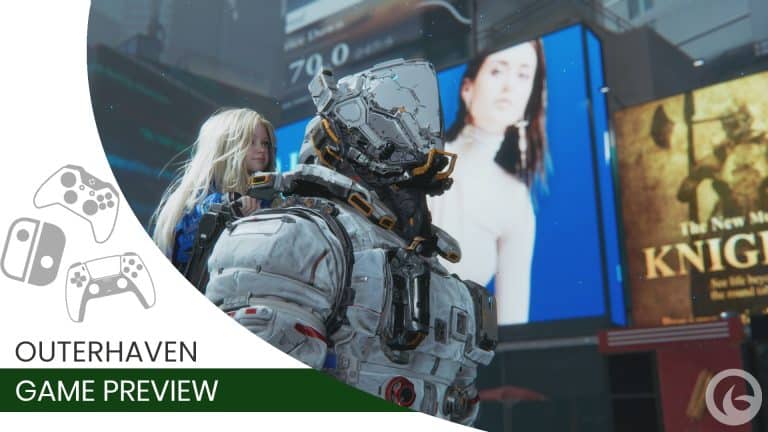
During New York Comic Con last fall, I attended the Capcom panel to learn more about Resident Evil Requiem. But another game, a new IP, piqued my interest. While I usually don’t go in for sci-fi games, Pragmata intrigued me with its blend of shooting paired with hacking mini-games. Its duo of human Hugh and tiny android Diana looked endearing as well. The NYCC footage showed them fighting various robots in a Times Square-like location, including a giant mechanized monstrosity. I wanted to know more about this quirky, unique game. And the other week, I got to go hands-on with this very section.
If you’d like to get a taste of Pragmata’s inventive gameplay for yourself, you can download the Sketchbook Demo. It introduces players to hacking robots as Diana, then following up with massive damage from Hugh. The demo showcases multiple different enemy types and weapons as well, which adds variety to the hack-and-shoot gameplay.
Give Me Shelter
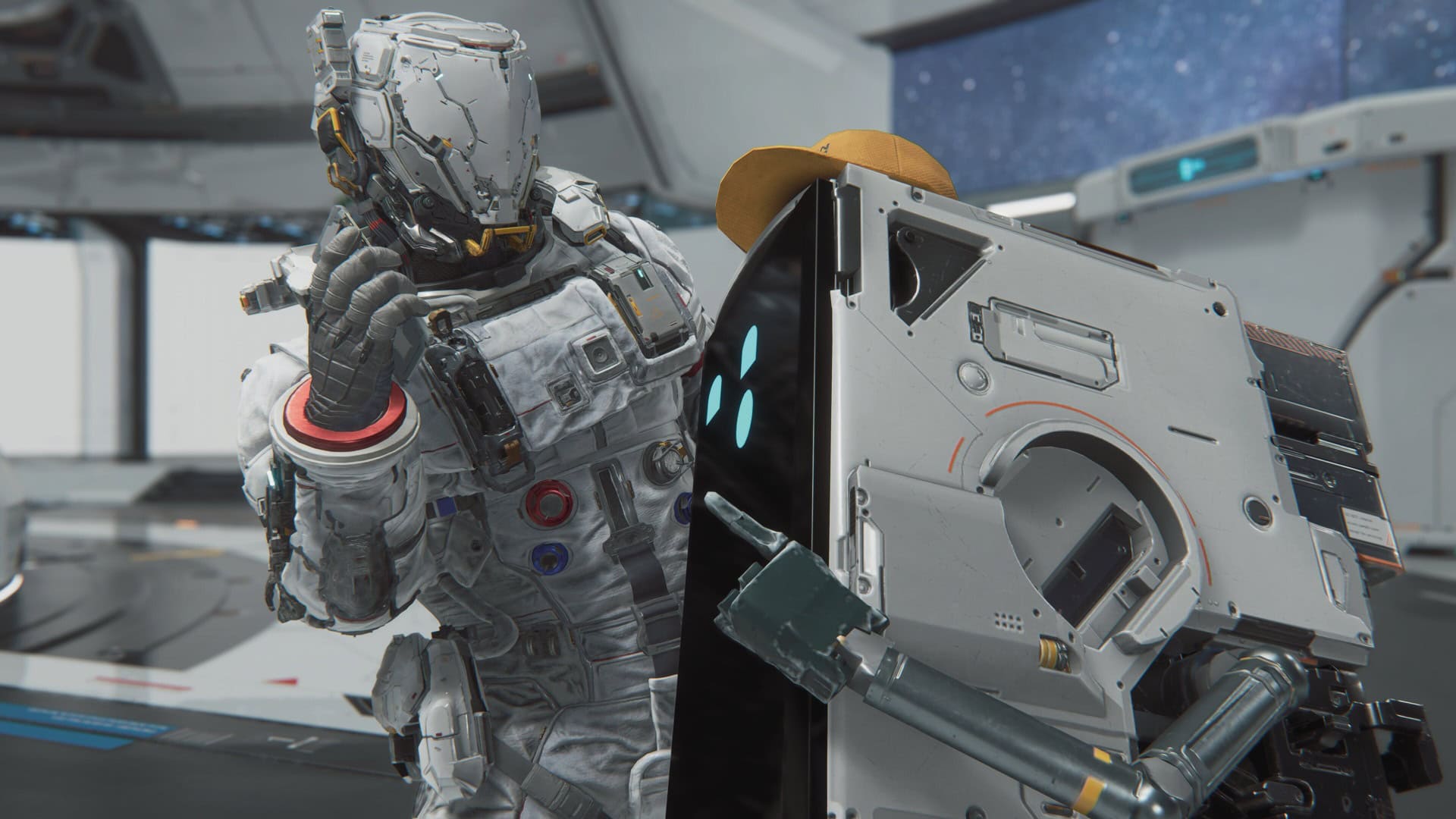
If the Sketchbook Demo impressed me with its variety, last week’s preview really expanded upon it. I got to go hands-on in the Shelter, a hub for Hugh and Diana. Here, players can use resources for two kinds of upgrades. They can upgrade the levels of their armor, their basic gun, and their hacks. At another desk, they can fine-tune specialized upgrades, such as the amount of damage each gun deals or how often certain hacking nodes appear.
The Shelter offers a few interactions as well. A spunky robot named Cabin inducted me into the Cabin Stamp Club. Cabin told me that I could exchange Cabin Coins for rewards. I don’t know if these were purely cosmetic, as they didn’t come up in my playthrough. But I expect that’s where a few cosmetic items come from, since the other desks already provided gameplay upgrades. I do know that Cabin will let players change the background music in the Shelter.
But I did find a cosmetic item already in my inventory that proved a delight. In the Shelter, a globe appeared in my inventory. And so, I got the chance to give it to Diana as a gift. Handing her the globe, she gave it a spin. Literally. I enjoyed watching this tiny android’s antics, of which she has many.
In just the next section, as we headed out to the Mass Production Array to attempt contact with other people, Diana spotted a holographic cat and gave chase. Hugh chided her for this as we had more important concerns: kicking shiny metal ass.
The Android Arsenal of Pragmata
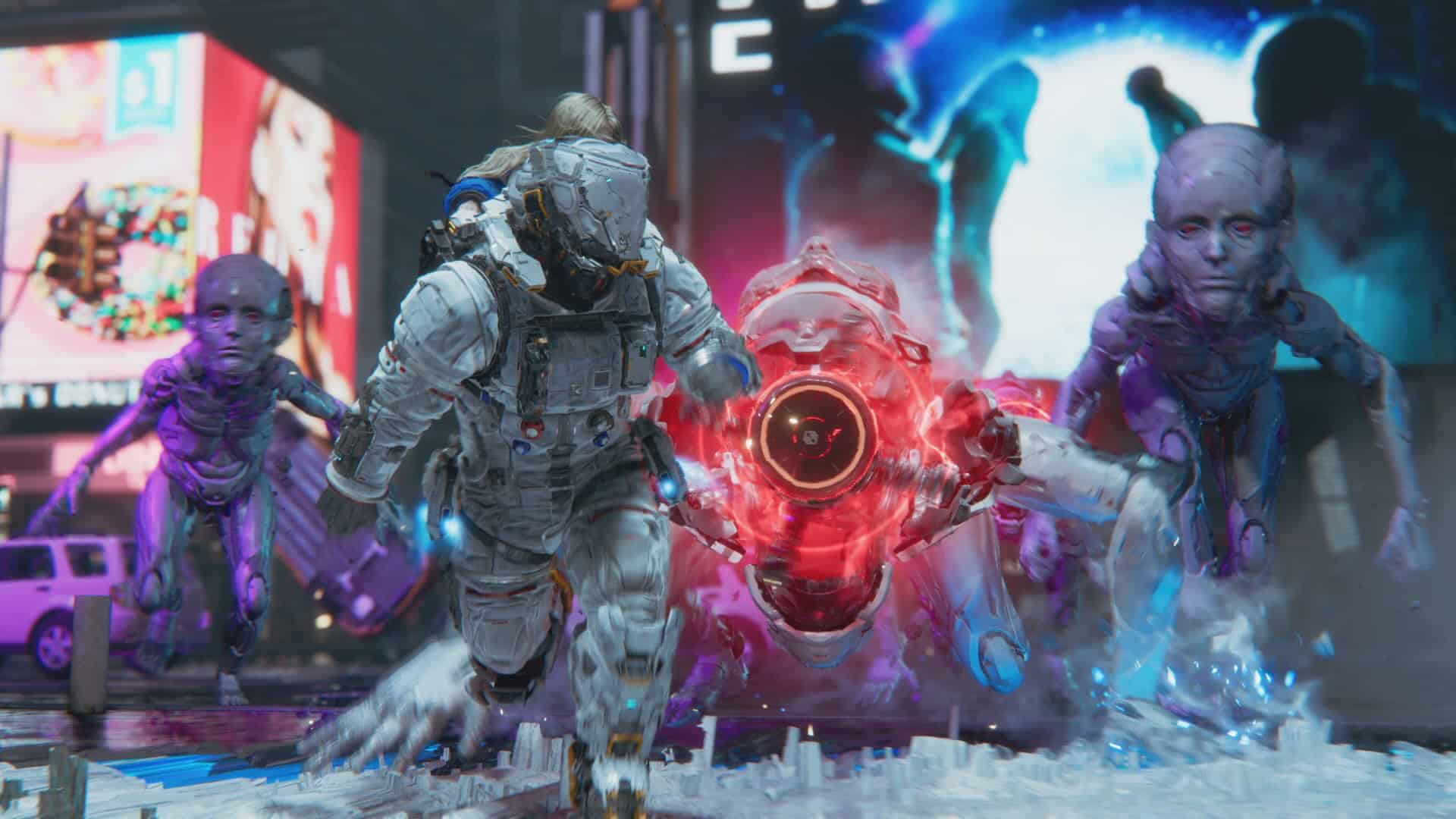
It wasn’t long before robots showed up. I knew what to do, setting up Diana’s hacking mini-game. This involves guiding a blue box through a grid to a green box, hitting blue terminals and limited yellow nodes along the way to raise potential damage. From there, I could fire away as Hugh, dealing deadly damage. Without hacking, I’d barely make a dent.
Even in the Sketchbook Demo, the gameplay iterates on itself. You gain access to different hacking nodes for different types of hacks, such as a multi-hack to affect multiple enemies simultaneously. You also get various weapons that do different types of damage. But in this preview, I was surprised to find I had previously only scratched the surface. This time around, I discovered several new weapons with unique uses.
If, like me, you wondered about how Pragmata would keep combat fresh, the answer lies in introducing variations. I found one new weapon that could pierce armor, the aptly named Charge Piercer. Another, the Decoy Gen, doesn’t fire bullets. It fires you! Or rather, it projects a hologram to act as a distraction for enemies. This proves especially useful for robots with damage-prone cores on their backs. Lay down a decoy, then swing around behind these bots and give them a beat down.
But of course, as the weapons iterate over time, so do the enemies. I had grown used to the human-like robots walking towards me, Terminator-style. We went way back (to the demo). But I had to figure out the handful of a new robot shaped like a ginormous toddler. And like toddlers, these things proved hungry. They’d unhinge their jaws and rapidly crawl towards me, between putting up shields and firing lasers. Unlike most toddlers.
Pragmata Parent and Preschooler
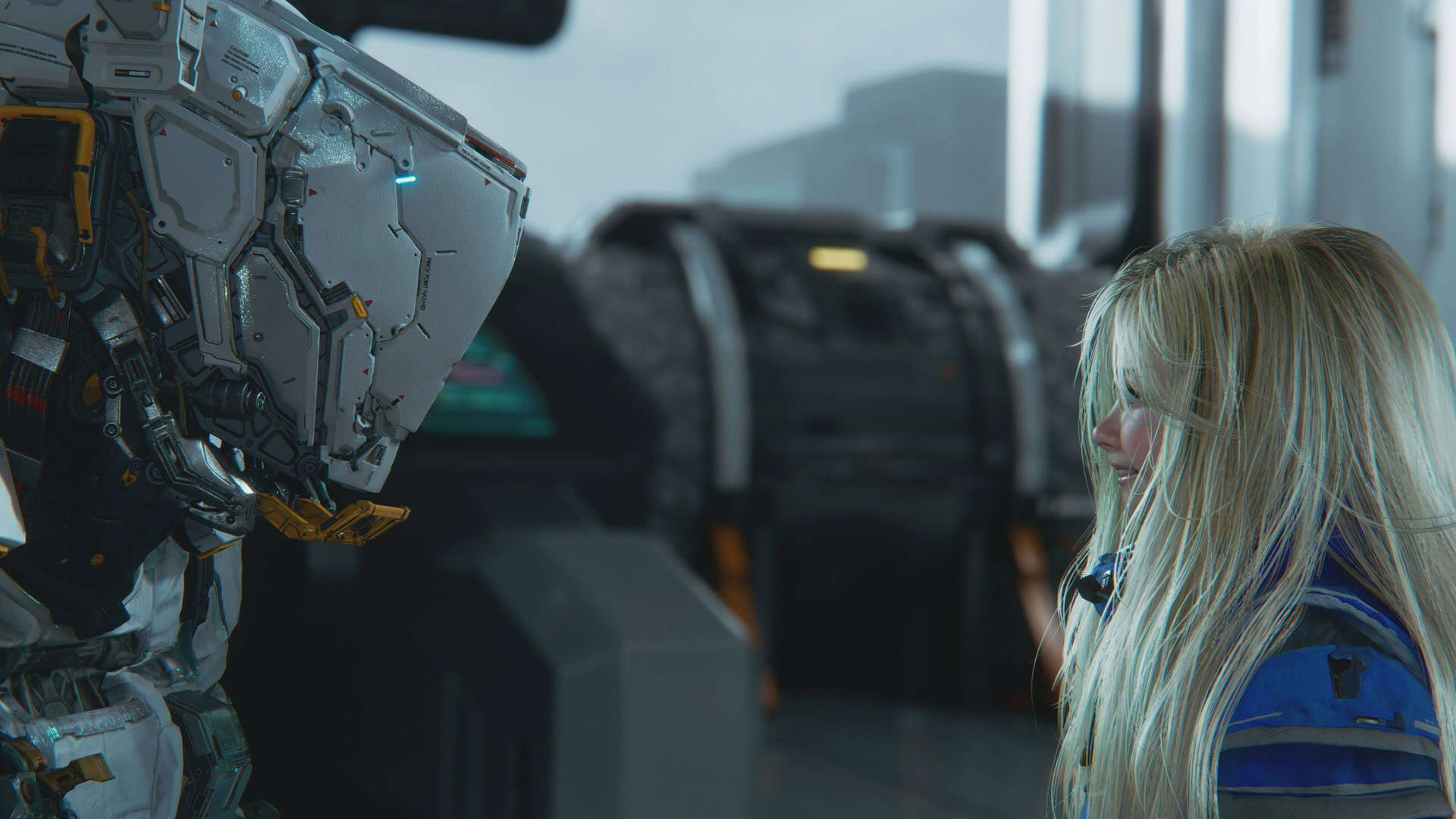
Speaking of robotic children, the gameplay could only go so far without the delightful dynamic between Hugh and Diana. During this preview, I got to witness much more of their banter. As a child and an android, Diana would learn from Hugh. She’d ask about why humans needed to eat so frequently and get confused about the “warmth” of people, mistaking this for body temperature. When Hugh would correct her, she’d later share what she remembered, doing an adorable impression of his adult voice.
And Diana has plenty to show Hugh as well. My favorite is her unconventional way of transferring data. Which is to say, when Hugh handed her a data drive at one point, she sucked the data out like juice from a juice box. Don’t try this at home, kids. But when a tiny robot does it, it’s bizarre and hilarious. Hugh is suitably confused but also grateful, as this allows Diana to blow up blue crystals impeding their way.
Tiny Android, Big City
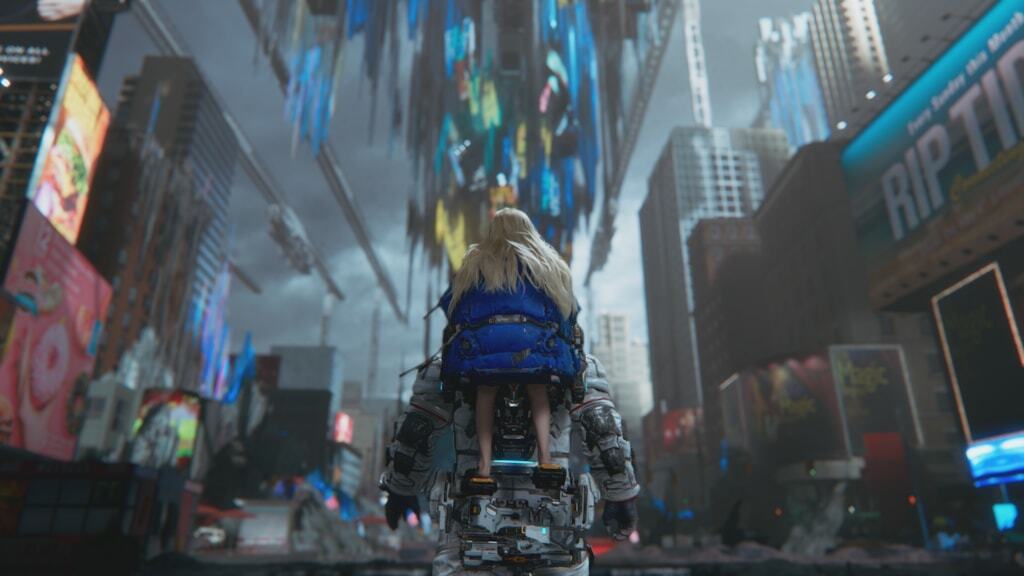
I think the reason I tend to shy away from sci-fi games is that they frequently take place in sleek, minimalist settings. Give me a lush forest or majestic mountain any day! And while Pragmata does have industrial locations, I got to see a more vibrant locale during this preview—one I know well.
As the New York Comic Con panel teased, Hugh and Diana visit Times Square. Or rather, a recreated Times Square. It has the same flashing billboard and many fewer creepy Elmos. Whether the killer robots prove preferable is debatable. Some favorite signs include one for “Yoloboutique” and another for “Spicy BBQ Burger.” I also saw a billboard for “Knights,” a new musical. And hey, after binging A Knight of the Seven Kingdoms, I’d get a ticket to see that. I also smiled at a poster for “Resident Devil,” a nod to the Capcom property that led me to Pragmata.
This is to say that Pragmata isn’t afraid to add a little pizzazz and razzle-dazzle to proceedings, as they say on Broadway. Exploring this faux-Times Square, I found files explaining the setting. Predictably, Pragmata takes place in a future in which we’ve mucked things up on Earth. So scientists have built facsimiles of iconic locations. While I just saw the Lunar Cityscape version of Times Square, a hologram hinted at a few other locations we might get to visit.
We’re Gonna Need a Bigger Bot
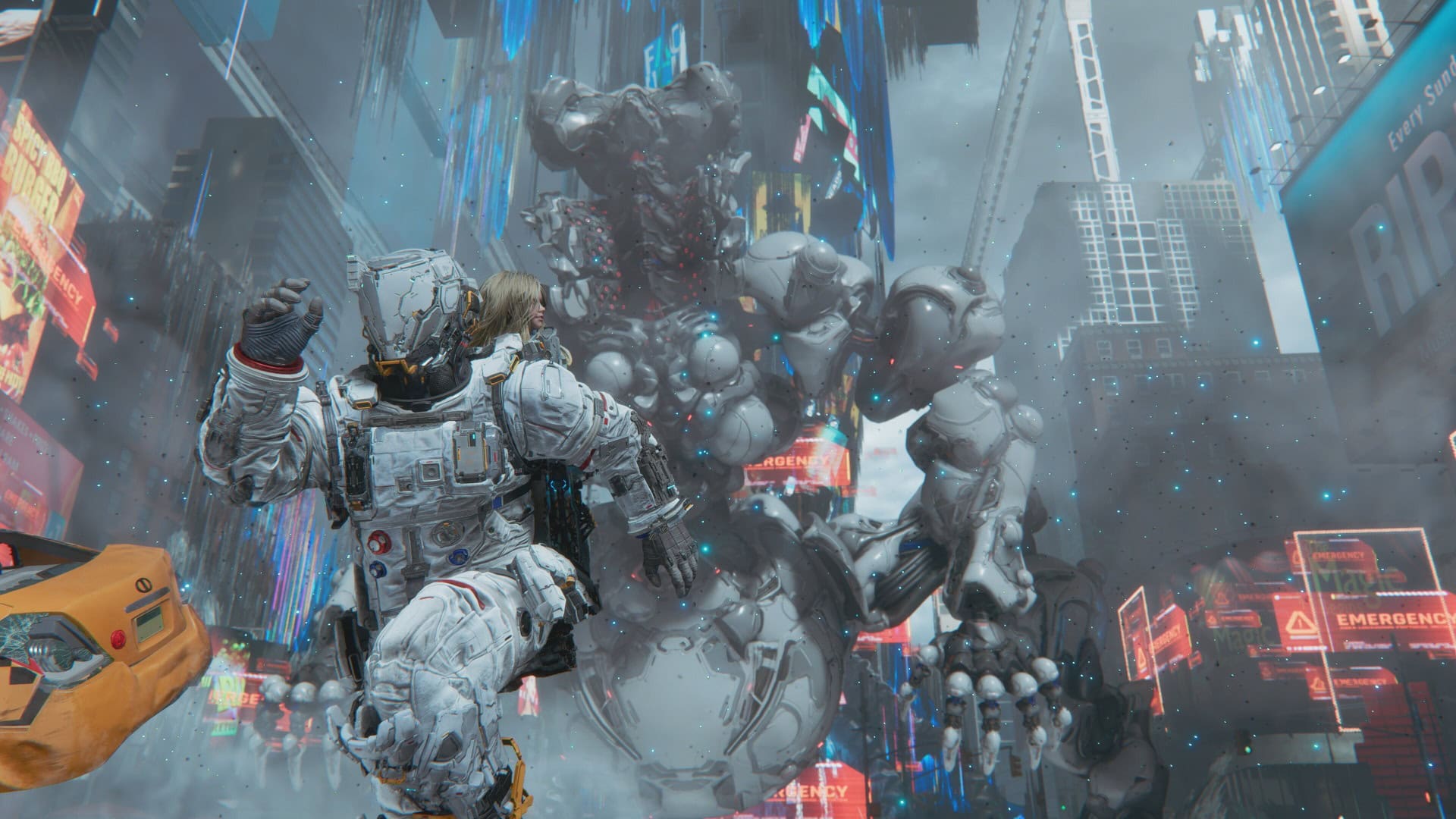
Carving my way to the plaza proper of Not-Times Square, I could see a Communications Tower just ahead. And I could also see a ginormous robot crawl out from behind it. Here it was, the major boss of the preview. This mammoth mech made the other enemies look like nuts and bolts. How would I manage to get close enough to hack it while staying far away from its many legs?
The answer to my question proved to be precision and patience. The boss attacked with an arm swipe I could jump over, a slam I could dodge, and a whole host of missiles and other area-of-effect attacks gained as the battle wore on. A couple of times, it put up shields, and I couldn’t hack it, literally. I died. And I died again.
Well, third time’s the charm, as they say. But after an otherwise successful run, why couldn’t I take down the Pragmata boss when it Prag-mattered? To paraphrase from another sci-fi story, my overconfidence was my weakness.
I realized that up until this point, I used whatever weapons I felt like using. I needed to try a more strategic approach. Back at the Shelter, I upgraded and equipped the Stasis Net, Decoy Gen, and Charge Piercer. I used the first two to slow down the behemoth bot and the Charge Piercer to take out the shields quickly. I had my robotic rival on the ropes and sent this massive malfunctioning mech to automaton Valhalla. It felt satisfying to pay attention to the weapon’s differences and have them pay off.
Pragmata Preview Impressions
Whenever I get to preview a game, I always have one main question. Could what I play potentially work as an entire game? Of course, I won’t know for certain until I play the whole game. But I aim to get a sense of whether I’ve seen it all or want more. With Pragmata, the demo showed hints of gameplay variation and sweet moments between Hugh and Diana. With this preview, I got a deeper sense of the strategy and the characters’ dynamic.
In fact, the varied gameplay humbled me. Defeating the main boss on the third attempt could sound like a bad time. But my loss came from assuming I could just hack and blast my way through it like the boss of the demo. Pragmata sat me down and made me actually go through the weapons and learn their differences. And it’s a better game for doing so.
If you’d like to get a peek at the Shelter, the Times Square-evoking area, or that brute of a bot, check out the trailer above. It also shows off a few locations that I didn’t get to see in either preview. This gives me hope that Pragmata will have environmental variety to match its weapon variety. I loved getting to see such a vibrant recreation of Times Square. And this time, Diana and Hugh are the tourists looking at a screen, but at least this screen lets you hack robots. Even in its virtual New York, Pragmata offers a welcome change.
Pragmata arrives on April 17th, 2026 for Nintendo Switch 2, PlayStation 5, Xbox Series X|S, and PC. Previously slated for the 24th, Capcom recently moved its release date up a week.
