

Invincible VS feels like exactly the kind of game a comic book franchise should get while its Amazon series is still running at full strength. With the show keeping the brand in the spotlight, Skybound Games and Quarter Up have found a way to celebrate Invincible with a fighting game that leans hard into the franchise’s over-the-top violence and superhero chaos. This is not some watered-down adaptation trying to play it safe, either, as the game fully understands the kind of messy, violent, and ridiculous world it is pulling from.
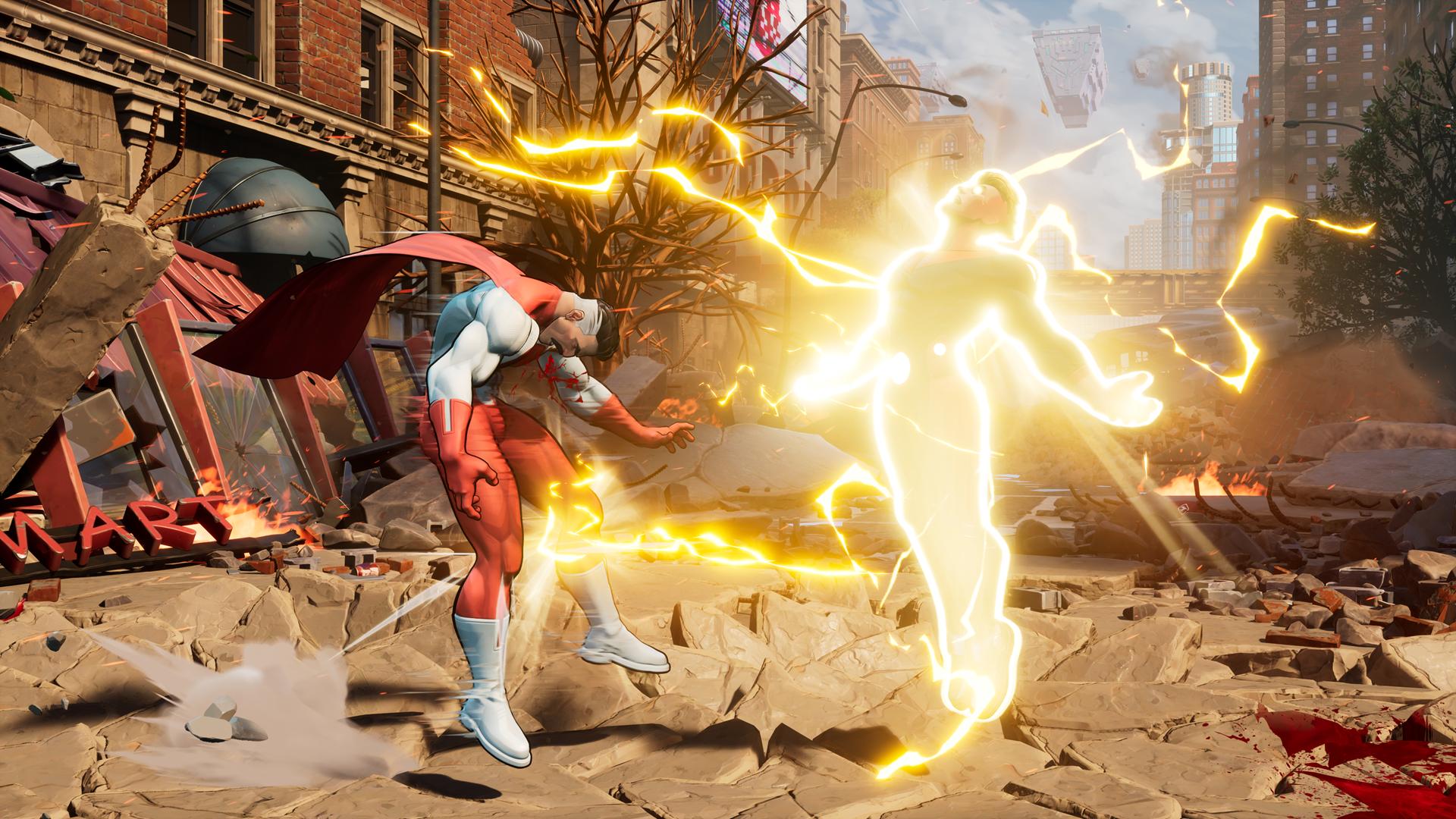
The game’s take on the universe is just as brutal as the show, complete with no-holds-barred finishers after knockouts and enough plasma splatter to make a blood donation center jealous. This is superheroes doing what superheroes apparently do best: beating each other senseless in the name of justice, revenge, survival, or whatever excuse they are using that day. That tone carries through much of Invincible VS, making it clear early on that this is a fighter built around impact, speed, and the franchise’s very specific brand of animated violence.
Game Name: Invincible VS
Platform(s): PlayStation 5, Xbox Series X|S, PC
Reviewed On: PlayStation 5
Genre: 3v3 Tag Fighter
Developer(s): Quarter Up
Publisher(s): Skybound Games
Release Date: April 30, 2026
The Story of Invincible VS So Far
Invincible VS starts its story mode around the end of a certain chapter from the current animated series, so having some knowledge of who these characters are definitely helps. Invincible and Omni-Man are seemingly ready to face off to stop a potential Viltrumite invasion, but things quickly become more complicated than they appear. To the surprise of Earth’s heroes, the fight is not exactly what it seems, which leads Invincible and Robot to start looking for clues about what is really happening.

The usual beats from the show are here, along with several familiar faces who get their moments to take the reins. Like many modern fighting game story modes with tighter narratives, this one gives players a feel for most of the roster either by letting them play as different characters or at least by putting them across the screen as opponents. It works as a solid introduction to the cast and the game’s systems, even if it does not go as deep as some longtime fans might hope.
The game also finds ways to explain why certain matchups and opponents repeat themselves during the story. It feels like an episode of the show, though more condensed, almost like a special that could possibly be expanded later. It also appears to take place outside the comic and show canon, especially considering the way the story plays out. This is separate from Arcade mode, which acts more like a traditional fighting game gauntlet with different ladders that can run up to 12 opponents.
Some of the actors from the show reprise their roles in the game, which helps sell the whole thing a bit more. J.K. Simmons is back as Omni-Man, while Phil LaMarr returns as Lucan, for instance. Aleks Le replaces Steven Yeun as Mark, but the performance still feels like Mark in the ways that matter. The personalities are definitely present, and the characters are not afraid to flip you the verbal bird once in a while.
The soundtrack also does its part, jumping between jungle-inspired beats and rock-heavy sounds across different stages whenever it can. It is not always the first thing that stands out, especially with all the chaos happening on screen, but it fits the pace of the fights well. For a game this aggressive, the audio needed to keep up, and for the most part, it does.
How Invincible VS Has Changed Since Its Earlier Tests
Before this review, we had already spent time following Invincible VS through its earlier test periods, including the game’s beta and closed alpha. That earlier coverage gave us a better sense of how the 3v3 tag fighter was coming together, what was already working, and where Quarter Up still had room to tighten things up before launch.
For more background, you can read our previous coverage on the Invincible VS open beta stats and our hands-on thoughts from the Invincible VS closed alpha. This review focuses on the final release and whether the full package delivers now that the game is officially here.
The Nitty Gore-Gritty

As a tag fighter, Invincible VS uses a simple structure that feels similar to other modern entries in the genre, such as 2XKO. The game leans on directional inputs and a dedicated special button for special attacks and supers, which makes it easy to understand on the surface. Normals still vary between characters, and each fighter has their own effects and quirks that help separate them from the rest of the roster. There are also two assists per character, handled through button and directional inputs.
Some of the more interesting additions include counter assists, cancel assists, and the ability to trigger a stage switch after a crumple happens. These mechanics help keep the complexity intact without making the game feel impossible to approach. As expected, once one character goes down, the next one steps in and the fight continues. With everything packed into the characters’ kits, it feels like the game could have needed an eight-button setup, but the developers made things surprisingly straightforward.
The Standard control scheme is exactly what it sounds like, while Motion controls take on a more classical fighting game approach. High specials performed with motion inputs function as supers, while medium specials are treated as Boosted or EX specials, similar in spirit to how Under Night In-Birth II handles some of its tools. These do not drain the super gauge, which means there are ways to get stronger specials out when you have enough boost available. Automatic combos are also here, along with a more traditional piano-style attack structure using low, medium, and high attacks.
Boost can also be used for defensive pushes, giving players another layer to think about when under pressure. That matters a lot because Invincible VS is fast, and once things go wrong, they can go wrong in a hurry. One bad decision can lead to a huge blowup, especially with tag mechanics, assists, and high-damage routes all feeding into one another. This is not a game where you want to panic, because panic gets punished hard.

There is a good amount of variety in the character archetypes across the 18 playable fighters. The three main styles, zoner, striker, and grappler, are broken down further across the roster, giving each character a more specific purpose. Nearly every fighter can also fly, which makes sense for the franchise and adds another layer to how space is controlled. I ended up sticking with Battle Beast, Dupli-Kate, and Atom Eve for most of my time.
Battle Beast is all brute strength, with super armor layered into his game plan in a way that makes him feel as dangerous as he should. I have always wanted to give summon characters more of a shot because of their zoning potential, and Dupli-Kate ended up being special for that reason. She reminds me a bit of Chizuru from The King of Fighters, except there is no stun for Kate when a clone gets destroyed. There is just pain, and plenty of it.
Atom Eve also has some fun tricks, including a launcher special that creates a reverse effect and pulls the opponent in. Ele-Mental, Robot, and Titan were also characters I was curious about, so I spent time dabbling with them for zoning and brute force fun. Training Mode has enough tools to help with the lab work, including hitboxes and hurt boxes for players who want to investigate what is really happening. Playing characters more also raises proficiency levels with them, which gives players another reason to keep experimenting.
Match quality felt impressive overall. Online play was buttery smooth most of the time during lobby matches, and both Ranked and Casual matches were easy to get into without any major hiccups. Even while playing on wireless, the ping rarely hit catastrophic levels, which speaks well of the rollback implementation. For a fighting game that clearly wants to be taken seriously, having strong online play is not just a bonus, it is mandatory.
Visually, Invincible VS tries to preserve the look of the show while adding a bit of that Killer Instinct-style fidelity. It does feel like a game developed by people who understand how to make hits feel heavy. The fight speed is quick, the effects are loud, and the finishers lean into the franchise’s blood-soaked identity. Everyone has a Level 3 cinematic super, and damage can vary depending on the situation, but there is no question that Invincible VS has some extremely high-damage moments.

Outside of fights, there are galleries for music, character profiles, and comic covers. These are unlocked through play-based achievements, such as completing 20 Ranked Matches, rather than simply dumping everything into a currency-driven system. It is very much a “do this to get that” approach, and I appreciate that more than another store tab full of things waiting to be bought. It gives players reasons to engage with different parts of the game, even if the overall mode selection still feels a bit thin.
Where Invincible VS Stumbles
Invincible VS is not as impenetrable as some might expect, but it is still clearly aimed more at the hardcore end of the fighting game audience than casual fans who are coming in mainly because they know the cast. The team has said before that this was designed to become part of FGC culture first, and in that sense, they have succeeded to a point. The systems are there, the online feels strong, and the roster has enough going on to give competitive players plenty to dig into. The issue is that fans looking for a broader Invincible experience may not find as much to hold onto after the fights are over.
The story mode ends without leaving much else for franchise fans to chew on afterward. It also feels shorter than expected for a property with at least 20 years of history behind it. The lack of extra modes is a concern, especially when the fighting game space has become more competitive with how much content players expect at launch. There are no combo trials to take on, which feels like a noticeable misstep for a game with this many mechanics and character-specific tools.
The gallery is nice, but there are no deeper fan-based lore dives for players who may not already be familiar with the comics or animated series. Ele-Mental has a great kit, for example, but not much is said about her beyond what players can pick up from her Arcade ending slides. That feels like a missed opportunity, especially for a game that is trying to bring in both fighting game players and Invincible fans. The cast has personality, but the game could have done more to celebrate and explain that personality outside of matches.
The lobby system and matchmaking are serviceable from a visual standpoint, but nothing about them feels especially exciting. There is no hub to run around in, which is always a personal nitpick for me, but it stands out more when other fighters have made that kind of social space a bigger part of the experience. There is also a lot to get comfortable with here, especially once boost, supers, assist types, and defensive options all start overlapping. The game teaches the basics, but it could do more to help players transition from understanding the controls to understanding the chaos.
Some user interface choices also feel like they could have been better. Stage and Character Quick Select options from the Training Menu are not present, which makes labbing more clunky than it needs to be. I was also not able to move the detailed data UI in Training Mode, and it could transparently cover the characters with no real way to shift it out of the way. These are not deal-breakers, but they are the kind of small quality-of-life issues that stand out when you spend serious time in training.
Some stages are exposed too early through other parts of the game while still being locked on the stage select screen, which feels a bit odd. Sudden Death also feels like a strange choice, especially when some characters have more health than others. Replay takeover is also missing, and while I would call that more of a want than a need, it is becoming more common in modern fighters. For a game that wants to sit at the FGC table, these kinds of features matter more than they used to.
Final Verdict
Invincible VS does what it sets out to do for a specific core audience. It is a strong tag fighter with fast matches, brutal hits, smooth online play, and enough mechanical depth to keep competitive players busy. If you are looking for something that scratches the same itch as Power Rangers: Battle for the Grid or even Marvel vs. Capcom 2, this might be the game that does the trick in a year already stacked with fighting game choices. It has the blood, the speed, and the attitude needed to stand out.
Where it falls short is in how much it gives back to longtime Invincible fans beyond the fighting itself. The story mode works, the character interactions are fun, and the violence absolutely matches the franchise, but the overall package feels lighter than it should. Invincible VS serves the brawlers at heart, but it slightly fails to pull in loyal fans who may have expected a deeper connection to the original franchise. As a fighter, it lands plenty of heavy blows, but as a full celebration of Invincible, it leaves a little blood on the table.
Invincible VS Review
While Invincible VS serves the brawlers at heart, it slightly falls short when it comes to giving loyal fans a deeper connection to the original franchise. It also could have used more content and tools to help close the gap between competitive pros and players still trying to find their footing.
Pros
- Frantic 3v3 fighting
- Robust genre mechanics, such as various assist types
- Two control styles for new and seasoned fighting game players
- Matches the comic book feel of the series
- 18 fighters available from the get-go
Cons
- Lack of modes hurts replayability
- Questionable UI choices in Training Mode
- Steep learning curve may be off-putting
- Short story mode could have used a few more chapters
