

When I found out that former CD Projekt RED developers who worked on The Witcher 3: Wild Hunt were developing a new game called The Blood of Dawnwalker, I was excited before I even knew what it was. Once I learned that it was another action RPG, I became even more interested because of the team’s history with the genre.
That said, I wouldn’t blame anyone for being skeptical about a new studio and a new IP in the current landscape. But I always felt that if The Blood of Dawnwalker could capture even a fraction of the magic of The Witcher 3, then we’d be in for a good experience. So, have they pulled it off? Let’s sink our teeth into The Outerhaven’s review of The Blood of Dawnwalker and find out.
Game Name: The Blood of Dawnwalker
Platform(s): PlayStation 5, Xbox Series X|S, PC
Reviewed On: PC
Publisher(s): Bandai Namco Entertainment
Developer(s): Rebel Wolves
Release Date: September 3rd, 2026
What Is The Blood of Dawnwalker?
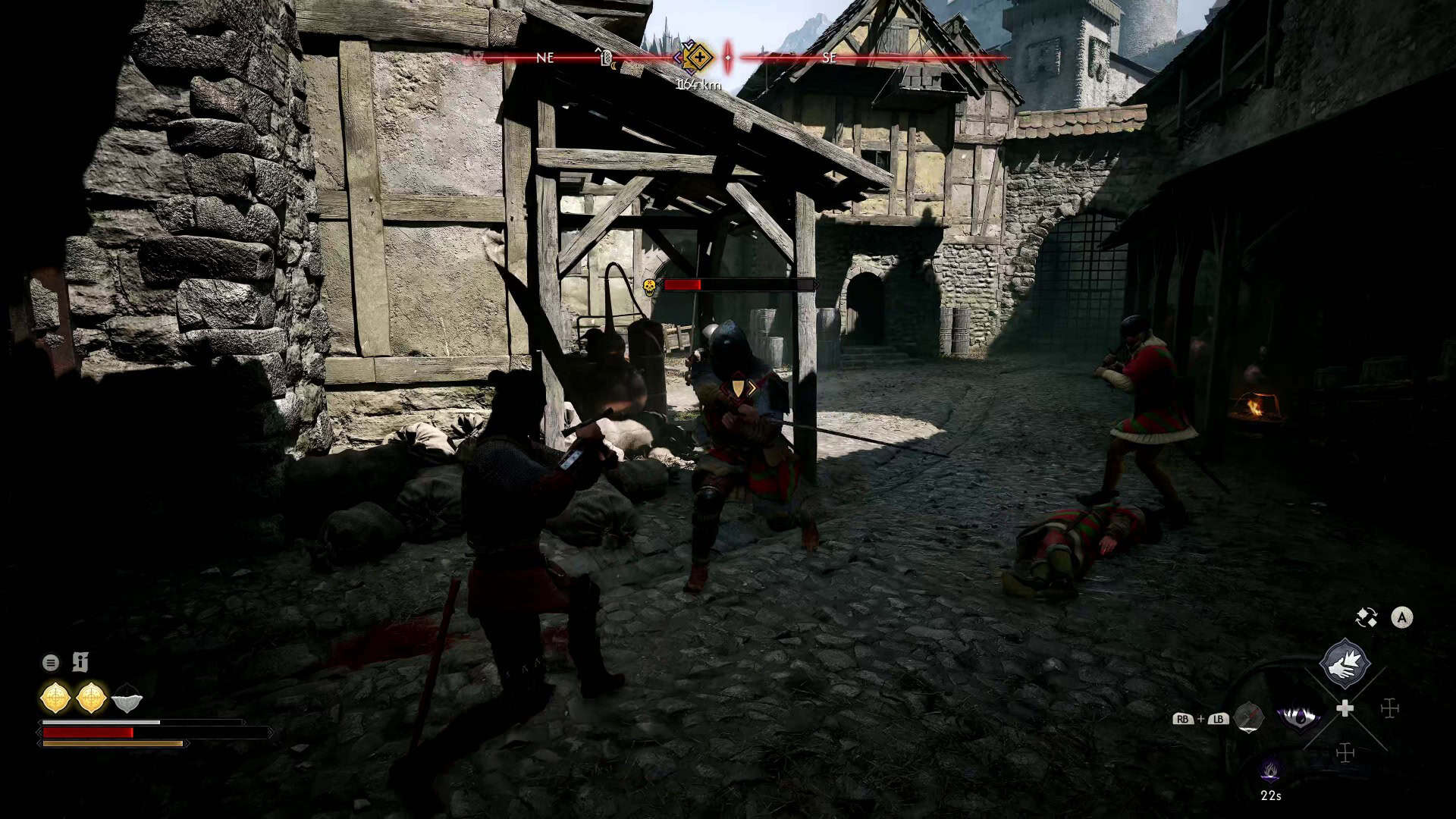
In The Blood of Dawnwalker, you play as Coen, a human who lives in the remote valley of Vale Sangora in the Carpathian Mountains during the 14th century. Sounds fairly inconsequential at first, but this valley is soon taken over by the vahkiri, a group of vampires led by Brencis. These events actually play out in the game’s opening sequence through a cinematic. Your actual playthrough starts some time after Brencis seizes control of Vale Sangora.
While we will be avoiding spoilers for the game, it’s impossible to discuss The Blood of Dawnwalker without discussing the fact that, some time into the game and after a series of unfortunate events, Coen is turned into a vahkiri by Brencis himself and then left for dead as the sun comes up. The thing Brencis didn’t account for, however, is that Coen is a Dawnwalker, meaning that during the day, he is human and can therefore survive in sunlight. But at night, Coen transforms into a vampire and lusts for blood.
After surviving being left for dead, Coen sets out for revenge on Brencis for everything he has done. But the clock is ticking. Coen only has 30 in-game days to stop Brencis’s coronation and save his family.
Time Is The Backbone Of Everything
This ticking clock drives the entire experience. There isn’t simply a day/night cycle like other games; in The Blood of Dawnwalker, time is a precious resource to be spent and managed. Everything from completing quests, learning skills, and even just having certain conversations costs you time.
That might annoy those who engage in completionism, since it means it’s virtually impossible to complete all the quests in one playthrough. I personally loved this mechanic as it added weight and therefore pressure to every decision, and beyond that it makes the prospect of multiple playthroughs even more interesting.
It’s not just in the choices that time plays a huge role either. Time has a huge impact on gameplay, since you have a different set of abilities depending on whether you’re in human or vampire form, which is decided by time of day.
This means that some missions you might prefer to tackle at night when you can literally walk up walls to reach places that would be otherwise inaccessible. During the day, though, you have access to witchcraft, and these spells can open up some interesting gameplay opportunities.
Combat Feels Unique But Familiar
Some of these gameplay opportunities come through in the combat. From a basic standpoint, The Blood of Dawnwalker’s combat feels like Witcher 3 and Kingdom Come Deliverance II had a baby.
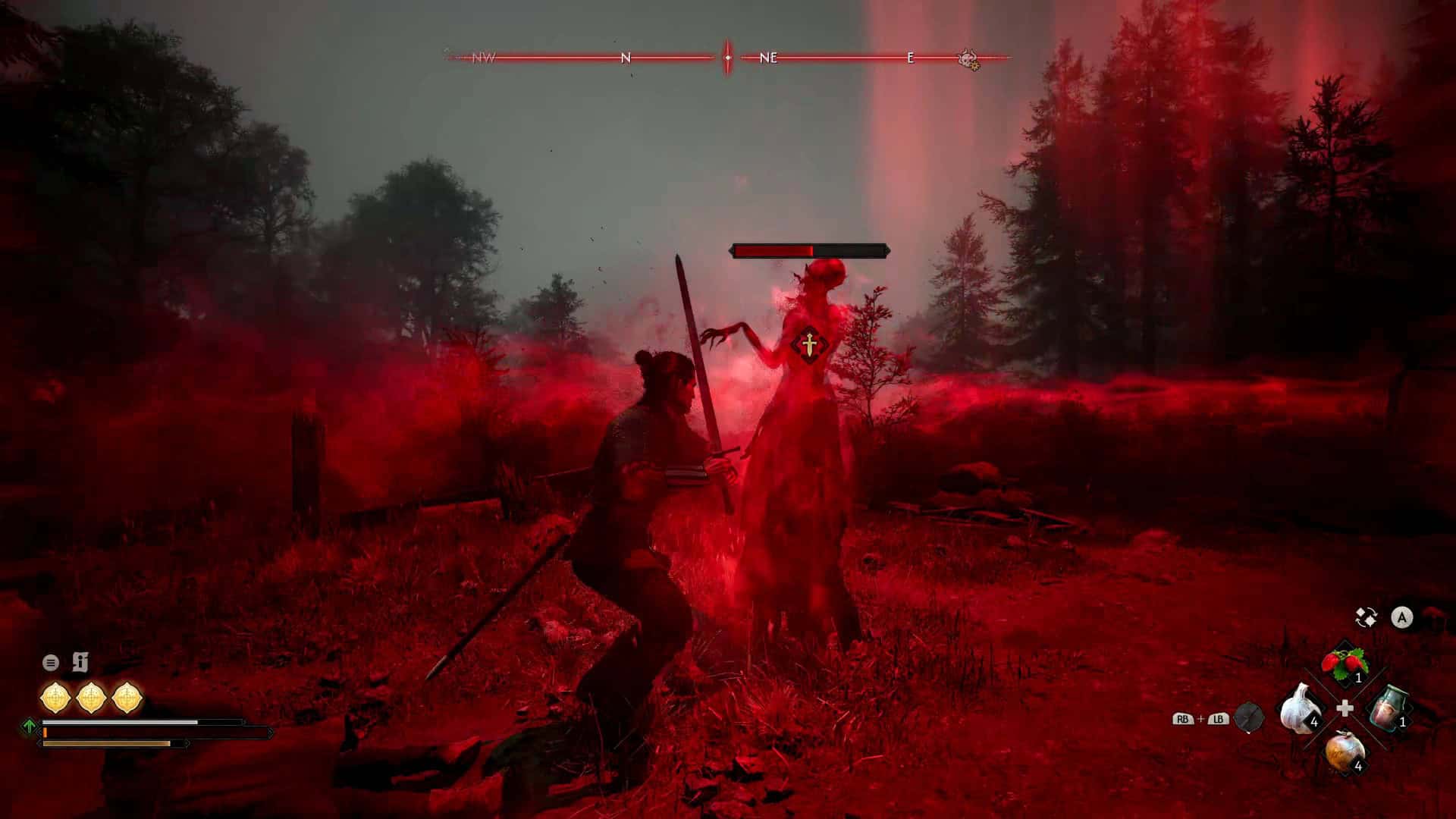
Animations and enemy types feel very Witcher-inspired, but the core mechanic is a directional attack and defend system. You choose one of 4 directions on the left stick before pressing the right bumper to attack, or the left bumper to block. If you time your blocks correctly, this makes enemies vulnerable for a short time. This is where you will deal most of your damage.
This core mechanic remains the same across both human and vampire forms. The two forms differ in the abilities you have access to. When Coen is human, you’re able to use spells to boil enemies from the inside, or summon a murder of crows out of the ground. You can activate these abilities when you have an ability charge, a yellow circle above the health bar, which is filled via perfect parries, blocks and attacks. Once you have enough charge, you can hold the left trigger to bring up a radial wheel and then select it from there, or you can assign some skills to the d-pad for easier activation.
As a vampire, Coen possesses abilities to use, such as biting an enemy to regain health, but you also have access to your claws if you don’t want to use a sword. These claws are much faster than any sword in the game but do less damage. So, think of the vampire form as your high-mobility, damage-dealing form, whereas human Coen is slower and far less mobile but packs a hard punch with the right equipment.
Combat definitely took some time to click with me, but once it did and I unlocked some additional skills, I honestly had so much fun with it. However, I do recognize that it won’t be a system for everyone.
Progression Has Consequences
Any good RPG requires robust progression systems, and The Blood of Dawnwalker certainly has one of those. Even more than that, it has a progression system with consequences, which is something we don’t see very often these days. So many games just want to be a power fantasy for the player, where you can unlock every skill and all the best gear by the end. The Blood of Dawnwalker still wants to give you power, but it comes at a price.
For example, unlocking more vampire skills requires a higher corruption level, but this could risk Coen taking a bite out of important side characters and ending quest lines. In turn, this can block you from getting some of the best armor and weapons in the game.
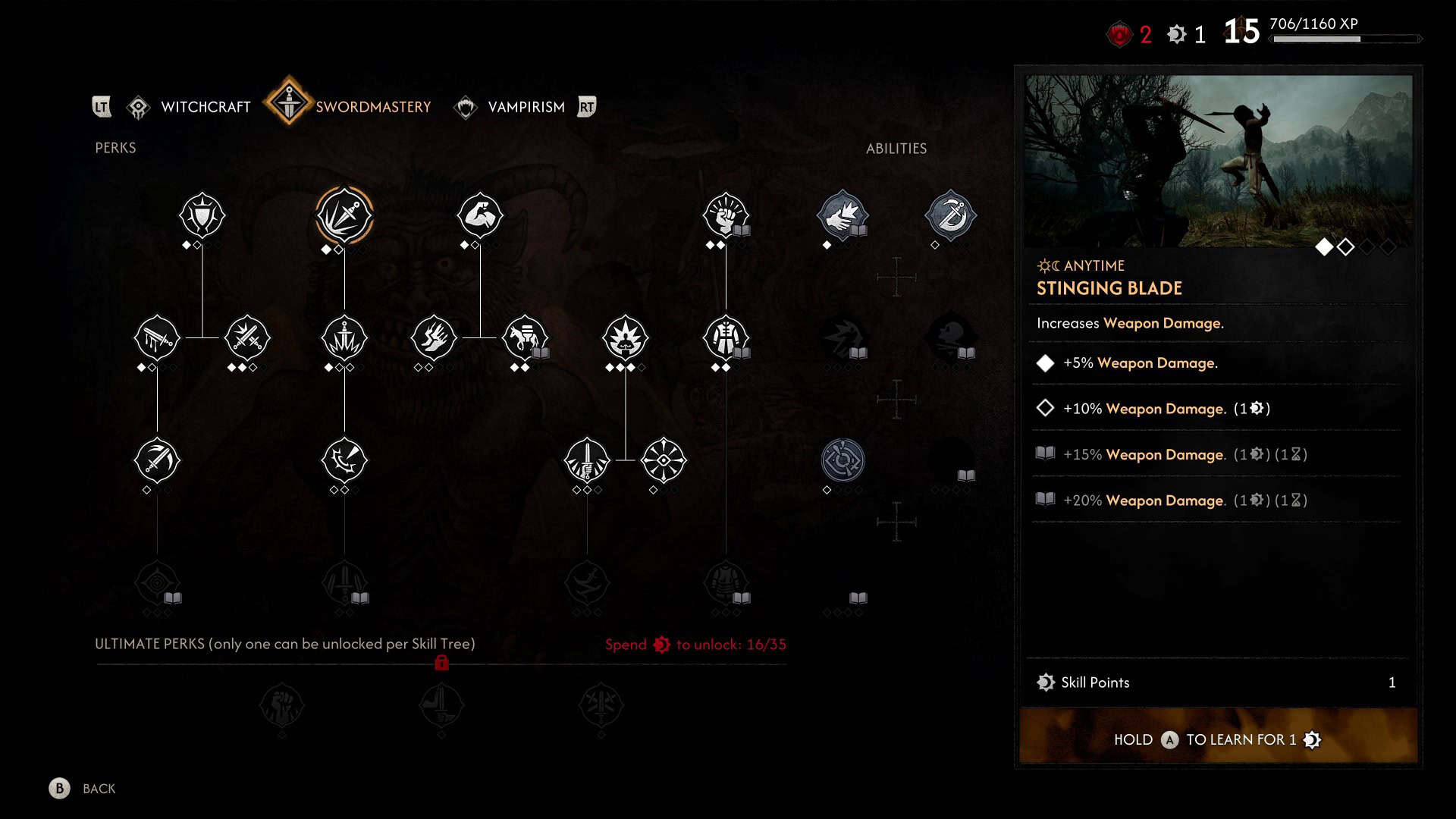
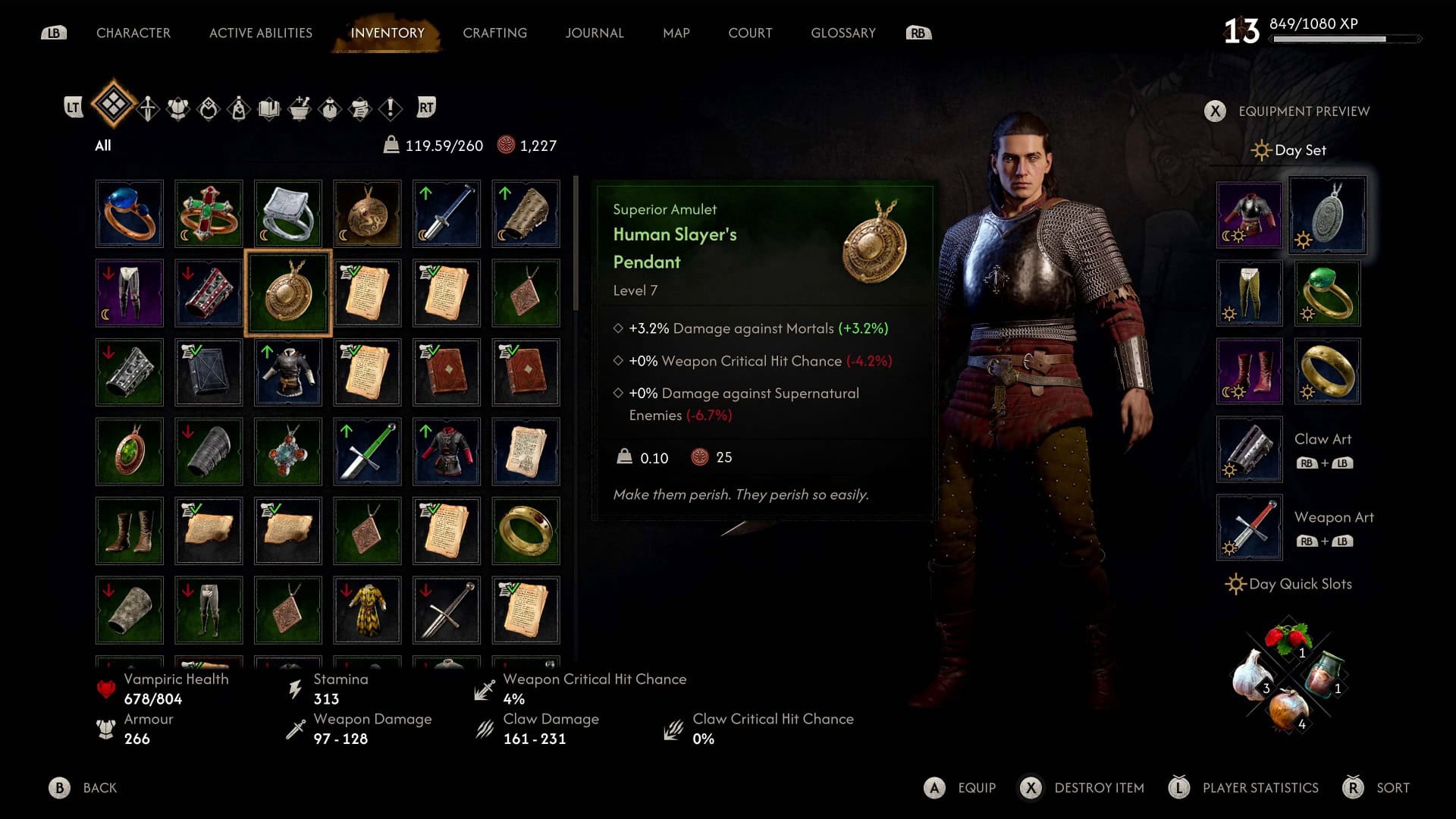
Then there are three different skill trees: one for swordsmanship, one for witchcraft, and one for vampire abilities. Each tree is full of skills to learn, but remember learning a skill costs time. Not only that, but the witchcraft and swordsmanship skill trees sometimes need you to find books that you can read for knowledge to even get access to the skills before unlocking them with a skill point.
Finding books also requires you to use time, which means it’s unlikely you’d be able to unlock all the best skills and find the best equipment on one playthrough. Hell, some decisions you make can straight up lock you out of certain abilities. While that again might frustrate some people, it’s exactly the kind of system that makes me want to complete multiple playthroughs.
At least getting skill points is as easy as leveling up Coen, which is done by earning XP through completing quests, engaging in combat and more.
A Beautiful Dark Fantasy Setting
It shouldn’t come as much of a surprise considering the pedigree of the team at Rebel Wolves, but The Blood of Dawnwalker absolutely nails its dark fantasy setting. Vale Sangora is a beautiful place to explore, even if just about everything happening within it is utterly miserable.
The 14th-century Carpathian setting gives the game its own identity, with dense forests, small settlements and imposing medieval architecture creating a world that feels grounded despite all the supernatural elements surrounding it. There’s always this sense that something isn’t quite right, which only becomes more pronounced when the sun goes down and the vampires come out to play.
The day and night system also gives Rebel Wolves an excuse to effectively create two different versions of the same world. During the day, Vale Sangora can occasionally look almost peaceful, but at night the atmosphere completely changes. Darkness consumes much of the landscape, supernatural threats become more prominent, and suddenly traveling through an area you’ve already visited can feel completely different.
That darker atmosphere is backed up by some excellent visual design, particularly when it comes to the vampires themselves. Rebel Wolves hasn’t gone down the route of making every threat look like an attractive human with some pointy teeth. There’s something much more unsettling about many of the creatures you’ll encounter, and that fits perfectly with the tone the game is going for.
More importantly, Vale Sangora is a world I actually wanted to explore. That’s particularly impressive in a game that is constantly reminding you that time is a limited resource. There were plenty of occasions where I knew I probably shouldn’t be wandering off to see what was over the next hill, but curiosity got the better of me anyway.
Performance
I reviewed The Blood of Dawnwalker on PC using a Ryzen 9 9950X3D, RTX 5090 and 96GB of DDR5 RAM, and overall performance was very solid throughout my playthrough. I didn’t experience any major performance issues, crashes or bugs that prevented me from progressing. The only problems I encountered were occasional animation and collision glitches, but they were minor and never meaningfully impacted the experience.
Considering the size and visual complexity of Vale Sangora, I came away impressed with how polished the PC version felt. Of course, my system is at the highest end of the hardware spectrum, so your experience will naturally vary depending on your configuration, but on my setup, The Blood of Dawnwalker ran extremely well.
Conclusion
The Blood of Dawnwalker is exactly the kind of RPG I hoped Rebel Wolves would make. You can certainly see traces of The Witcher 3: Wild Hunt throughout its DNA, but this isn’t a studio simply trying to recreate the game its founders previously worked on. Instead, Rebel Wolves has taken some of those foundations and built something that has a very clear identity of its own.
The 30-day time limit will undoubtedly be one of the most divisive parts of the experience. Anyone who wants to see absolutely everything in a single playthrough may find it frustrating, but for me it’s one of the game’s greatest strengths. Every quest, conversation and decision carries additional weight when you know that spending time on one thing could mean sacrificing something else.
Combine that with Coen’s transformation between human and vampire forms, meaningful progression choices and a combat system that becomes incredibly satisfying once it clicks, and you have an RPG that genuinely encourages you to live with the consequences of your decisions.
Most importantly, finishing The Blood of Dawnwalker didn’t leave me feeling like I’d seen everything Vale Sangora had to offer. It left me thinking about the quests I didn’t complete, the decisions I could have made differently and the abilities I never unlocked. I wanted to start another playthrough immediately and see how differently things could unfold.
For a brand-new studio working on a brand-new IP, that’s a remarkable achievement. Rebel Wolves hasn’t made The Witcher 3 again, nor should it have. It’s made The Blood of Dawnwalker, and if this is the foundation the studio intends to build upon, then Rebel Wolves has one hell of a future ahead of it.
If you enjoyed this review, explore more of our in-depth video game reviews across PlayStation 4, PlayStation 5, Xbox One, Xbox Series X, Nintendo Switch, Nintendo Switch 2, and PC.
Review Disclosure Statement: A copy of The Blood of Dawnwalker was provided to us for review purposes by Bandai Namco Entertainment. For more information on how we review video games and other media/technology, please review our Review Guideline/Scoring Policy for more info.
The Blood of Dawnwalker Review - A Beautiful Captivating Vampire RPG
The Blood of Dawnwalker is an excellent dark fantasy RPG that combines meaningful choices, a clever time-management system and satisfying combat with a world that constantly encourages another playthrough. Rebel Wolves wears its Witcher 3 influence proudly, but this is a game with a strong identity of its own.
Pros
- Excellent dark fantasy setting and world design
Time system gives real weight to quests and decisions - Human and vampire forms create meaningful gameplay variety
- Deep progression systems with genuine consequences
- Combat becomes very satisfying once it clicks
- Strong replayability thanks to mutually exclusive choices and content
- Very solid PC performance on high-end hardware (at native 4K, ultra settings)
Cons
- 30-day time limit may frustrate completionists
- Combat has a noticeable learning curve
- Occasional animation and collision bugs
-
The Blood of Dawnwalker Review - A Beautiful Captivating Vampire RPG
