

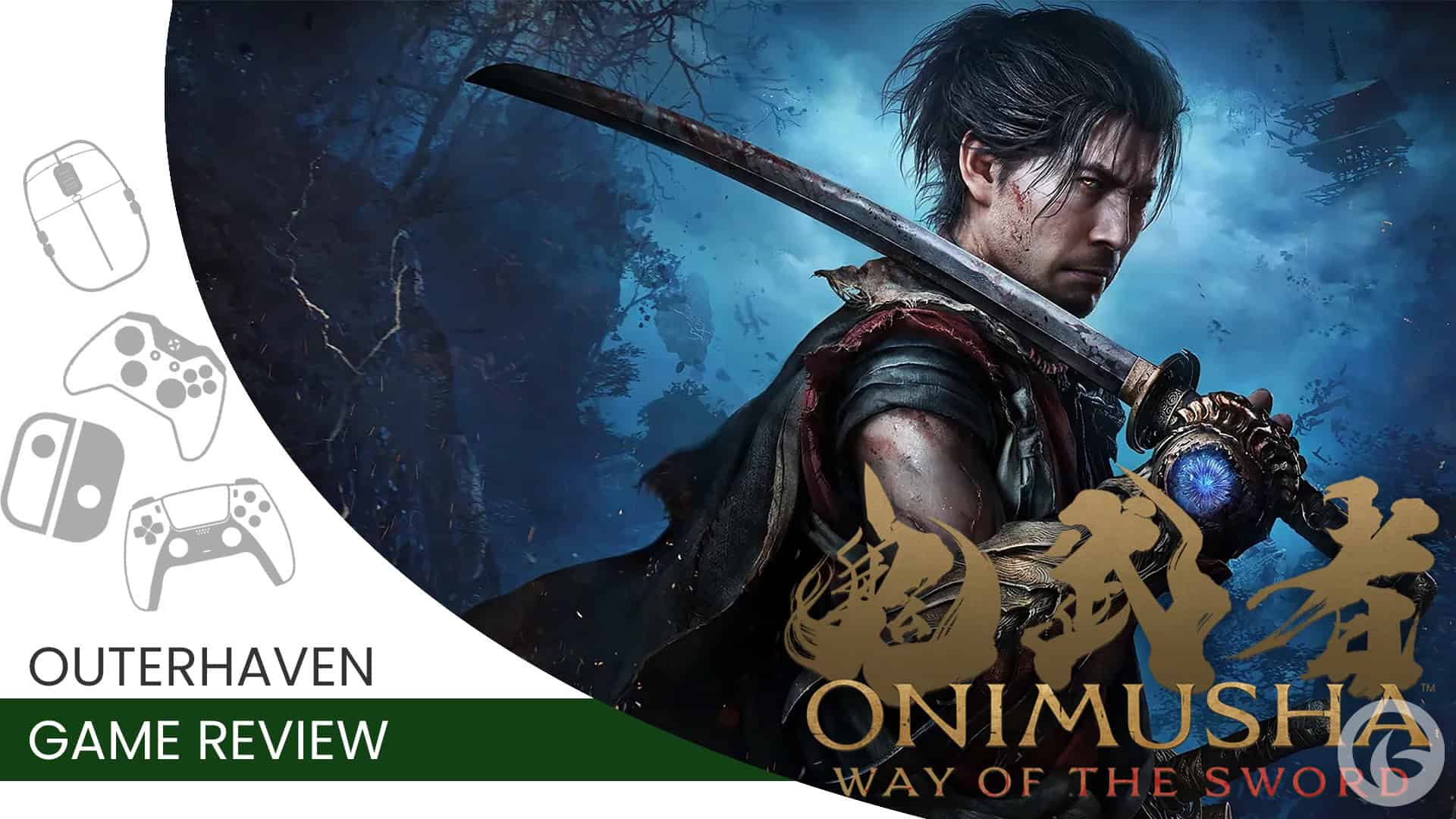
For samurai, sometimes the Onimusha: Way of the Sword is about losing something, or at least the need to forget everything we’ve learned in an effort to move forward – finding true self-improvement. Onimusha protagonists have to die and be reborn to face the challenges ahead of them, and it seems the series as a whole has reached a similar metamorphosis. Did Capcom’s new installment spark a demonic evolution, or simply cast aside its past to follow trends? Find out in our Onimusha: Way of the Sword review!
Game Name: Onimusha: Way of the Sword
Platform(s): PS5, Xbox Series X|S, PC
Reviewed On: PS5
Developer(s): Capcom
Publisher(s): Capcom
Release Date: September 4, 2026
Onimusha: Way of the Sword sees players returning to feudal Japan and taking on the role of Miyamoto Musashi, a skilled samurai with a lot to learn about himself, but things will never be the same after the swordsman encounters his first Genma and obtains the Oni Gauntlet. Now he must vanquish evil demons, clean up the Malice they are spreading, and protect Kyoto, one blade swipe at a time.
Musashi, however, isn’t really down with his new path. He’s highly disgruntled, to the point that he tried to cut the gauntlet off of his arm. Thankfully, he has a few allies to help him see the light, including the Oni trapped in his new accessory, who is trying to be a mentor, since her existence ends when his does.
The Way of the Samurai is Found in Death
I do like Musashi as our hero. He’s incredibly cocky and just the right level of irritated about having been killed and now being back alive with important work to do. Sometimes the game makes him feel like an errand boy, and he doesn’t take being told what to do or losing well, but at least he seems willing to try and help others.
This man comes equipped with some comedic insults, clowning on an enemy for crying over his dead brother, and we know he’s a swordsman who can back it up, as one of the demons even admits he really is a ‘bad dude’ as he lay dying. His grumpy attitude is charming and feels earned, as this new power changes his body. He’ll need it, because the Genma we meet are serious business.
This game looks incredible, with some slick action sequences, fluid motion, and only a few uncanny faces (mostly on the kids and elderly). Some of these backgrounds are dropping serious Vampire Hunter D aesthetics, and I appreciate what they’re doing, but sometimes the palette comes off as a little bland and makes some areas feel too similar. The color comes out in the souls we’re trying to capture and attacks, making it easier to spot what is important and allowing the areas with more hues to stand out.
Some of the environments are denser and have neat little details. There are plenty of objects we can interact with to hurl at our enemies, even if it’s a tad goofy. Some items look present and breakable, throwing me off when they aren’t. I loved catching one of the smaller monsters trying to hide in a large jar, even though it was scripted. Our hero moves awkwardly, constantly missing ladders, not being able to climb up places where he’s clearly supposed to, getting hung up on debris the bosses didn’t clear out, and taking a couple of tries to move in the perfect spot to talk to someone. The cutscenes are spectacular, but I’m more blown away by how cinematic the fighting is, rounding out what is mostly an incredible presentation.
My issues mostly come from the audio side. The music works, and some tracks are quite good, helping to set its eerie and otherworldly tone, while a couple sound like they’ve taken inspiration from the Resident Evil series. The balancing seems off in several sections, however, drowning out some of the voices, especially during combat.
Some characters simply speak softer, but this makes it tougher to hear the banter or important information when the music is going. Other than some of the voices not being even, a few are quite annoying (it’s these damn kids again, they’re the problem). I also imagine many people will be playing this with the Japanese voice cast, as for some reason, the English dub is composed of British accents. Musashi’s voice grew on me throughout the adventure, and it truly works, especially when he’s telling demons to “piss off.” There’s clearly some talent at work; it’s just a bit awkward initially
A Samurai Must Have the Discipline to Resist His Own Impulses
There is some excellent banter and dialogue here, but a lot of it is repeated, and getting stuck on a particular fight makes it easy to memorize these lines. The writing overall is strong, but there are pacing issues as we jump around, and the story itself isn’t anything spectacular. There is a good bit of lore, and much of it feels messy. Things come together closer to the end, but I imagine a good number of people won’t care much by that point, or just be confused.
There is this comedic, almost campy element in some scenes, especially during the opening portions of the game. Some aspects are handled more subtly, but the tone feels jarring compared to the camp of the original installments.
Admittedly though, the intro did make me want to re-watch Samurai Champloo, which is always a good thing. Onimusha as a series is this dark fantasy with disturbing Giger-esque art, and that shines through in a few spots, while other areas just feel a little cold and depressing, like a watered-down Silent Hill. Consistency is less the issue; more that I just wanted them to lean into those elements more and be less subdued. I do like the way some of these enemies look now, though attention-grabbing and gruesome, while the variety improves further along–a welcoming spectacle in the sea of fodder.
The reason most players will want to check out Way of the Sword is its combat. The game has taken definite cues from the popular genre, but most, including the project’s director, don’t believe it’s a Soulslike. People familiar with those titles will feel at home, however, as the action heavily relies on stamina/staggering gauges, precision parries, blocks, and dodges, as well as other smaller mechanics to complete the new package.
The swordplay here feels as if it has some weight to it, with the developers looking more at how an actual master in his craft would fight. It makes playing defensively almost as enjoyable as being aggressive, even having different button layouts for the two styles. We find a balance between the two, and some encounters start to feel more like a piece of art than a confrontation. Parrying at the perfect moment causes these counterattacks that feel like the ultimate response to an unworthy foe—a chef’s kiss on the end of a blade. Practicing and getting better with the combat feels rewarding.
There are moments where it’s a bit of a guessing game, trying to anticipate what kind of attack the enemy is going to do so we can successfully countermine it. Some of this becomes second nature after a while, and the Story difficulty shows which buttons work best in those situations.
Choosing a Path of Resistance
The game asks if we want Story or Action difficulties in the beginning, and I hesitate to call the former an ‘easy mode,’ as it still makes us work for the outcome. I did manage to put away a couple of bosses on the second or third try, which made me feel almost as badass as our protagonist, but eventually I switched modes just to figure out what the game wanted from me (showing the commands for how to interrupt or block certain moves), and so I wasn’t banging my head against the wall for hours on end.
Veterans of these types of games probably won’t have too many issues, but don’t be surprised if the deaths start racking up. My biggest hurdle was getting used to how healing works, because it seems easy to accidentally cancel the action out or put it on cooldown by performing other simple maneuvers. This causes some of the icons to gray out, but as I’m legally blind, I missed this initially. This game could use better visual accessibility features to go with the existing text and HUD options.
Thankfully, the difficulty can be switched at any save point (Spirit Mirror), or just fail the boss encounter a few times to have the game offer the option naturally, because dying is not nearly as punishing here. The opening somewhat lulls us into a false sense of security, as there are several easy tutorials in the beginning that are no threat at all as we learn. These guys are practically just standing there, waiting for me to move.
I wish they had put all of this together to help with the pacing, but I get they were trying to sprinkle the knowledge into the story, yet nothing prepares us for when the camera costs us a fight. There is a practice ground where players can work on skills, try to figure out timing (my weak point), and re-fight some bosses. I genuinely enjoyed several of the bosses in this game, but there might be too many, and let’s just say we won’t be fighting them once, as Onimusha pulls a classic Capcom trope at the end. There are a good number of mini-bosses as well, which likely adds to the feeling of oversaturation. Thankfully, we have our trusty sword, an arsenal of Oni weapons, and a large bag of tricks to use.
You Can Always Die, It’s Living That Takes Real Courage
There’s almost too much to keep up with. Not only do we have a wheel of items and consumables to use, but several gauges and temporary buffs to keep an eye on. Managing everything feels daunting at times, but most of it will become second nature. The Oni Bow with infinite arrows is quite useful for destroying objects, puzzles, and targeting body parts, not to mention it makes for a solid opening volley. It just took me a while to get used to button placement and firing it.
There are so many things we can upgrade as well: our pouches, charms, clothing, sword, and the gauntlet, of course. Then there are a couple of skill trees. All of which may be enhanced by using mixtures of red orbs, offerings, and other ingredients found around the map.
Though most of the game is linear with a little exploration, there is a large section of Kyoto that opens up for side quests and resource hunting after we start clearing out some of this Malice. I love that we have a little summonable, in-universe golden orb that shows players where to go – though I wish it worked in other areas as well – as it helps cut down on needless wandering, and the map isn’t too bad either. I ended up doing much more in this section than I intended to, as the side bits offer decent compensation from the citizens we help, and it feels nice to aid the city, open everything up, and save a few lives in this bleak world.
Way of the Sword is a game with many strong qualities and some shaky elements that connect just a bit crookedly. There’s enjoyment in the frustration and a lot of work in the details, a suitable jumping-on point that doesn’t feel as much like a reboot, but a fresh start for what’s to come. It shares so many similarities with the original entries, while also feeling not very Onimusha – at least not the way I remember it.
I’m glad we received this new installment to revitalize the series, but much like Capcom’s other hit horror franchise, I wonder if we can’t go back to the originals. Onimusha had to die, shed its past, and change its way to stay relevant, and that feels strange, but history may remember it as being for the best.
If you enjoyed this review, explore more of our in-depth video game reviews across PlayStation 4, PlayStation 5, Xbox One, Xbox Series X, Nintendo Switch, Nintendo Switch 2, and PC.
Review Disclosure Statement: A copy of Onimusha: Way of the Sword was provided to us by Capcom for review purposes. For more information on how we review video games and other media/technology, please review our Review Guideline/Scoring Policy.
Onimusha: Way of the Sword review
Onimusha: Way of the Sword successfully revives the series with rewarding swordplay, cinematic combat, and a compelling new protagonist. Uneven pacing, audio problems, awkward movement, and limited accessibility options keep this promising new beginning from reaching its full potential.
Pros
- A beautiful and cinematic presentation
- Featuring an enjoyable, yet grumpy, badass protagonist
- Wonderful combat, especially when taking on large groups
- Enjoyable side-quests and upgrades
Cons
- Challenging, while sometimes frustrating game due to certain mechanics
- A thin storyline that can be confusing at points
- Not quite the Onimusha many fans remember
-
4
