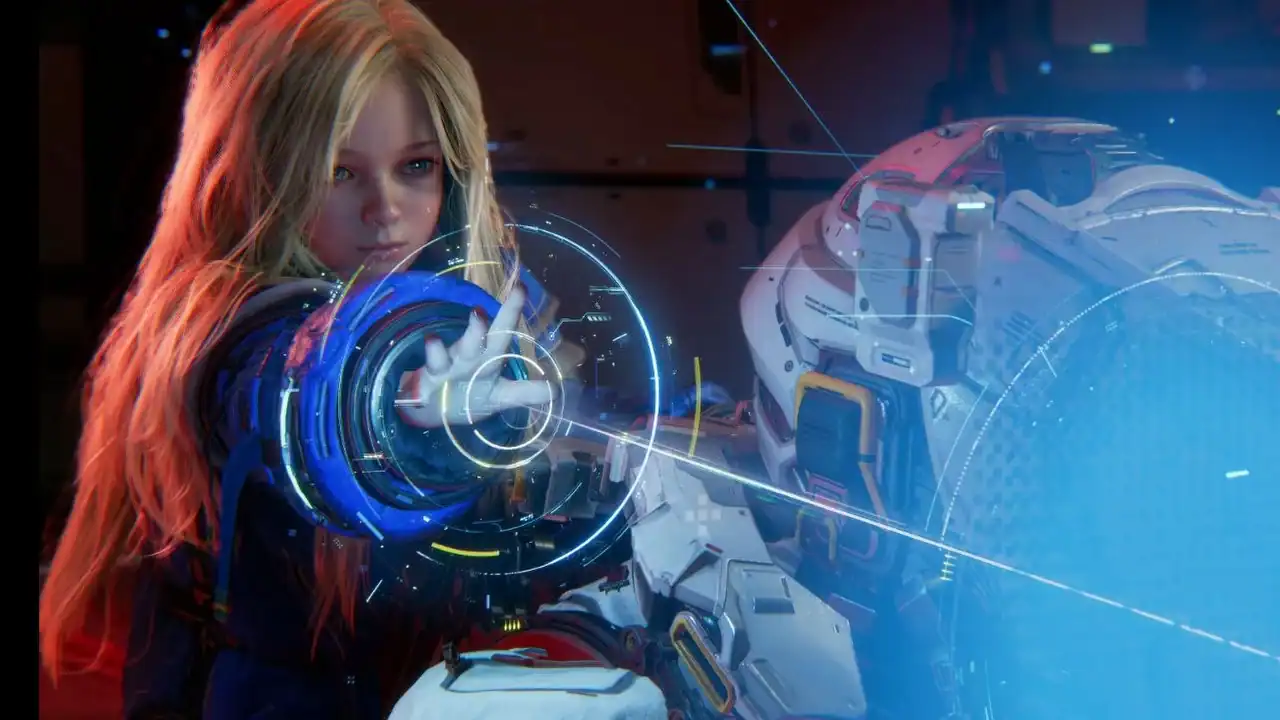
I once read that multitasking isn’t actually productive. Most of the time, I’d agree. But Pragmata makes a strong case for the opposite. Capcom’s long-awaited sci-fi action game doesn’t just encourage multitasking, it demands it. Players control Hugh, a spacefarer stranded on a lunar research station, alongside Diana, a childlike android who hacks enemies in real time. The result is a unique blend of shooting and puzzle-solving that immediately sets Pragmata apart from other action games.
Game Name: Pragmata Platforms: PlayStation 5, Xbox Series X|S, Nintendo Switch 2, and PC Reviewed On: PlayStation 5 Genre: Action-adventure / shooter Developer: Capcom
Publisher: Capcom Release Date: April 17th, 2026 Price: $59.99
Pragmata starts off simple enough. Hugh, an astronaut, and his team of astronaut buddies land on the moon for a routine moon inspection. It’s the future, see, and they work for a company called Delphi that operates the Cradle, a station on the moon. What is this company, and what is its goal? I’ll admit, it’s fairly generic sci-fi stuff. Delphi found a material on the moon called lunafilament, which can essentially 3D print anything: robots, trees, the entirety of Times Square… It can even print people-like androids.
And this is where the real heart of the story comes from. Pragmata refers to these “people materials,” aka androids. When Hugh’s team is wiped out in an earthquake—sorry, moonquake—Hugh is patched up by Diana, a small child-like Pragmata. The two team up so that Hugh can contact Earth and find a way home. This proves easier said than done, as the moonquake apparently messed up IDUS, the AI in charge of the moon and its robot legions, who are now pissed off at you.
You Can Hack It
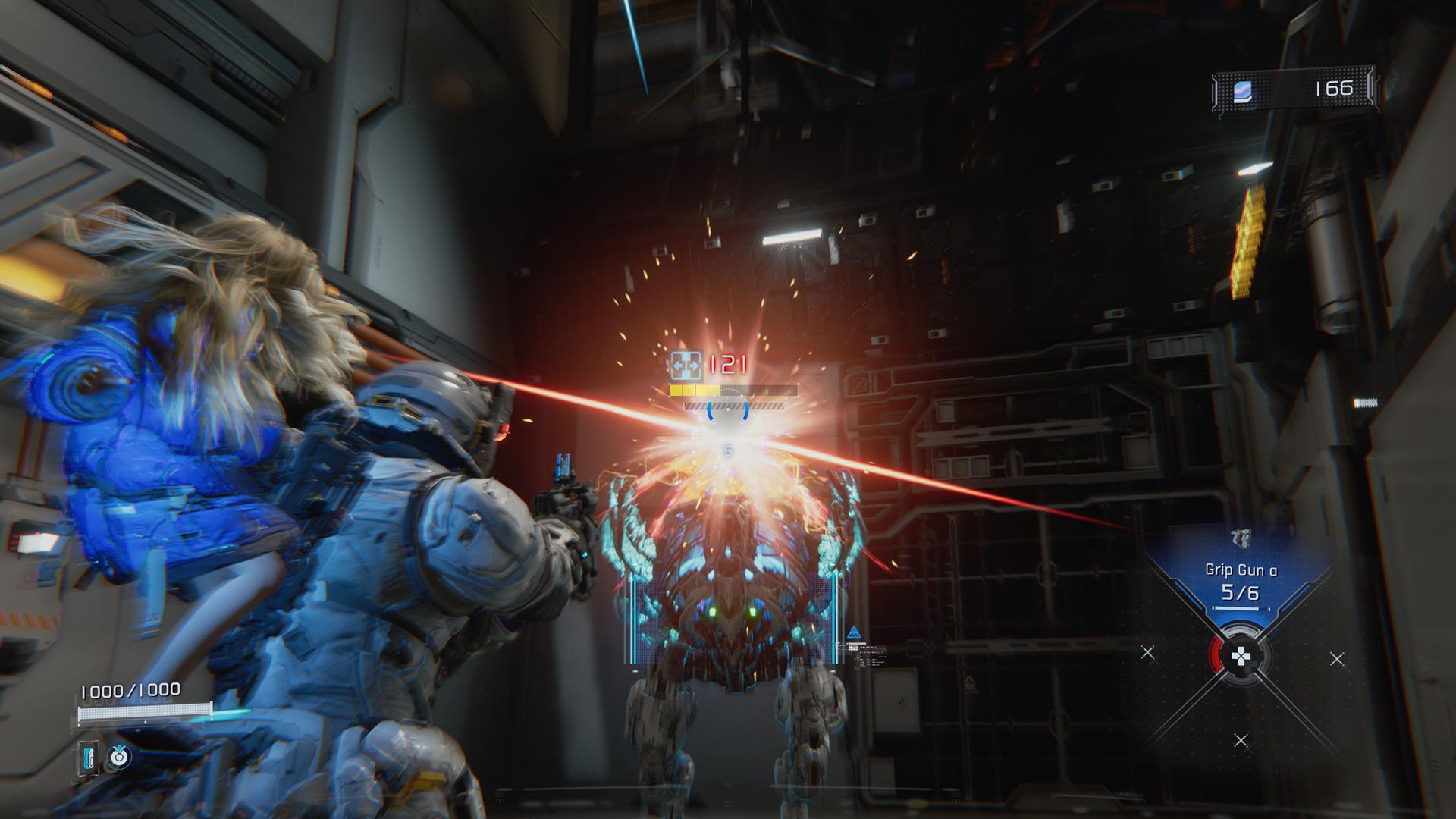
The gameplay of Pragmata is easy to learn and rewarding to master. Whenever an enemy robot appears, you just have to hack it as Diana in order to follow up with significant damage from Hugh’s shooting. The hacking minigames are satisfying and largely intuitive, especially early on when the game gives you time to understand how everything works. They involve moving a cursor through a blue grid to reach a green node, which completes the hack.
Of course, the game iterates on this formula as you progress, and that’s where things start to open up. Passing through blue nodes on the way to the green ones increases the damage you can deal, while gray nodes can block your path. Red nodes can result in failure, forcing you to start over and rethink your route.
On the helpful side, various yellow nodes yield special bonuses when you pass through them. These can do anything from increasing damage further to triggering a multi-hack, opening up nearby enemies for damage as well. You can find these yellow nodes around the Cradle as you explore, which will then appear in the minigames. They disappear after use, but you can collect more and even equip specific ones manually at a certain point.
As encounters become more intense, the system starts to demand quicker thinking while you’re also trying to stay mobile and avoid damage. It’s in these moments that Pragmata feels the most engaging, forcing you to juggle both hacking and combat at the same time. The downside is that while the challenge ramps up, the structure doesn’t evolve as much, and some encounters can start to feel a bit repetitive over time.
Shooting for the Moon
On the shooting side of things, Pragmata iterates on its gunplay as well. Hugh starts out with a Primary Unit that never runs out of ammo—it just has to recharge. But of course, there are bigger and better guns out there. These consist of Attack Units, weapons with high-power, Tactical Units, weapons that create openings, and Defense Units, weapons that distract or defend against enemies. Like hacking nodes, these may be found lying around, but they also expire upon using up their ammo.
This might sound like an annoyance. What do you mean, I lose an entire weapon when it runs out of ammo? But actually, I found it refreshing. Pragmata scatters these weapons generously, but you may not always find the same ones. As such, their placement encourages players to try out various units. And some weapons aren’t as effective against certain enemies as others.
Thankfully, the game has a few features that nudge players into making good choices. Frequently, a weapon or hacking node you stumble upon will be the best one for the job in front of you. For example, you encounter a gargantuan boss early on that likes to throw up antenna shields, preventing hacks. Can’t damage it? No problem. Nearby Charge Piercers, a type of Attack Unit, can smash those shields after a full charge.
Shelter From the Lunar Storm
As you explore the Cradle, you’ll frequently return to the Shelter, a hub for Hugh and Diana. Here you can perform various activities, from making upgrades to giving gifts to Diana. The Firmware Updater allows you to enhance Hugh’s Primary Unit damage, Diana’s hacking, or your suit’s health. You can choose to focus on one at the expense of others, though I personally found it made sense to upgrade them equally.
At the opposite terminal, the Unit Printer allows you to acquire and upgrade new weapons, hacking nodes, and other abilities. This is where customization really comes into play. I made certain weapons and nodes readily available in my loadout. This way, I didn’t have to leave things totally to chance. I also chose to focus on adding slots for hacking nodes and mods. Unlike hacking nodes that expire with use, mods provide effects for as long as you keep them equipped—anything from more HP to reduced damage while aiming.
The Shelter is overseen by Cabin, a chatty and bubbly bot who introduces a few other features of the hub area. If you find mini-Cabin figurines in your exploits, you can get Cabin Stamp Coins. By using these at Cabin’s Stamp Club, a kind of bingo game, you can unlock even more bonuses.
The other denizen of the Shelter is Diana herself. You can gift her Read Earth Memory (REM) Chips, to create playsets for her, such as globes or slides. While these are purely cosmetic, it’s fun to see Diana interact with them and then come up to you eagerly, if you’d like to have an adorable chat. As you play through Pragmata, even more activities unlock in the Shelter.
Pragmata Strategizing
While the bread and butter of Pragmata’s gameplay consists of shooting and hacking, the game has a few other mechanics. Exploring the Cradle and taking down bots yields lunafilament and upgrade components, which you can use to improve gear.
You can also find repair cartridges that restore HP. Unlike weapons, these are far from plentiful. They mostly come in handy during the epic boss battles. The boss encounters are a blast, featuring gigantic robots with multiple phases that encourage you to try multiple weapons and strategies to take them down. But during my run, I didn’t find myself taking too much damage outside of boss battles.
I’m not trying to Pragmata brag-mata here. Rather, the thrusters on Hugh’s spacesuit make it easy to dodge. And once you get the hang of balancing the various types of weapons, you can use Tactical and Defensive units to buy yourself time. This allows you to pick enemies off one by one through hacking and then shooting with Attack or Primary units.
Rhythm on the Moon
Whenever you use a hatch or die, you return to the Shelter. This heals you at the cost of respawning enemies. Now, before anyone calls this a sci-fi souls-like, it’s actually the inverse. You don’t lose materials by dying. Quite the contrary, you keep all of the upgrade materials you come across. This means that dying gives you a chance to upgrade. As someone who can hoard upgrade resources in games due to decision paralysis, I appreciated how dying gives you perspective on what to upgrade.
As such, I found that Pragmata only becomes a difficult game if you ignore upgrades for too long. Once you’re sent scurrying for shelter, you get a clear picture of what you need to do. For example, dying to a quick-moving boss encouraged me to upgrade the Stasis Net to lock them in place. Playing on standard, I found the difficulty to scale really nicely with my upgrades.
Pragmata’s campaign consists of a rinse-and-repeat process of going to a Cradle location with Diana, fighting through robots to get to a destination guarded by a boss, and then returning to the Shelter to do it again. While this might sound a bit rote, each location has a unique aesthetic. So it rarely gets boring.
Pragmata Sightseeing
I don’t often play sci-fi games due to their oftentimes generic locations. If I wanted to wander around clinical hallways, I’d just visit a hospital, thanks. But Pragmata plays into its conceit of using the moon to 3D print really well. You can go to a Times Square facsimile—complete with billboards for fake Broadway shows—followed by a lush tropical forest dotted with holographic wildlife. Each location also offers some unique mechanics, though nothing too fancy.
For the most part, each location funnels you towards your goal. You can use Diana to scan to show you which direction you should head, or where the nearest Shelter hatch is. Still, there are some nooks and crannies off the beaten path. These typically have extra materials for upgrades or files that shed light on the story. Occasionally, you may find a red door. These unlock combat zones with tougher enemies but better rewards. Sometimes I completed these. But since keys to them are limited and you often have to backtrack through enemies you already fought, I often found them not worth the effort.
At a certain point in the game, you unlock a simulation station in the Shelter. At first, I thought it would just be a combat simulator, which I didn’t have much interest in. I have enough real bots to fight, thanks. But to Pragmata‘s credit, the simulations are varied and inventive. Some involve combat, while others involve movement or skills. My favorite involved dodging lasers, which felt straight out of a James Bond movie. It also highlighted the precision of the controls; important in a game where you shoot and hack simultaneously while dodging killer robots.
No Compromises on Capcom’s RE Engine Showcase
I had the pleasure of playing Pragmata on the PlayStation 5, and while this wasn’t my first time going hands-on with the title as I’ve previewed it multiple times and played the Pragmata Sketchbook demo, I’m still impressed by how well it performs on the base PS5. Much like Resident Evil Requiem on the PS5, Pragmata looks and plays exceptionally well. On the base system, you have the option to prioritize gameplay or resolution. Resolution mode leans into better global lighting, shadows, and reflections, while Performance mode focuses on maintaining a more stable frame rate.
Our EIC, Keith, played Pragmata on the PlayStation 5 Pro and echoed the same sentiment about the game’s performance and visual quality. That context matters, because on the PS5 Pro, there’s no need to choose between gameplay or resolution. Instead, the Pro delivers enhanced lighting, shadows, and reflections while maintaining a stable 60fps. With PSSR helping to present a clean 4K image, it feels like Capcom didn’t have to make the usual compromises seen on the base hardware. There’s also a High Frame Rate option for those with a 120Hz display, allowing the game to push smoother performance if your setup supports it. Even so, all options feel polished and well-optimized.
Capcom has absolutely knocked this out of the park, and whether you’re on a PS5 or PS5 Pro, you’ll be impressed with what’s been achieved here.
Heartwarming in the Cold of Space
If all of this sounds a bit technical, I don’t blame you. Pragmata is definitely a mechanics-forward experience. You’re blending tactical puzzles with third-person shooting, after all. Despite a couple of late-game twists, the story is mostly just kind of there.
But make no mistake, Pragmata still has a human heart. Plus an android one. The relationship between Hugh and Diana is warm and endearing. David Menkin as Hugh and Grace Saif as Diana breathe believable life into their natural conversations. It would be easy to make a game about a human and an android hesitating to trust each other. But from the get-go, the affable Hugh and curious Diana get along like two peas in a lunar pod. Awakened from a long sleep mode, Diana has many childlike questions. And Hugh is ready to respond with fatherly wisdom—along with frequent dad jokes.
Pragmata is a surprisingly wholesome experience, even with its constant threat of killer robots. The game quickly settles into a satisfying rhythm of hacking and shooting, with boss encounters that occasionally push you to rethink your approach. Along the way, the growing bond between its main characters is supported by a calming, atmospheric soundtrack. It all comes together in a way that makes multitasking feel natural and genuinely rewarding.
If you enjoyed this review, explore more of our in-depth video game reviews across PlayStation 4, PlayStation 5, Xbox One, Xbox Series X, Nintendo Switch, Nintendo Switch 2, and PC.
Review Disclosure Statement: Pragmata was provided to us by Capcom for review purposes. For more information on how we review video games and other media/technology, please review our Review Guideline/Scoring Policy.
Pragmata blends the strategy of puzzle-solving and the thrill of shooting into a winning combination. It’s a simple gameplay loop set against a simple sci-fi story, but it gets a lot of thruster mileage out of its unique systems and two endearing main characters.
Pros
Hacking and shooting gameplay is fun, inventive, and surprisingly intuitive
Interactions between Hugh and Diana are delightful and heartwarming
Visuals are stunning, aided by varied environmental design
Upgrade system provides a lot of flexibility and encourages experimentation
Large variety of weapons, hacking nodes, and other tools and activities
A big fan of Final Fantasy VII, Uncharted, and Metal Gear Solid, Andrew loves great stories and any and all things horror flavored. He also works in the world of interactive theater, its own kind of gaming. Andrew gets his powers from listening to indie folk music and drinking aloe water.