

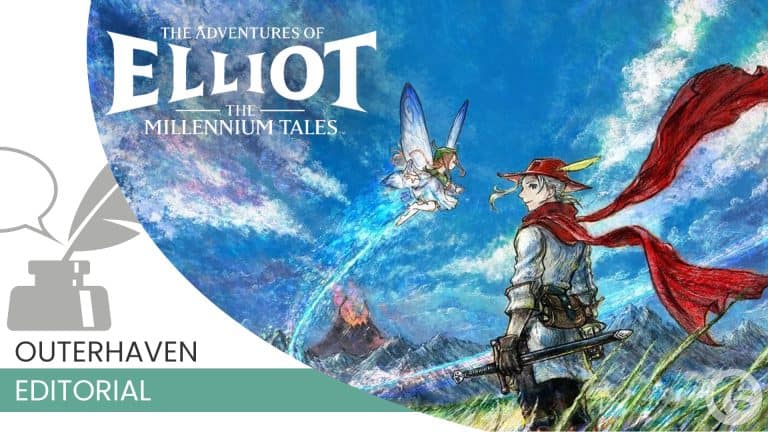
The Adventures of Elliot: The Millennium Tales has popped out of its time portal to quickly become one of my most anticipated games of the year. I’ll admit, I haven’t played any of Square Enix and Team Asano‘s HD2D role-playing games—as much as they intrigue me. But as a big fan of action RPGs, when I heard The Adventures of Elliot would adapt the genre to the HD2D style, I knew I had to check it out.
I recently got to go hands-on with this intriguing title and walked away pleasantly surprised. You can read my overall impressions here. But if you’re a fan of classic yet accessible RPGs like Chrono Trigger or The Legend of Zelda, you’ll want to have The Adventures of Elliot on your radar.
But why not hear from the creators themselves? I had the opportunity to chat with Tomoya Asano, who handled concept and planning, and producer Naofumi Matsushita via email. They discussed The Adventures of Elliot, the development process, its unique HD-2D action RPG design, dual-character gameplay, and what the team learned from last year’s demo.
AA: Previously, Team Asano has worked on such well-received role-playing series as Octopath Traveler and Bravely Default. Could you tell me a bit about the decision to make this game a new property instead of an entry in one of those series?
Tomoya Asano (TA): Through the HD-2D visual style, we first explored the RPG genre with OCTOPATH TRAVELER, followed by the strategy genre with TRIANGLE STRATEGY. Building on that progression, we wanted to reach an even broader, newer audience with this latest entry, which led us to adopt the action RPG genre for this title. The project was originally greenlit as a new IP, with the genre being determined later for the reason mentioned above.
AA: The Adventures of Elliot offers two player co-op. Could you tell me a bit about the differences players can expect between Elliot and Faie and their playstyles?
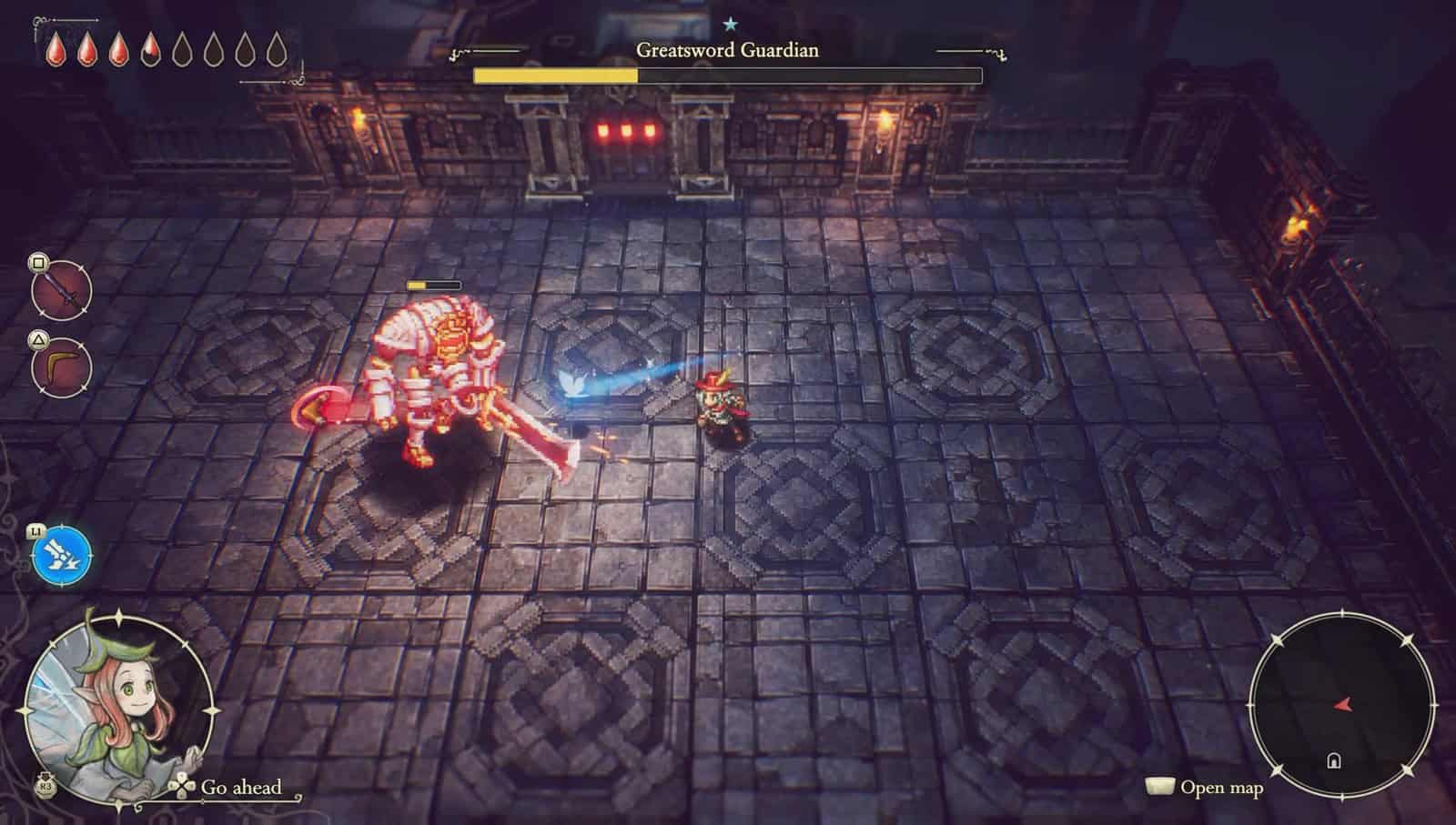
Naofumi Matsushita (NM): Elliot and Faie’s roles remain the same in two-player coop mode as they are in single-player mode. Elliot can attack by switching between two equipped weapons selected from seven different weapon types, and can also perform actions such as guarding, jumping, swimming, and throwing objects.
Faie, on the other hand, does not take damage from enemies. In addition to normal attacks, she can use five different spells including Ignite, which sets enemies ablaze, and Warp, which teleports Elliot to her location. In single-player mode, Faie’s movement is typically controlled with the right analog stick, while spells are cast using the button assigned to magic. In two-player mode, however, these actions can be freely controlled by a second player using their own controller, effectively sharing actions that would normally be handled by a single player.
AA: In developing an HD-2D title that’s not turn-based, did you run into any challenges in combining 2D sprites with real-time combat, and how did you overcome them?
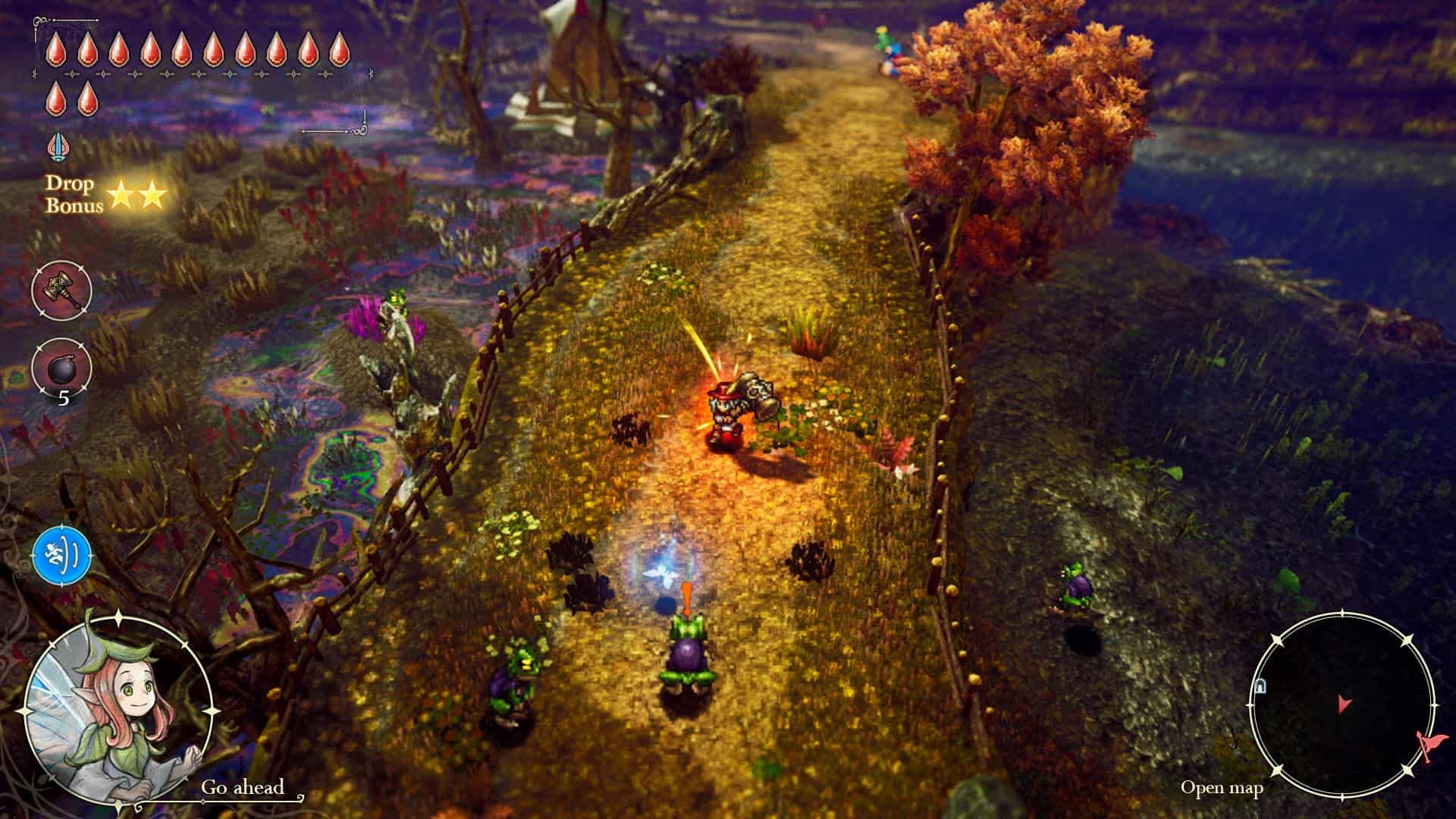
NM: The appeal of the HD2D visual style lies in its use of 3D backgrounds, which create a sense of depth in the maps and environments even though the characters themselves are 2D. One of the main challenges was finding a way to blend this strength with 2D action gameplay. In pixel-based 2D action games, the screen can easily become dominated by the ground plane of the map, making it difficult for players to feel any sense of three-dimensional depth and causing the visuals to feel somewhat flat.
In this title, particularly in the overworld, we adopted a “drumroll” approach, curving the map into the background so that distant terrain becomes visible. By incorporating original techniques to further maximize the visible range, we were able to create an experience that conveys a strong sense of depth while still being a 2D action game. This was also an area where we spent a significant amount of time carefully finetuning the details in close collaboration with the development studio.
AA: Last year, you shared a Nintendo Switch 2 demo of the game. Is there anything you’d like to share about what you learned from the demo or the feedback you received?
NM: From the development team’s perspective, we’ve received a great deal of positive feedback from players both in Japan and overseas. We feel there is strong demand for many of the core game systems, and that players are largely satisfied with those elements.
Regarding detailed adjustments and requests, we carefully reviewed the feedback we received. In particular, we made several menu related improvements, such as separating the map open and close buttons, allowing players to access the magicite menu immediately without navigating additional layers, and increasing the protagonist’s base movement speed, all with the goal of improving overall quality of life. In addition, by adding an “Easy” difficulty option, we aimed to make the full version of the game accessible to a broader range of players.
AA: I look forward to playing The Adventures of Elliot: The Millennium Tales. ほんとうにありがとうございます (Thank you very much).
NM: It’s truly an honor to hear that you’re looking forward to the game! I sincerely hope your thousand year journey will be an exciting and enjoyable one, and I’d be delighted if you stayed with the adventure all the way to the very end.
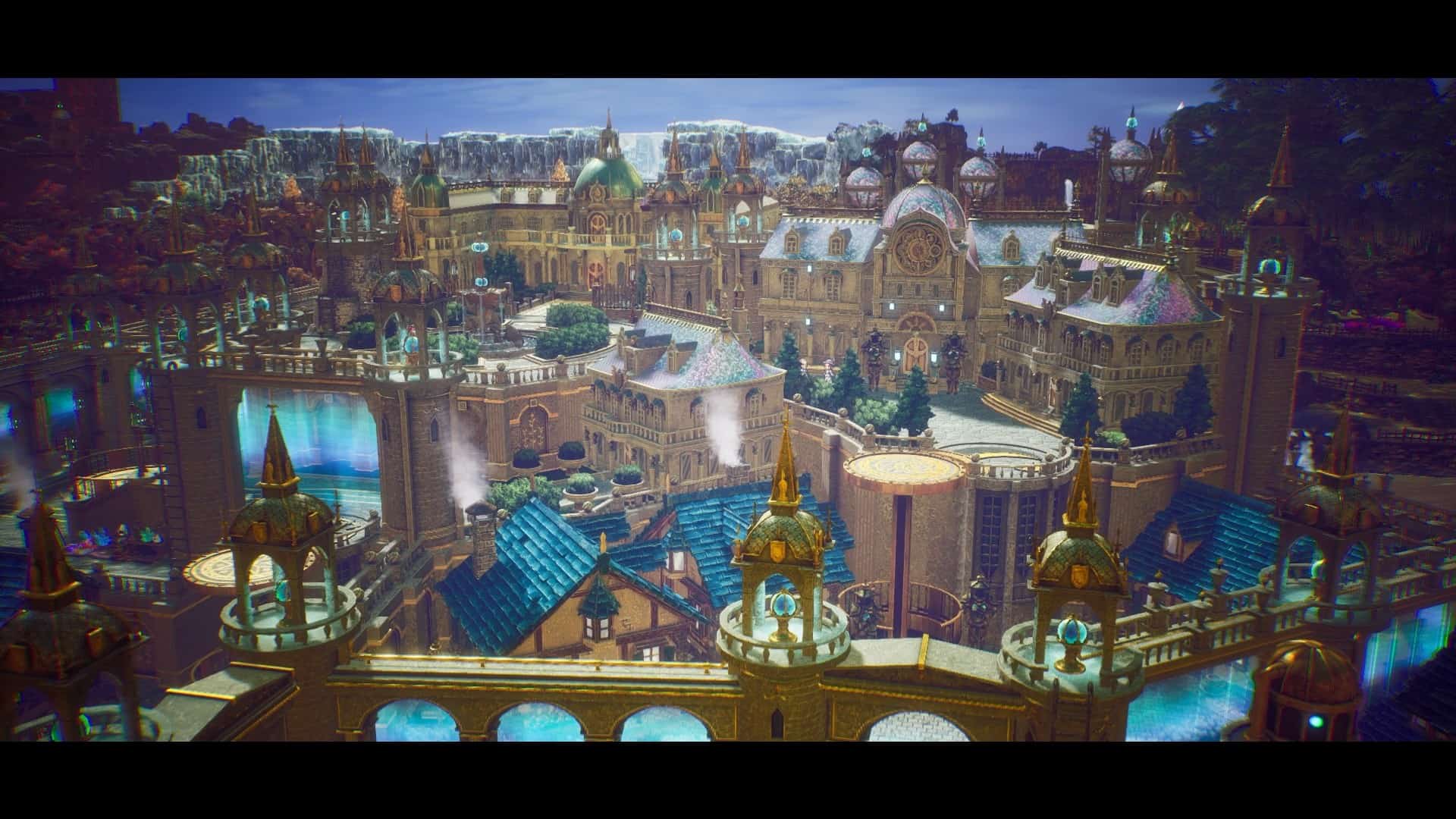
The Adventures of Elliot: The Millennium Tales will arrive for Nintendo Switch 2, PlayStation 5, Xbox Series X/S, and PC on June 18th, 2026. In the meantime, Nintendo Switch 2 players may check out a demo for it here.
