

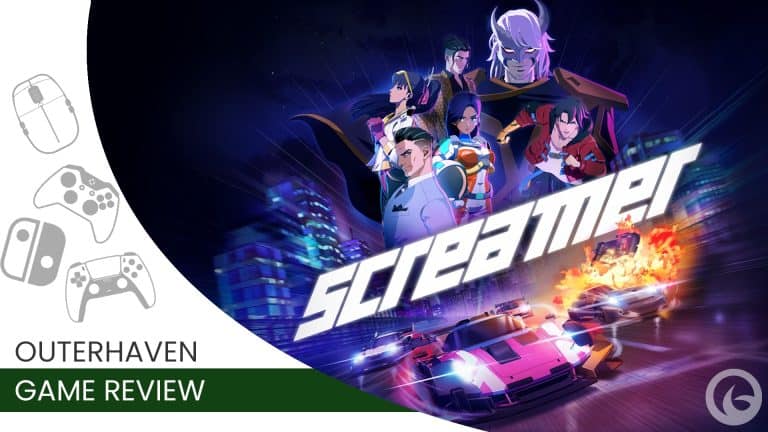
I’ve been a fan of arcade racers ever since I first visited an arcade with my father, many years ago. Outrun, Daytona USA, Ridge Racer, and so many others were always getting my quarters. However, none of those games were available for the PC, and that platform was devoid of racing games. That is until Milestone S.r.l. created the first Screamer game back in 1995. And now, the game is back for another go, and it couldn’t have come at a better time, as arcade racing games are pretty much dead. But can the developer recapture what made arcade racing games so good, with Screamer (2026)?
Well, read on to find out.
Game Name: Screamer
Platform(s): PlayStation, Xbox Series X|S, PC
Reviewed On: PC
Developer(s): Milestone S.r.l.
Publisher(s): PLAION
Release Date: March 26, 2026
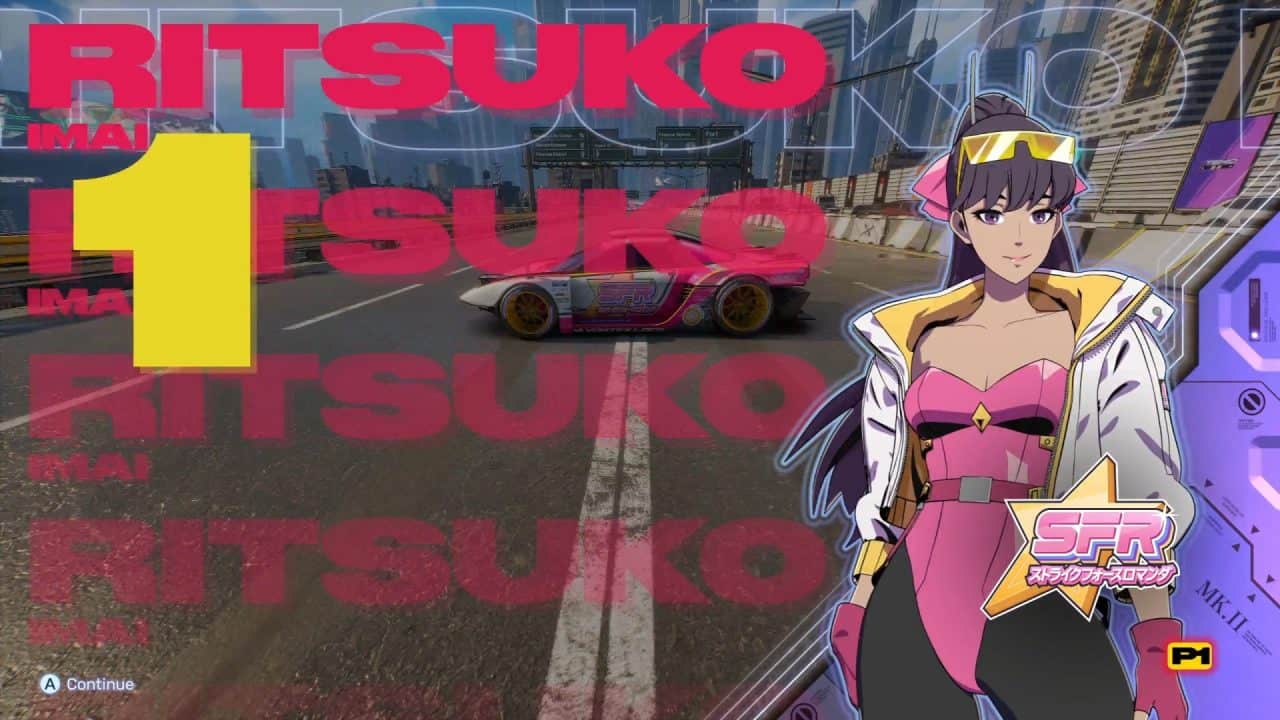
Unlike the original game, this reboot of Screamer is an anime-infused racing game with a story that revolves around a specific racing team, and it’s actually pretty fun. It’s like a Saturday morning cartoon, if you’re young enough to remember those. It’s not too serious, but it may not be for everyone. I enjoyed it though.
On top of that, the story is fully voiced, which I honestly didn’t expect going in, and it’s a welcome surprise. It goes a long way toward making the characters feel more alive, and the fact that they voiced them in their native language, instead of making them all English or a singular language, is appreciated.
The Need For Speed
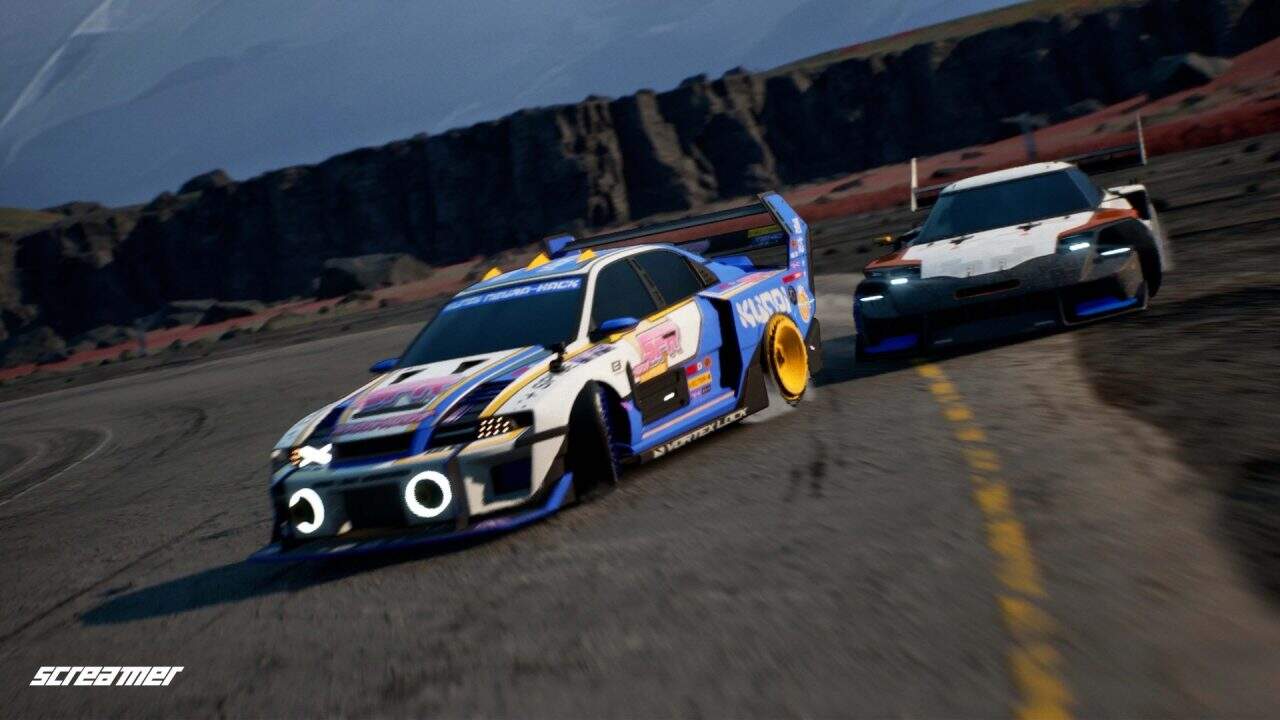
This game is fast, and I love it. It’s been a while since I’ve had the pleasure of playing a pure arcade racing game, where the only thing I need to worry about is taking the racing to the streets. No off-roading, no disciplines, just racing. I grew up on Ridge Racer, and everything that I missed from that series is alive and well here. Even just starting out, the sensation of speed is noticeable, and that’s even before you hit the boost. There’s also a healthy number of tracks to test your skills. The only downside is that you’ll need to unlock the rest of the tracks and cars via the story mode or the arcade modes.
While the game features three different views: behind the car, hood/bonnet, and street level, I prefer the hood view, as it helped me navigate all of the drifty turns. Thankfully, those can be switched on the fly, so you can decide which works best for you.
However, while the focus is racing, Milestone S.r.l. has incorporated several other things such as speed boosts, shields, and attacks, that they’ve likened to a fighting game. For me, it’s easily comparable to another racing game from the past: Wipeout. And if you’ve ever played Wipeout, then you know what to expect. But if you haven’t, just be ready for some insane speed, tight corners, lots of drifting, and getting frustrated because the AI opponents will simply hammer the crap out of you, repeatedly, and it doesn’t matter what difficulty you put it on.
Another mechanic that adds some depth is how shifting works. The game will handle it automatically, so you don’t have to think about it, but if you time it just right, you can manually shift and get a nice little burst of speed. It’s one of those systems that you can ignore if you want, but once you start using it, you realize it can give you an edge. It doesn’t completely change the game, but it’s a smart addition that rewards players who take the time to learn it.
Hey, look, you’re in first place. That is, until the AI isn’t happy with you, and the next thing you know, you hear it rapidly applying its strike attack, with you frantically trying to engage your shield and hoping that it’s enough to stop them from blowing you up. Which, by the way, happens a lot, and is a bit annoying. Not because you get blown up, but because it also obscures the screen while the explosion effect takes place. And yes, you’ll see a lot of cars being blown up, either yours or your opponents’.
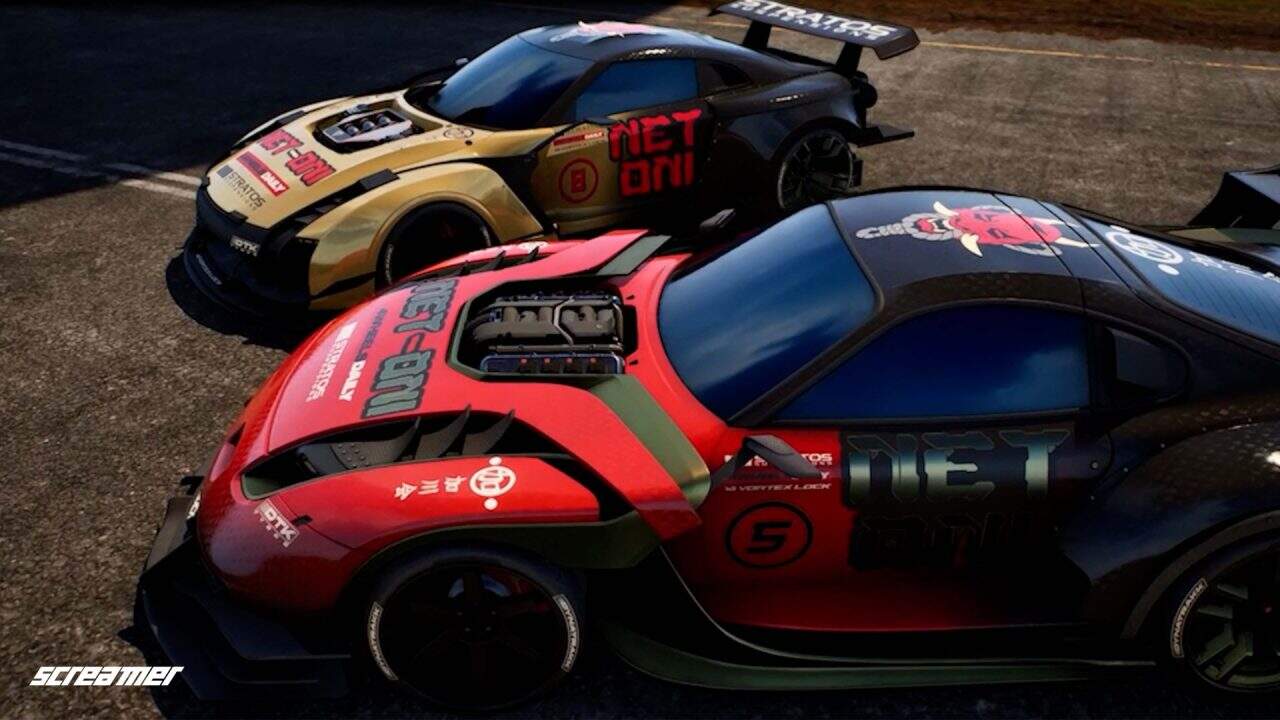
You can even modify any of the cars in the game, but this only goes as deep as making them look different cosmetically. This includes the spoilers, hoods, tires, windows, bumpers, etc., where you can swap out parts and colors to make the rides unique. Or don’t, it’s up to you, but again, it doesn’t affect your performance. You can ignore it if you want, but it’s pretty fun to just make a few tweaks to the vehicles. It’s not completely in-depth like, say, Forza Horizon, but on the flip side, it’s an arcade racer and ain’t nobody got time for that stuff. I just want to race.
Twin-Stick Drifting
What really sets Screamer apart is its control scheme. Most arcade racers have you tap the brake, feather the accelerator, or double-tap to drift. Screamer does things differently. Here, you use both analog sticks. Yeah, I know that sounds weird, but stay with me here. The left stick handles steering, while the right stick controls the drift by pushing the back of the car left or right.
It sounds simple in practice, but muscle memory from playing decades of racers that aren’t as “complex” really caused some problems when learning this new approach. Yet, once it clicks, it feels second nature. Once you get the hang of it, you’re able to push your car through turns and can either throw the back end as much as you want or do a gentle turn, adjusting as you move through it. It gives you a nice amount of control that you just don’t see in other arcade racing games. With this, you can even drift on sections where maybe you shouldn’t. But who am I to tell you when you can drift?
It’s unlike anything I’ve played before, a true twin-stick arcade racer. At first, my muscle memory fought against it, but once it clicked, it felt fantastic. It makes you wonder why this scheme hasn’t been used in more racing titles.
Just Call Me The Rubberband Man
Ah, yes… rubberbanding, which is synonymous with arcade racing games, is present here, and I grew frustrated running a near-perfect race, only to have the AI racers zoom past me. Not just zooming past me, but taking turns with zero issue, while I’m drifting around the corners and timing my boost because I don’t want to slam into anything, while the AI is doing everything perfectly. If that isn’t enough, you also have to worry about being blown up, losing your place, and trying to get it back.
Thankfully, a patch that will address the difficulty is being released at launch. I can only hope that it does what it says, otherwise, there are going to be some people who are going to be screaming bloody murder.
Plenty of Modes to Keep You Busy
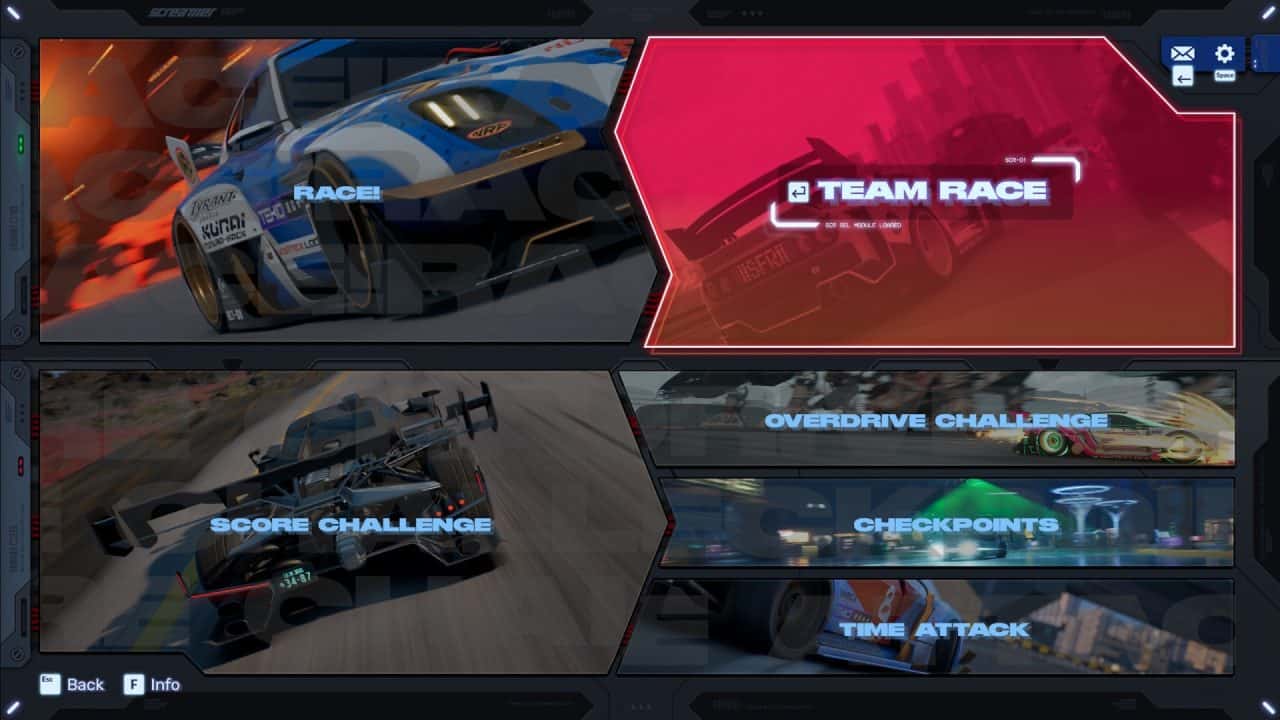
Beyond the story, Screamer offers a solid mix of modes that lean heavily into its arcade roots without overcomplicating things. The main draw is the Tournament mode, which acts as the campaign and follows multiple teams and characters while unlocking cars, tracks, and progression as you go. Outside of that, you’ve got your standard Race mode for straightforward competition, along with Team Races that add a bit of strategy through placement scoring and knockouts. There’s also Time Attack for chasing lap records and Checkpoint races that keep the pressure on by forcing you to beat the clock at every turn.
If you’re looking for something a bit more chaotic, the game leans into its arcade side with several challenge-focused modes. Score Challenge rewards aggressive driving and skillful play, encouraging you to rack up points through drifting and combat, while Overdrive Challenge cranks things up by keeping boost active at all times, turning every race into a high-risk sprint where one mistake can end your run. It’s not the deepest lineup of modes out there, but it does a good job of keeping the gameplay loop fresh without pulling focus away from the story/tournament mode.
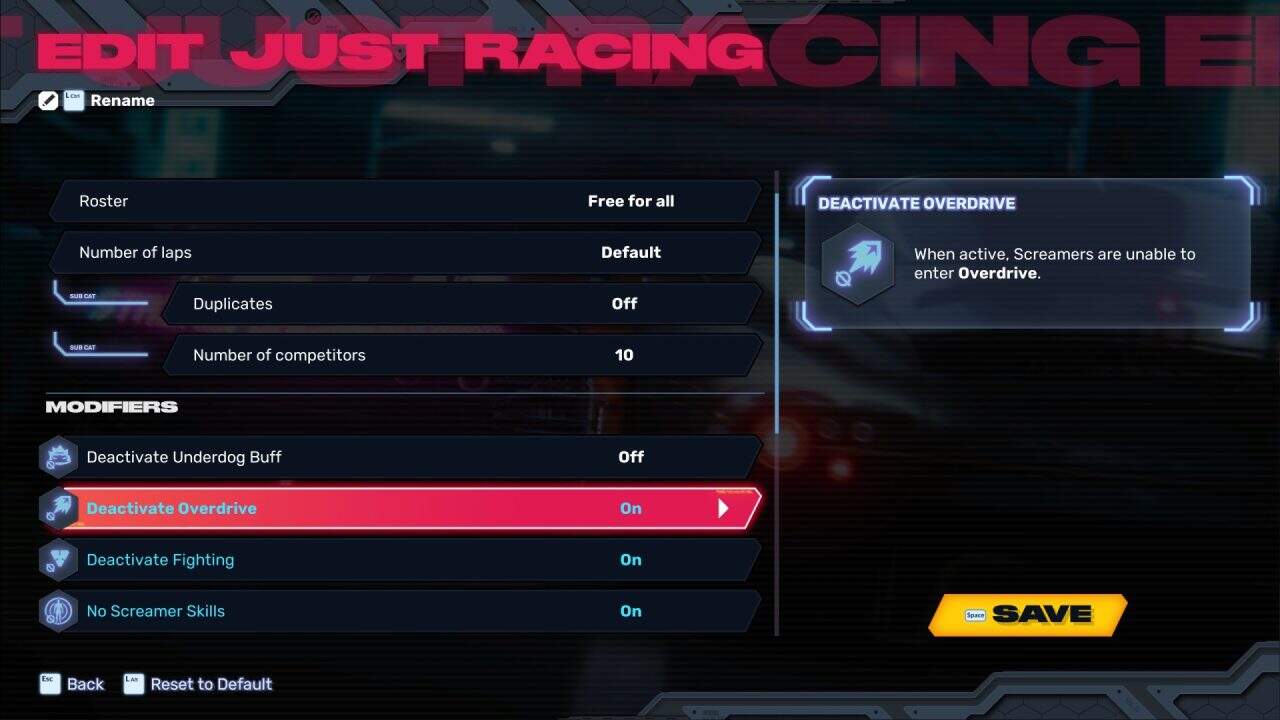
And if you really want something to do, you can modify the arcade races however you want them to be. Disable the skills, add or remove racers, change the number of laps, and even disable fighting if you what a strictly racing only session.
Multiplayer
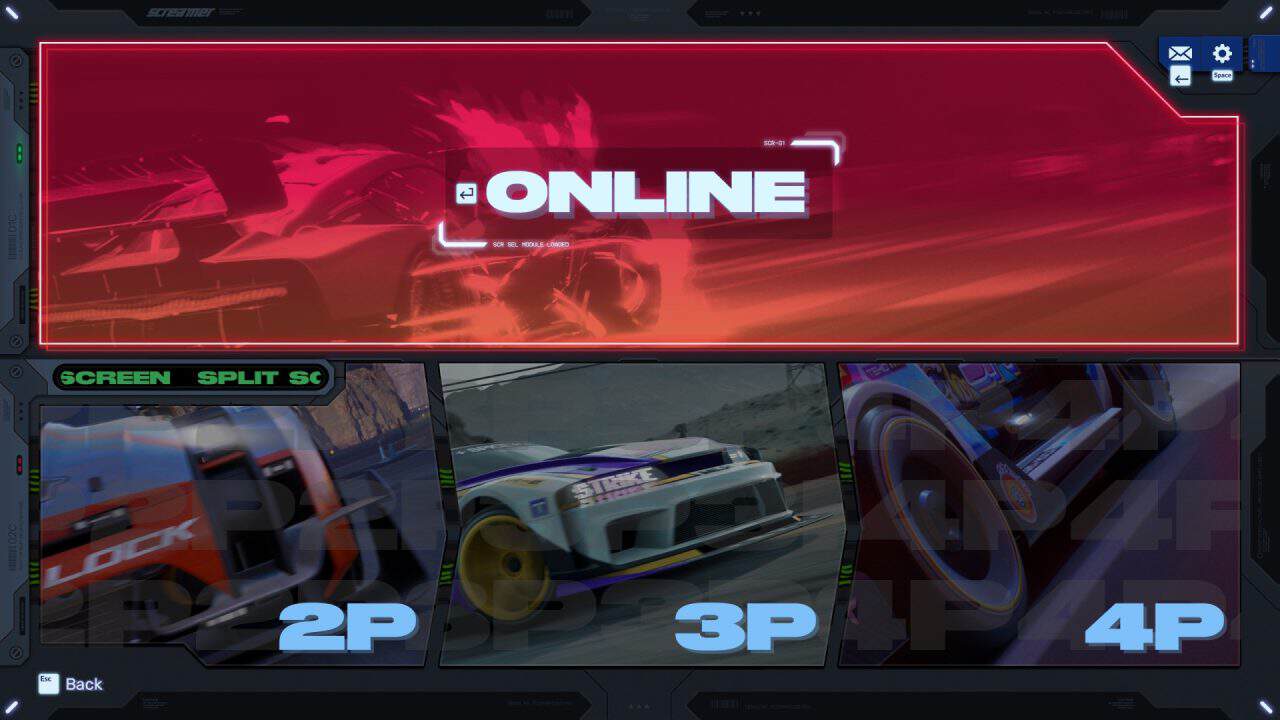
You’ll be able happy to know that Screamer supports both an online and offline multiple components. And while I wasn’t able to participate in any of the online racing or get my scores uploaded to the scoreboard due to the lack of the online working during the review, I’m hopefully that the netcode holds up for some run online racing.
However, the local racing is fun, as it not only allows you and a friend or foe to compete in some split-screen action, but can be played with up to 4 players.
How Does It Run On PC (Performance)
While Screamer does utilize Epic Games’ Unreal Engine 5, upon playing it, you wouldn’t realize it. There’s no shader compilation upon loading the game, I haven’t noticed any stuttering during gameplay, the game loads fast, and the performance was solid, whether on my main PC that is basically overpowered or my laptop that is not as powerful. Plenty of options to tweak the visuals, including upscaling (DLSS, FSR 4) which is always appreciated.
I also tested this on several of my handhelds, the ROG Ally X and the Lenovo Legion Go 2, and I was able to play the game at a solid 50 frames per second, with either TSR or FSR. This was using SteamOS, as I’ve long removed Windows 11 from both devices, but I was still shocked at the performance I was getting from both of them. Sure, the smaller screen didn’t really help, or maybe because my eyes are old, but it worked just fine.
Seriously, I’m impressed to see yet another UE5 game running this damn well. Kudos to Milestone S.r.l. for taming that beast.
Accessibility
I’ll be honest, when I went through the settings, I was pretty shocked to see that accessibility was front and center, with an option I didn’t even know existed: Tinnitus options. This basically removes any sounds that may aggravate someone whose Tinnitus is triggered by certain noises. As someone who suffers from Tinnitus, but the different kind (Somatic), I really appreciated that. In addition to this, there are various other options to make the game playable for those who would otherwise have issues, including a one-handed option.
Final Verdict
Screamer is a refreshing return to pure arcade racing, and it’s one of the fastest, most exhilarating racers I’ve played in quite some time. The sense of speed is fantastic, the tracks are fun to learn, and once the twin-stick drifting finally clicks, it opens up a level of control that feels both unique and incredibly satisfying.
However, that enjoyment is held back by some frustrating design decisions, especially when it comes to the AI. Rubberbanding is aggressive, and the constant barrage of attacks can turn what should be a clean race into a chaotic mess that feels more punishing than fun. Add in the occasional visual clutter from explosions and a progression system that locks content behind story mode, and it’s clear that Screamer isn’t without its issues.
Still, despite those frustrations, there’s something special here. Between its bold control scheme, strong performance, and commitment to arcade-style racing, Screamer stands out in a genre that doesn’t get enough love these days. If you can push past its rough edges, you’ll find a racer that delivers thrills in ways few modern titles do.
If you enjoyed this review, explore more of our in-depth video game reviews across PlayStation 4, PlayStation 5, Xbox One, Xbox Series X, Nintendo Switch, Nintendo Switch 2, and PC.
Review Disclosure Statement: A copy of Screamer was provided to us by PLAION for review purposes. For more information on how we review video games and other media/technology, please review our Review Guideline/Scoring Policy.
Screamer is a fast, chaotic arcade racer that brings back the spirit of the classics with a modern twist. The speed and twin-stick drifting feel fantastic, but aggressive AI and rubberbanding keep it from reaching its full potential.
Pros
- Extremely fast-paced arcade racing gameplay
- Strong sense of speed and control
- Solid performance with the PC version
- Plenty of cool looking racing machines
- 4-player split-screen multiplayer
Cons
- Aggressive rubberbanding hurts race consistency
- AI can feel unfair regardless of difficulty
- Visual clutter during explosions can obscure gameplay
