

Inside Riot’s Design Room: Dave Guskin on Riftbound: Vendetta, Zed’s Shadow Clones, and Why Nine Legends Beat Twelve
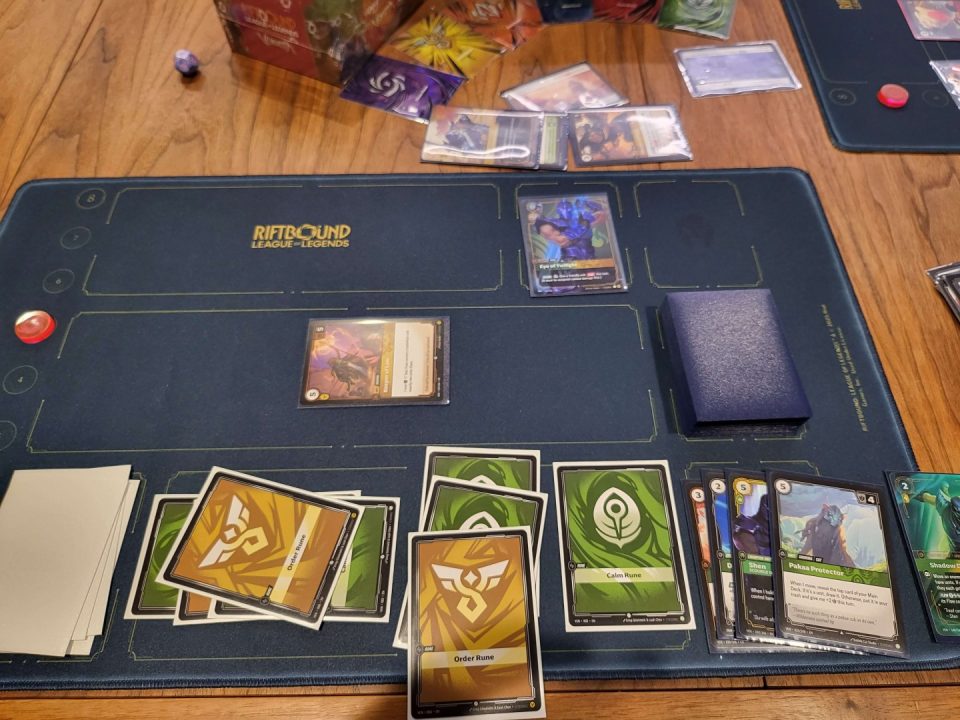
I got to sit down with Riftbound Game Director Dave Guskin ahead of the launch of Vendetta, and if you’ve ever wondered how a card that simply says “discard, draw” can turn into an entire deck archetype three sets later, this is the conversation you want to read. We played a game, with me piloting a Shen deck and him running Zed, and somewhere between his shadow clones punching through my board and me asking far too many follow-up questions, I got a real look at how Riot thinks about building this game for the long term.
Here’s what stuck with me.
Accessible on the surface, deep if you want it
The first thing I asked about was the gap between the two decks we played. Shen felt intuitive almost immediately. Zed felt like a puzzle I still hadn’t finished solving by the time the game ended. That’s not an accident. It’s the point. Plus his design was to play out of the trash, which ended up bigger than his drawing deck.
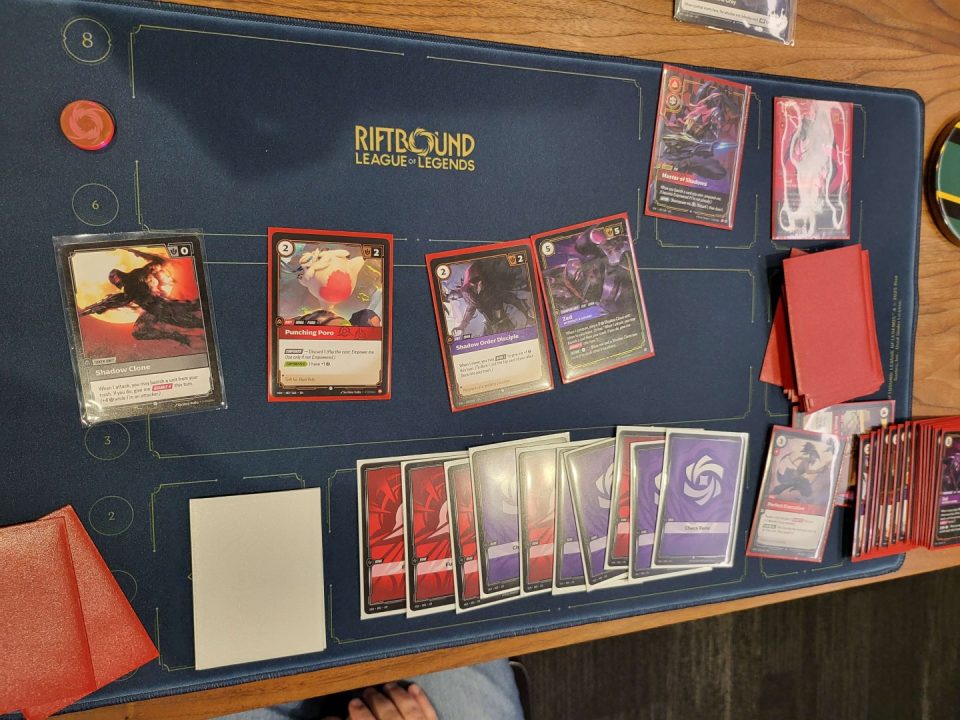
“One thing we try to do when we make a set is provide a lot of different things for a lot of different audiences,” Guskin told me. Shen is built to be a fast read: get two units on a battlefield, and the deck mostly solves itself from there. Zed is the opposite kind of experience by design. “You’re opting into the complexity if you play Zed. You’re going to be managing your trash all the time, making little piles: these are the ones with Flow, these are the ones I’m making eat with my shadow clones, and these are the ones that care about their name.” He called it “opt-in complexity.” Riot wants every set to offer that depth without forcing it on players who simply want to sit down and play.
It’s a philosophy that shows up again and again throughout this conversation: don’t gatekeep the fun, but don’t flatten the game for people who want to dig deeper.
New units, with a nod to the old
The Shen deck I played is built around new units created for this set, but there’s a nice wrinkle alongside them: you can also slot in the original Shen unit from Riftbound: Origins as your Legend’s chosen champion. Guskin explained that this option is becoming a real design tool as the champion pool grows. “As we make more and more Legends, the chance that we’ve already made a champion unit for that Legend goes up,” he said, pointing to Vi as another example. She appeared in Set 1 long before becoming a Legend in Unleashed.
But reusing that card is never automatic. The team has to decide whether the deck should build around what the original card already did or move in a different direction. “Once we started testing for [Vendetta], we’re like, okay, we see how we want Shen to play. Can we make it work with his original champion, or is it not quite fitting?” In Shen’s case, it clicked: sneak in with one unit, let your opponent think you’re overextending, and then have Shen drop in to unblock, tank bonus and all. It’s a bonus option layered on top of the set’s new cards, not a replacement for them.
Guskin brought up something similar with Zed’s entire trash-matters archetype: “That’s one of the exciting things about TCG design, finding a deck where this old card is like, you can rediscover it. It’s totally new in this new context.”
The physicist behind the design
I asked how a deck like Shen even comes together, and Guskin’s answer explained a lot about how his team operates. “I come from a science background. I used to be a physicist,” he said. “For me, everything is: let’s experiment, let’s try things out. What’s our hypothesis? How should Shen play?”
For Shen specifically, the team knew they wanted a support-oriented Legend, but “exactly two units,” one tank and one supported piece, turned out to be the hook that made the deck distinct within the green-yellow color pair. It wasn’t the first draft, either. “I think we changed what Shadow Clones did maybe seven times during development, just trying to get the exact right feel, something that both feels like a Zed shadow but also does something that progresses the game forward.” That’s why Shadow Clones carry Assault 4 instead of entering the battlefield inert. They’re a real threat, but also a fragile one that your opponent can punish if they remain on the board.
Why the “enemy” color pairs waited for Vendetta
Vendetta introduces color pairings, such as the calm-and-fury duality behind its champions, that weren’t available at launch, and I wanted to know why Riot held them back. It turns out that it was a scope decision from day one. “We felt like fifteen [color pairs] was just too many,” Guskin said. “We started coming up with these enemy pairs where it’s like, maybe it’s actually not that common to be able to play these two colors together. That left us with something cool we could do later.”
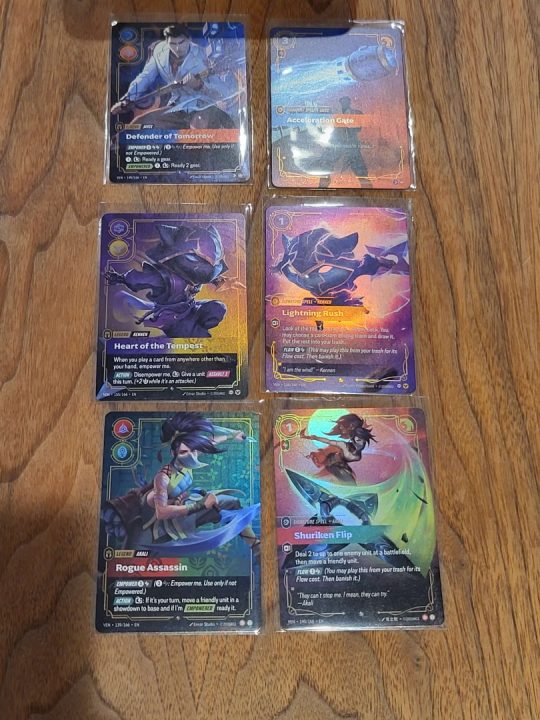
Those pairs have existed in Sealed and Draft from the start, but not in Constructed. A set like Vendetta, fittingly built around internal conflict and colliding rivals, gives Riot a strong thematic and mechanical reason to introduce them there.
Don’t expect this to be a one-time event, either. “I think in the future we’ll probably print more enemy domain champions,” he said. “It’s a special moment the first time they come out.”
On Draven, bans, and “pressure release valves”
This is the part of the conversation that I think matters most if you’ve been following the competitive scene. I brought up the Draven ban and the purple-dominant meta that preceded it, and Guskin was refreshingly direct about the situation. The problem wasn’t just its power level. It was the experience of playing against it. “It’s just not a very fun or enjoyable experience when the person’s just taking a twenty-minute turn,” he said, referring to the trash-dumping “miracle” decks that Draven enabled.
What I found most interesting was how Riot tries to avoid needing bans at all. Guskin described building “pressure release valves” directly into sets, with cards that only become important if a specific strategy gets out of hand. “Let’s say Zed is really strong, using your trash to fuel your shadow clones. We can put cards into this set, or the sets around it, that are only strong if somebody is really screwing around with their trash. It flies under the radar if nobody cares about the trash, but as soon as somebody wins a tournament with it, oh, look, this tool already exists.” The goal is to create a self-correcting meta, with bans serving as a last resort rather than the first response. “I’d always prefer that players find the answers before we have to force a ban hammer.”
He also pointed out something structural about live TCG design that’s easy to forget as a player: Riot is already working on sets one or two years in advance, so lessons learned from a banned card often can’t be applied retroactively. They can only be used going forward.
Why Vendetta has nine Legends instead of twelve
I asked directly about the drop from twelve Legends to nine, and Guskin framed it as active experimentation rather than a permanent format decision. “Having fewer Legends lets us put the spotlight more on specific Legends and the decks that they make,” he said. When a card design is spread across too many Legends in one set, “it’s like, how are we going to make this one card satisfy these three, four, five masters?”
There’s a sustainability angle as well. “We want to make sure we can make Riftbound forever, and being able to pick and choose the right champions for the right sets helps us do that.” More than anything, though, he was candid about Riot not having the format completely figured out yet. “I don’t know exactly what the right kind of mix and definition of a set really is. I want to try things out and see how players react. Vendetta is kind of the first experiment in that space.”
Finding the right home for a champion
We also discussed how Riot decides which League of Legends champions appear in each set, and it’s less about popularity than it is about narrative fit. “There are some champions that are so popular it’s just a matter of making sure we don’t fire all the popularity bullets at once,” Guskin said. “But there are some that are maybe a little less popular, or a little harder to build a design around, where we’re just looking for the right spot for them.”
His examples were sharp: Nasus and Renekton “make the most sense to be in Vendetta” because of the set’s themes, while Ivern, a champion he acknowledged isn’t heavily played in League of Legends, was slotted into a jungle-themed set specifically because “that’s just who he is.”
When discussing the origins of mechanics, Guskin described a genuine back-and-forth between character and system. Empowered grew out of champions in the set who transition into stronger forms, while Flow came from the desire to have ninja characters such as Zed reuse resources they had already spent. “He’s using the darkness,” as Guskin put it.
Simpler on-ramps, and art that’s finally all Riftbound’s own
There are two smaller notes worth flagging for new and returning players alike. First, accessibility remains a stated priority as the card pool grows. “We never want to lose, hey, this is an accessible game you can sit down with your buddy and teach him how to play.” Guskin didn’t confirm anything concrete, but he clearly suggested that more is coming. Revising Proving Grounds “is likely something we’ll do,” while Riot also wants to create new introductory products that serve as “additional steps on the way into becoming an expert or fun player.” He stopped short of making an announcement, saying there was “nothing specific to announce right now,” but it’s clearly on the team’s radar as a gap they want to close.
Second, and this one’s for the collectors, Riftbound‘s early sets leaned heavily on repurposed Legends of Runeterra and League of Legends splash art out of development necessity. That’s changing. “As we progress forward into new sets, like with Vendetta and with Radiance, we’re starting to make more and more new art for Riftbound,” Guskin said, “and I imagine that as time goes on, it’ll be primarily new art for Riftbound.”
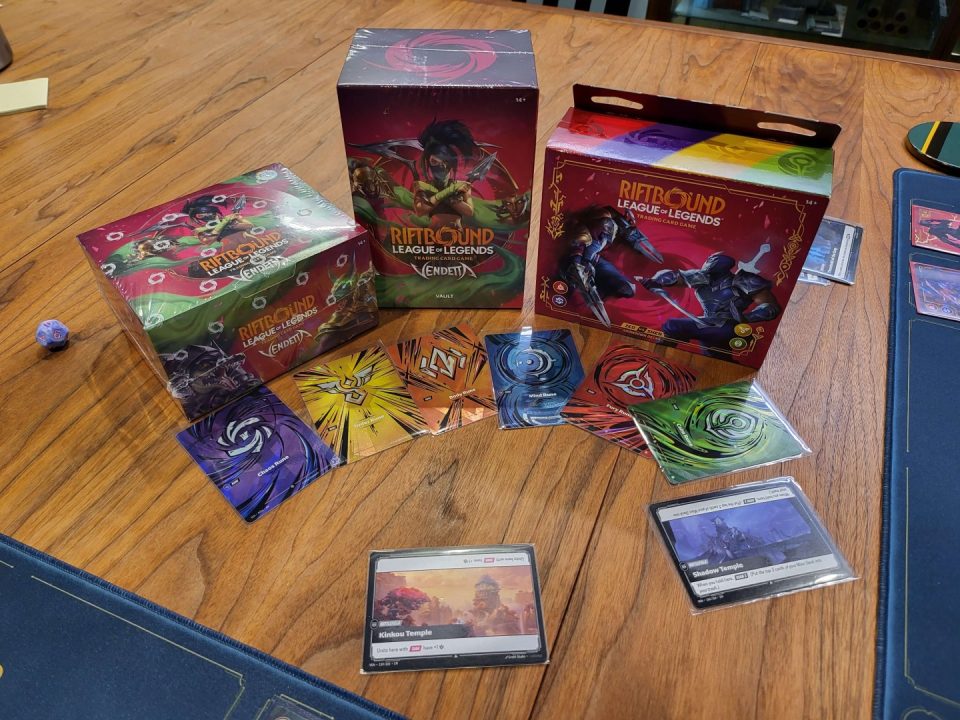
Riftbound: Vendetta launches July 31. My thanks to Dave Guskin and the Riftbound team for their time, the conversation, and for sending me home with more cards than I walked in with.
