

I had no intention of watching Akane-banashi, as my plate was already full this season; however, I saw it getting very high praise online and someone in my Discord ranted about it, so I caved and gave it a watch. Let’s say that I’m glad that I did.
Let’s Jam
The Story
Akane’s father, Shinta Arakawa, is a Rakugo, a type of entertaining storyteller in Japan. It involves telling an engaging story while acting out different characters. The skill for this is high as one needs to shift personalities, mannerisms, body language, voices, pitch, and everything in between on the fly in a believable way while drawing the audience into the story without breaking their suspension of disbelief.
While Akane believes in him and wants to follow in his footsteps, others see him as mediocre at best. He is preparing to take an exam to become a Shun’ichi, the highest-ranked Rakugo performer, but he wants to do it to make enough money to support his family, the one thing that matters to him the most. While he practices, so does Akane… so much so that when she recited her essay in class about the one person that she admired the most, she did it in Rakugo style, which drew the ire of a fellow classmate. An argument ensued, and they both ended up in the counseling room.
After Shinta apologizes and retrieves her, he goes back to rehearsing for his exam. When the big day comes, we see him in deep concentration, but there is a point when he realizes just who the head of the jury will be for his performance, and that causes his nerves to become erratic. While on stage, he hastily and nervously blows through his introduction until he hears Akane sneeze. He remembers why he’s up there and delivers a performance of a lifetime. The audience roared with approval, the judges seemed overly impressed, and that’s why when the results came, he and every other single Rakugo were called a disgrace and expelled from the school!
Years later, Akane states that on that day, the Rakugo Shinta Arakawa died, but this is where her story begins. Now, she aims to become a Rakugoka to honor her father. She ends up becoming an apprentice under the same master as her father, and from there begins to learn the ropes of Rakugo. This leads her to the Karaku Cup. While the competition is meant for students, she enters it anyway because the prize for winning is a 15-minute meeting with Issho Arakawa, the man who expelled her father, and she wants to know why he did it!
The Characters
Akane Ousaki
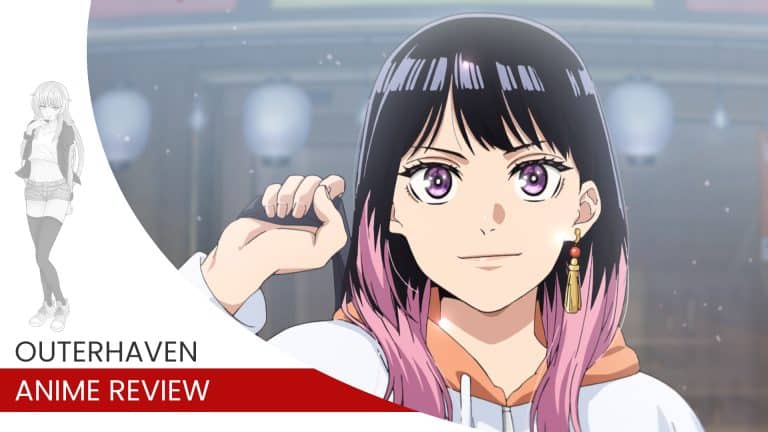
The daughter of Isshou Arakawa (stage name), who is determined to follow in her expelled father’s footsteps. Akane is bright, energetic, and my favorite archetype… a tomboy! Despite her being a handful, she’s also mature enough to know what she’s getting into. She doesn’t have an ego about her, but rather a sharp determination to listen to advice, hone it, and perfect it into her storytelling. This isn’t some fantasy dream that most teenagers have. She’s dead serious about making this her life’s profession, not only because she loves Rakugo thanks to her father, but she wants to prove to the world that her father’s Rakugo had a place in it.
This is what I love the most about her character. More often than not, characters like this tend to have big heads. They think that they know everything and end up making a lot of mistakes. Then, they pout and do not take the time to realize that they are even making mistakes. Akane isn’t like that at all. When she makes a mistake, she knows it, and she wants to learn how to correct it. When she’s given a challenge, she goes beyond the basic effort to overcome it. Her determination is about as serious as it gets, so when you see her acting foolishly around her friends at school, it’s like watching two completely different characters, but they mesh together so cohesively that you accept them as one.
In that sense, Akane is a very diverse character, one of the most diverse that I’ve seen in a long while. Whether she’s making you laugh, getting you emotional, or entertaining you through her Rakugo, I can’t imagine a more perfect lead character for a story such as this. Needless to say, she stole the show, but only stole it by a very thin margin due to our next character.
Shiguma Arakawa
This is everything that you want in a master. His demands are strict, but they are fair. He is understanding, he is nurturing, and he shows that he isn’t just a serious old man. There is a lighthearted side to him that makes him down-to-Earth. In other words, he became the father figure in Akane’s life when her own father disappeared from it (i.e., left Rakugo to take a standard job that kept him away from home) You can tell that he deeply cares about Akane, and even though he had no intention of taking on another apprentice, he knew Akane, he knew what her goal was, and his heart wouldn’t let him say no. On top of that, he saw incredible potential in her and perhaps a chance to make up for what happened with Shinta.
When he gives her the strictest test for the Karaku Cup, he comes across as the strict master, but with the way he conducts himself, you instantly know that it’s more than just a mere test. Even towards the end of the arc, he explains what he sees in Akane, and it’s at that moment that he lets on that he knows more than what we perceived. He unveils what he sees… pure, unbridled potential. And yes, there is a part of him that wants to correct the past with Shinta, but it becomes less and less about that. He wants to nurture this raw talent that Akane has, but he wants to do it with his style of Rakugo… something that has come under criticism from Issho Arakawa. In a way, he, too, wants to prove his Rakugo has a place in the world, and he sees Akane as a vehicle to prove that.
It doesn’t mean that he’s using her, though. In the final episodes, it becomes crystal clear how deeply he cares about her… not just as an apprentice… but as a person. It’s even stated that a Master/Apprentice relationship can be something deeper… almost on the level of a Parent/Child, and I think that’s what’s happening here between Shiguma and Akane. Because of that caring attitude, you can’t not love Shiguma, and he nearly steals the show as much as Akane does.
Issho Arakawa
Before you wonder… no… Shiguma and Issho are not related, and neither is Akane’s father, Shinta. Arakawa is a stage name given to all students who train under the same school. It was a bit confusing at first, but it makes sense once it’s explained. It’s kind of a tradition in Rakugo, but with Issho, the name Arakawa is spoken with a higher reverence than most because of his profound love and protection for the rawest form of art that Rakugo is. He believes that Rakugo is steeped in ancient tradition, and he wishes to protect that at any cost. He also believes that if traditional Rakugo is watered down to cater to today’s generation, its meaning will be lost, and the art form as a whole will suffer greatly. This is why he comes across as very strict and intimidating, which makes him the perfect antagonist.
You truly get the sense that he has that final boss aura that you need to overcome if you’re going to make it in this world as a Rakugoka. All the while, the show does an excellent job of making you wonder why he expelled Akane’s father. When we get to the end, and he explains the reason, you get a profound understanding of why he is revered so heavily. The mere fact that he can pick apart a performance down to the most minute details and tell if something is off even by a fraction is astounding. His wealth of knowledge and respect for the art form is nothing short of extraordinary, and it’s because of that that his mere presence commands respect.
I thought he was an incredible antagonist, and when you hear his answer, you can snarl and grit your teeth all you want, but deep down, you know he was right!
Shiguma’s Apprentices
Since I rambled a bunch here already, I will lump Shiguma’s apprentices together. We have Maikeru, Koguma, Kyoji, and Guriko Arakawa. Kyoji becomes the main mentor of Akane to train under before Shiguma would consider her his formal apprentice, and Koguma is the one they turn to for some advice… much to his chagrin. Kyoji plays the role of a big brother more than anything, while Kogura is a tough shell to crack. He’s quite reserved, but he does eventually come around. Maikeru and Guriko kind of felt there when needed, and that’s about it, though. Kyoji and Koguma did most of the heavy lifting as supporting characters, but when they did play their parts, they were impactful and helped Akane grow as good supporters should.
I could go into detail about the Karaku Cup participants, but at this moment in time, it’s not really clear how long they are going to be around for, or if they are even coming back after that arc ended. I will say that out of all of them, the one that has a story most unfinished is Hikaru Koragi… a voice actress who believes she only gets her roles because of her good looks and not her acting talent, so she entered the Cup to prove her value as a performer. With the way the tournament ended, she still has a burning determination to prove to the world that she is more than just a pretty face, so out of that cast, I can see her chances of returning being the highest. The other could be Karashi Nerimaya, who seems to believe Rakugo should be modernized, and thus carries a huge chip on his shoulder.
Art, Animation, and Sound
Guys, this is a slice-of-life anime… it has no business looking this good! The character designs were phenomenal here, and that’s quite the compliment to say because it’s hard to make average-looking characters stand out. I could show you Typical High School Shonen Boy A, and you’d have to really think about what anime they were from. Here, you don’t. I show you Akane, you know where she’s from. I show you Machiko, you know where she’s from. I show you Issho, you know where he’s from.
While yes… some of the designs have been done in the world of anime before, I just believe that they have enough uniqueness about them from their coloring, their overall line work, and their design to make them memorable.
Plus, the animation during the Rakugo scenes during the Karaku cup was excellent… especially during Akane’s rendition of Jugemu. Animating the story and having her voice all of the characters was an exceptional choice because when you watch them perform on stage without any of that visualization, it’s hard to tell just how good a performance is. When you combine that by turning their storytelling into a mini anime itself, you truly get an appreciation for their performance. I believe that was the right call to do that.
Plus, can we talk about that opening theme? Hitotarashi by the 70-year-old Keisuke Kawata was nothing short of astounding. The amazing old-school sound blended with something modern, to the unique animation style that the opening presented, to be one of the most stand-out openings of the year! I loved it! (Also, who didn’t love Akane finger poking towards you with that tomboyish grin on her face?)
Outside of the opening and ending theme, there wasn’t much to this show’s soundtrack, but I will have to replay my broken record here when it comes to slice-of-life shows. The majority of them do not have memorable soundtracks because they are meant to be an ambiance to accompany what you are seeing on the screen. Does this show accomplish that? Absolutely! There wasn’t a single moment when a background song pulled me out of my suspension of disbelief. So, it doesn’t have to be memorable… it just has to do its job, and it did.
Overall Thoughts
Well, I gave away the fact that I enjoyed this show in my opening statement, but how much did I enjoy it? The answer is simple… this is in the running for my personal Anime of the Year. Of course, we still have six months left to go, which means we still have two more seasons to try and offer up something that can change my mind, but as it stands right now… if 2026 were to end today, Akane-banashi would be my pick.
And what’s even better is that once Episode 12 concluded, we got the announcement that a second season is coming in January 2027. (If you’re reading this in the future, I hope you enjoyed watching it as much as the first season!)
So, like Shigumi’s heartfelt talk with Akane… where do I even begin? I can’t say that the story of the show was super deep because it used a very simple premise… a father expelled and a daughter who wanted to prove his Rakugo had a place in the world, so she follows in his footsteps. It’s a journey of that very simple premise, but it works… and it works all thanks to the very heavy lifting of it’s exceptionally-well-written characters.
The show is driven by more than just its characters, though. Each one has a story to tell… whether it’s through advice, or their personality, or their reason for wanting to be a Rakugo. Because of that, the majority of the cast feels alive, and you want to invest yourself in those characters. All the while, you want to take that journey with Akane as if you were standing by her side… celebrating her accomplishments with her, and encouraging her through her setbacks.
In other words, this is a show that draws you in, hooks you, and doesn’t let you go. It captivates your imagination through an art form of traditional Japanese storytelling, and does so in a way that modern audiences can relate to and be entertained by. Karashi, as a character, wanted to modernize Rakugo, but this show is the antithesis to his character because it proves you can use tradition to tell an incredible story that makes you want more.
Overall Score: 4.75 / 5
Akane-banashi
Akane-banashi is a simple tale of a daughter following in her father’s footsteps to become a Rakugoka after he was expelled… a simple tale told exceptionally well.
Pros
- Very well-written characters
- Proof that a simple story works best
- Gives an excellent glimpse into the world of Rakugo
- Realistic goals
- Excellent Opening Theme Song
Cons
- A severe nitpick: Leaving Shinta out of the show entirely save for the first episode and some flashbacks.
