

I tend not to get involved with politics here at The Outerhaven unless a situation directly affects the industries, companies or consumers we cover. However, when this latest development involving Nintendo and its consumers came to light, I felt we had a responsibility to bring attention to it and discuss the matter in a fair and professional way. With that said, here is what is going on.
What’s Going On
In a court filing, Nintendo is asking a court to dismiss a proposed class action lawsuit filed by consumers who believe the company should pass along any refunds it receives for tariffs that were later found to be unlawful. Nintendo argues that customers “received exactly what they bargained and paid for” and are not entitled to a rebate simply because the legal situation surrounding the tariffs later changed.
Countries affected included Canada, Taiwan, Japan, Vietnam, and China; the latter three are where Nintendo has the majority of its products produced. At the time, Japan faced up to 35% in tariffs, Vietnam 20% and China was hit with the heftiest tariff at 54%.
Eventually the tariffs enforced by President Trump were deemed illegal by the Supreme Court, as such, have mandated that money collected by means of these tariffs need to be given back to the companies. ironically, Nintendo is suing the US government to get the money back it paid due to the tariffs. Which is ironic, since they are doing what consumers are attempting to do to them.
However, Nintendo, if it gets the money back, has stated it doesn’t need to give the money back to the consumers. Legally, Nintendo may have an argument because consumers were not charged a separate tariff fee at checkout. Customers saw an advertised price, agreed to pay it and received the product they purchased, which is why Nintendo believes the original transaction should be considered complete.
However, Nintendo Is Not Being Completely Truthful
However, I tend to agree with the consumers in this situation. The argument is not that anyone was forced to purchase a Nintendo product at a higher price, but that Nintendo told consumers its prices were increasing because of tariffs imposed on imported products. This occurred during August 2025, and affected the Nintendo Switch, Nintendo Switch Lite, and several first party accessories.
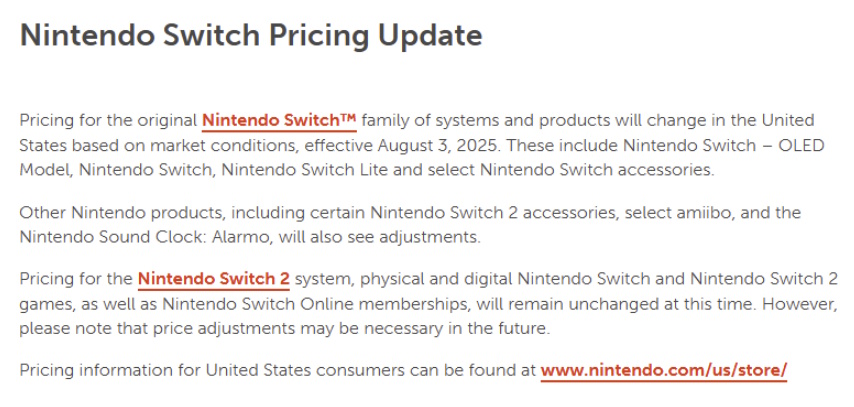
Nintendo did not want to absorb those additional costs, so it passed them along to consumers through higher prices. That is understandable from a business perspective, but if the government refunds Nintendo for tariffs that were collected illegally, then the money should ultimately make its way back to the people who were forced to cover those costs.
Nintendo would otherwise receive the money from products sold at higher prices while also collecting a refund from the government. That would allow the company to recover the same expense twice, essentially letting Nintendo have its cake and eat it too.
Who’s Right?
The legal challenge will be determining exactly how much of each price increase was tied to tariffs and which consumers paid those increased prices. Other expenses may have also contributed to Nintendo’s pricing decisions, but Nintendo publicly connecting the increases to tariffs makes the consumers’ argument difficult to dismiss completely.
Nintendo may ultimately convince the court that it has no legal obligation to issue refunds. From a fairness standpoint, however, the company passed the tariff costs onto consumers, so it should not be the only party benefiting when those costs are refunded.
For now, we will just have to wait and see how this all plays out. While I do not believe the consumers’ lawsuit is going to succeed, at least an attempt was made, and that still matters.
If anything, this situation should remind everyone that Nintendo, just like Xbox and PlayStation, is a business. These companies exist to make money, not to be anyone’s friend.
Sources: Game File
