

I’ve stop trying to even justify that PC gaming is what it used to be, and I’ve even stopped trying to push one of my favorite hobbies on people who’ve been on the fence of switching over. It’s not because I think PC gaming is terrible, or it suddenly got worse overnight. No, the problem is much simpler and far more uncomfortable. PC gamers aren’t what we used to be, and companies have started to price us out of a hobby that many of us love.
Hardware prices are climbing because the industry is looking beyond the gamers that sit between the gaming chair and monitor. Have you taken a look at the prices of PC components as of late? I sure have at multiple stores from Best Buy to Microcenter and even Amazon. It’s frightening and frustrating at the same time. RAM is being swallowed by AI and data center demand. GPUs are treated like enterprise assets first and gaming products second. Even SSD prices are creeping back into uncomfortable territory. None of this is accidental, and none of it is being done with players in mind.
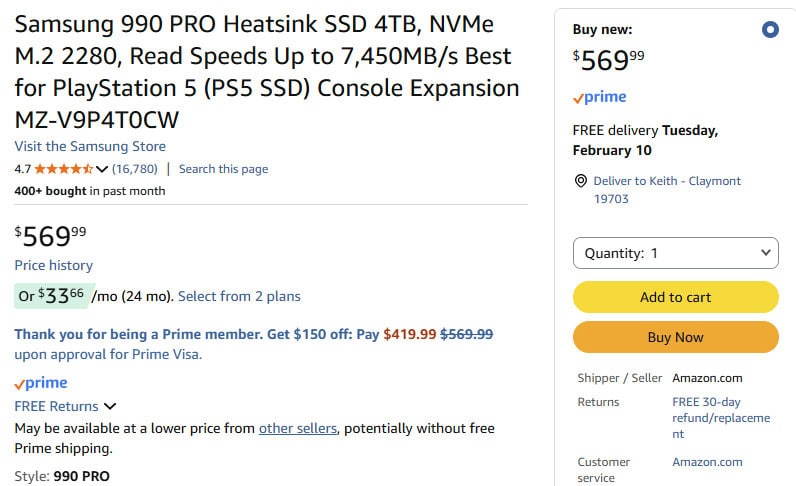
For example, I purchased this very same SSD for $309 at the end of 2024. Currently, it’s sitting at $570! That’s nearly double the price! How are people supposed to afford this when they want to upgrade their PCs?
When major hardware companies quietly put the brakes on refreshes like a next-generation Super lineup, it says everything without needing an official statement. There is no urgency to help gamers. There is no rush to bring prices down. The money is elsewhere, and PC players are expected to either keep up or quietly step aside. Or, as some have suggested, you look elsewhere. And that elsewhere, is the cloud. The future of PC gaming may not be the cloud, but people are starting to being herded towards it like cattle, and I’ve been watching.
Is Cloud Is Being Sold as the Answer
Cloud gaming is increasingly being positioned as the solution to the highway robbery: High-end performance without the upfront cost. No GPU upgrades. No building a PC. Just pay a monthly fee and play. On the surface, it sounds great. Almost too great, because it skips over what you are actually giving up, and a lot of it is your freedoms.
Cloud gaming completely changes the relationship between players and their games, and not in a way that benefits players. You do not own the hardware. You do not control the performance environment. If your connection drops, your session ends. If a publisher pulls support, the game is gone. If pricing changes, you deal with it or you stop playing. There is no fallback. There is no offline option. There is no safety net. Latency and input delay are also real concerns, especially for games that demand precision.
Fighting games, sports titles, shooters, and yes, even action RPGs suffer the most. Modding, community fixes, and long-term preservation are either limited or outright impossible. These are not minor inconveniences. They are core pillars of what made PC gaming worth investing in. Calling this a replacement for traditional PC gaming feels dishonest.
Seriously, could you imagine playing a ranked match in your favorite fighting game on a cloud service and losing because of input delay, lag that not even rollback netcode can save, or a sudden disconnect? That is not competition. That is frustration disguised as convenience.
Renting Forever Is Not a Winning Solution
Subscriptions always look reasonable month to month. Over time, they become a trap. What once would have been a single hardware purchase turns into an endless payment cycle. The first month might be free. Maybe you like what you try and stick with it.
Then what? You stop upgrading and start paying indefinitely just to maintain access. Eventually, you may end up paying what it would have cost to buy the hardware outright, with nothing to show for it. No system. No resale value. No long-term ownership.
And let’s be honest. Subscription prices never go down. Once players are dependent on cloud platforms, price increases are inevitable. At that point, renting access can easily cost more than owning a PC ever did, without any of the benefits ownership once provided. This is not only about accessibility. It is about predictable, recurring revenue. And players are the product.
Why This Direction Should Worry You
PC gaming thrived because it was open. You could build your own system. You could upgrade at your pace. You could mod games, fix problems yourself, and keep playing long after official support ended. Cloud gaming limits all of that.
Don’t get me wrong or take what I’m saying as a stab towards cloud gaming, because it isn’t. I do enjoy it when I’m not near my PC, or when I’m chilling on a device that isn’t powerful enjoy playing games. As an option, it is fine. As a supplement, it has value. As a replacement, it represents a future where ownership is optional and control is conditional. Once that future becomes normalized, there is no going back.
The problem is not that cloud gaming exists. The problem is that rising hardware prices are quietly steering players toward it as the only realistic path forward, while companies with interests in both hardware and cloud services are more than happy to leave the breadcrumbs leading the way.
That should bother anyone who still cares about what PC gaming used to stand for.
