

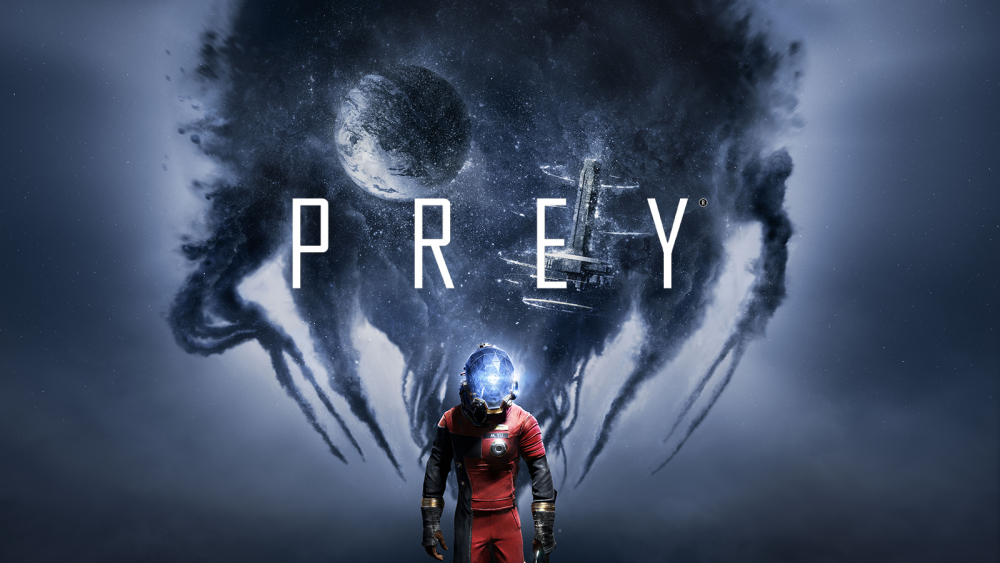
As someone who really enjoyed games like BioShock, Half-Life, and Dead Space, I wasn’t sure what to expect from Prey. Not only is this a reboot of a series rooted in a completely different genre, but it also attempts to succeed in the same space those games defined. I had to wonder: what exactly was I in for, and would Arkane Studios pull it off or deal yet another blow to a dying genre?
Thankfully, Arkane Studios knocks it out of the park, albeit with a few issues.
Game Name: Prey
Platform(s): PC (reviewed), PlayStation 4, Xbox One
Publisher(s): Bethesda Softworks
Developer(s): Arkane Studios
Release Date: May 5, 2017
Price: $59.99
The Story
Prey takes place aboard a derelict space station called Talos. At least, that’s what we know it as at first. It isn’t until later that we learn the station once had a different name: Kletka. Kletka was the result of a joint effort between North America and the Soviet Union during the space race, though its true purpose was never made public. The Soviets had encountered an alien race of metamorphic creatures that would come to be known as the Typhon, and undocumented experiments were conducted on them in secret. Unsurprisingly, things went sideways. After enough incidents, Kletka was abandoned, only to be acquired by the Yu family, renamed Talos, and put back into operation.
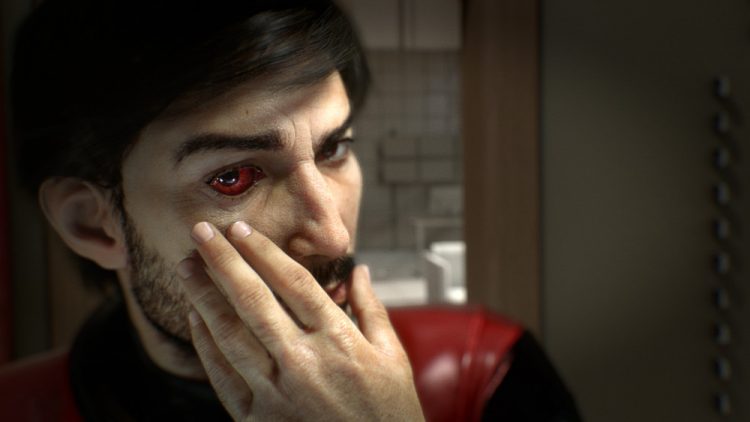
And yes, the experiments started up again, this time under the banner of advancing mankind. The Typhon possessed unique abilities, and the Yu family wanted to harness them for humanity’s benefit. That research led to the creation of Neuromods, a device that allows a human to instantly acquire new skills and abilities. All it takes is jamming the thing into your eye. Who needs college when you have that, right?
One thing I appreciated early on is that you can choose to play as either a male or female version of Morgan Yu. The name is unisex, and the game doesn’t change based on your choice, but having the option was a nice touch.
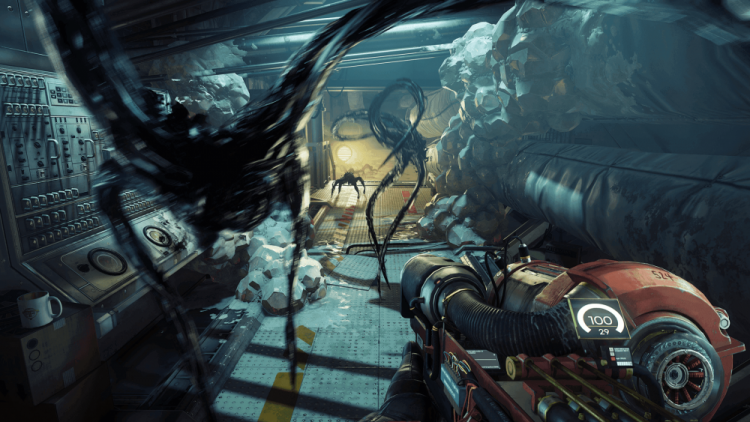
You are not alone on Talos. Stranded Typhon aliens are scattered throughout, some annoying, others genuinely deadly. The mimic in particular deserves a mention. There is nothing quite like wandering the station trying to piece together what is happening, only to realize that cup sitting on the desk might not actually be a cup. Mimics are fast, dangerous if not dealt with quickly, and unsettlingly good at blending in. They can disguise themselves as ammo, health kits, and ordinary objects. They are not the toughest enemy you will face, but the dread and paranoia they create is a mechanic that works extremely well.
Gameplay
For the most part, Prey is an enjoyable experience, though the alien encounter count felt lower than expected. Some confrontations left me running because I simply was not equipped to fight, while others pushed me toward stealth, a system that was advertised as a core feature. Unfortunately, stealth rarely worked the way I hoped. Enemies seemed to detect me from halfway across a room or through hallways, which undercut what should have been a meaningful playstyle option.
That said, combat has its highlights. You start with just a wrench, but you will eventually get your hands on one of my favorite weapons in the game: the Gloo Cannon. This thing shoots blobs of adhesive that stick to walls, floors, machines, and aliens alike. It can freeze enemies in place long enough for you to regroup or put them down with something else in your loadout. You will also find pistols, shotguns, laser weapons, and deployable turrets as you progress.
Crafting is also part of the loop. Almost everything you collect can be broken down into raw materials, which can then be used to craft health packs, weapons, and other items. Finding schematics opens up more powerful options. It is not mandatory, but it makes the game significantly more manageable.
The talent tree is where Prey really shines. You can customize Morgan to fit your preferred playstyle, whether that means hacking terminals, moving heavy objects, beefing up health and stamina, or specializing in weapons. Early on, you have access to three skill trees, but as the game progresses, you gain the ability to use Typhon powers, which changes things considerably. The further you lean into alien abilities, the less human you become, and those turrets you set up to protect yourself will eventually start targeting you.
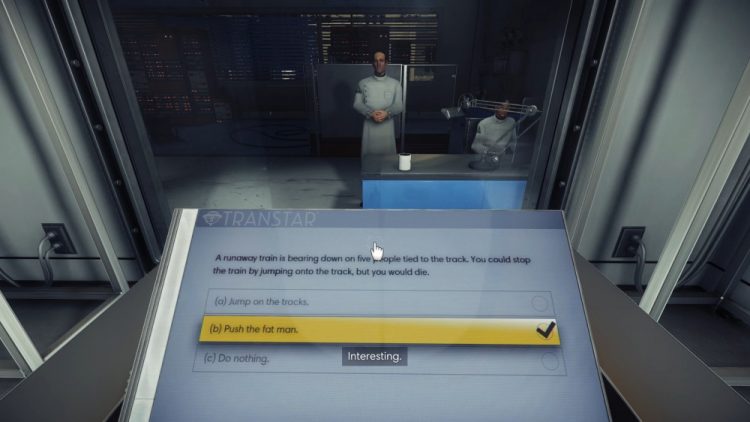
The game also gives you meaningful moral choices. You can look out for yourself exclusively, or go out of your way to help survivors. Saving an NPC might cost you valuable resources while letting them die could lock you out of something useful elsewhere. Every decision has weight. There is also a questionnaire early in the game that most players will probably dismiss as filler, but it ties into the experience in a more significant way than it initially appears.
Talos itself is massive, and the game is not linear. Side quests are plentiful and range from genuinely useful to a waste of time, depending on how you approach them. My first playthrough took around 30 hours doing everything. My second run, sticking to the main mission, came in around 18. The length is a double-edged sword. It gives the game legs, but it also stretches a story that probably could have been tighter.
One standout moment that deserves its own mention is the exterior of the station. Venturing outside into zero gravity is one of the best experiences of its kind in any game I have played. I found myself floating around out there just to take it all in. It also serves as the game’s fast travel system once you locate and unlock each airlock.
Visuals and Audio
Prey is a good-looking game on PC. Every environment is detailed and well-constructed, and I never found myself in a space that felt rushed or unfinished, even when I was lost or getting swarmed. There are occasional moments where textures are noticeably flat, but they are rare enough that they do not hurt the overall presentation.
The audio is equally strong. Sound effects, alien movement, even your own footsteps all add to the tension. The audio logs are a particular highlight. The voice performances communicate genuine emotion, and piecing together what happened to the crew through those recordings is one of the game’s best storytelling tools.
PC Performance
Arkane’s previous release, Dishonored 2, launched with serious performance problems on PC that were never fully resolved. Going into Prey, that was my biggest concern. I am happy to say those fears were largely unfounded. Across both test machines, the game ran at a consistent 1080p and 1440p at 60 frames per second, with only one notable FPS drop across 20+ hours of play. I flagged it with Bethesda and expect it will be addressed in a patch.
The PC options are a bit sparse compared to other high-profile releases. Resolution, V-sync, shadows, and a handful of other settings are available, but the FOV slider is absent from the menu and must be adjusted through the game’s config file. Arkane has said it will be added later, but shipping without it feels like an oversight.
Load times are the other sticking point. Transitioning to new areas takes 45 to 50 seconds on average. I could get up, grab a drink, and come back to find the game still loading. Respawn times are not an issue, fortunately. Controller support is solid across Xbox 360, Xbox One, and DualShock 4 (with a small setup step for the DS4). After some sensitivity adjustments, the controls feel tight and responsive whether you are on a gamepad or keyboard and mouse.
To call Prey just another first-person shooter would be doing both the game and Arkane Studios a disservice. It is closer to Dead Space meets BioShock, and while it does not quite reach the depths of either, it is a strong, atmospheric experience that earns its place alongside them. The name Prey is probably its biggest liability given the baggage the original series carries, but taken on its own terms, this is one of the better games in its genre in years.
*Prey on the PC was purchased by the reviewer for review purposes. For more information on how we review video games and other media/technology, please review our Review Guideline/Scoring Policy for more info.
While I wasn’t sure what to expect with Arkane Studio’s reboot of Prey, after finishing the game I did come away impressed. Despite being vastly different than its predecessor, the title still managed to captivate me with its sci-fi settings, horrifying encounters, and story, despite it being slightly unoriginal. Adding to that, the mimics have become my favorite alien in any video game so far, thanks to their jester-like demeanor.
I also have to applaud the amazing PC performance and putting to rest the fears that Prey would end up a steaming pile of, well you know.
Arkane Studios has created an enjoyable new sci-fi series and I’m hoping that we’ll see more Prey in the future. If that’s even possible will depend on which ending is actually canon.
