


After rolling credits on Star Wars Jedi: Survivor, my inner Jedi demanded that I search my feelings. Not only was I reflecting on the emotional journey I had just wrapped in the Koboh system, but it also left me appreciating where that journey started. Star Wars Jedi: Fallen Order had already proven that Cal Kestis’ story had plenty of life, challenge, and heart behind it.
For Respawn Entertainment, that meant selling an original Star Wars story centered around a newcomer to the Jedi scene. Any other development team might have pushed Cal into something closer to The Force Unleashed. Instead, Respawn Entertainment took a very different approach, putting players into a Metroidvania and Soulslike-inspired adventure that challenged both patience and skill.
Game Name: Star Wars Jedi: Survivor
Platform(s): PC (reviewed), PS5, Xbox Series X|S
Publisher(s): EA
Developer(s): Respawn Entertainment
Release Date: April 28, 2023
Oftentimes, playing these types of challenging games can leave the unfamiliar, myself included, feeling like they are running against 90mph winds. But the more I played, the more I began to find comfort in the challenge and mastery of Cal’s lightsaber. That left me curious to see if Star Wars Jedi: Survivor would rekindle that same flame, pulling me back into another adventure on the outskirts of the galaxy with a scrapper from Bracca turned Jedi Knight.
Star Wars Jedi: Survivor pays homage to its 2019 roots while embracing a much wider vision for Cal’s adventures in some of the best ways, even if it has the scars to prove it. Taking place five years after the events of Star Wars Jedi: Fallen Order, the game immediately reunites us with Cal, now older, more seasoned, and more accustomed to the constant friction caused by the growing Empire.
Friends on the Frontlines
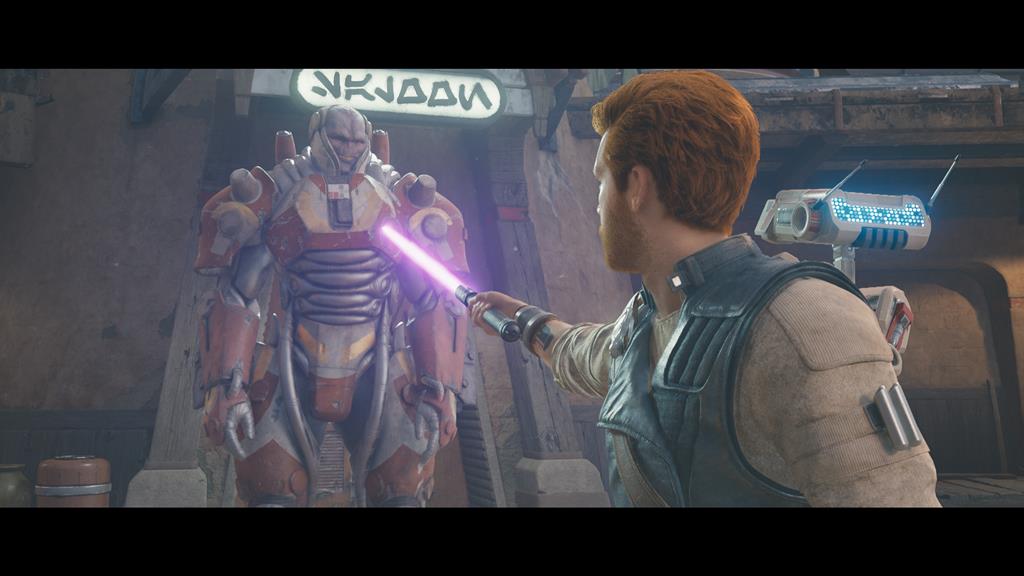
You might assume that this Star Wars sequel would pick up right where the first game left off. Instead, the crew has somewhat disbanded, mostly on everyone’s own terms. Cal is fighting the Empire on the front lines alongside Saw Gerrera, while Cere continues the fight in a different capacity. Merrin is no longer standing directly beside Cal either, as he has seemingly become obsessed with staying on the battlefield. Instead, the Nightsister has left Dathomir to see the galaxy, discovering a new future while still dealing with the scars of the past. And Greez Dritus, well, he opened the Pyloon Saloon on Koboh. Good old Greez.
New to the scene is Bode Akuna, who is more than just a hired gun. He is introduced during the game’s first mission, moving heavy objects for Cal to wall run on and helping create new paths forward. Bode and Merrin both act as companion fighters, though not in every mission. When these characters appear, they are used selectively, so you are not riding with them into every single battle. However, you can have them attack targets alongside you or use Merrin’s ability to trap enemies while you tear through them with attacks.
I never felt like this was one more system to manage, especially with all of Cal’s stances and abilities already in play. Instead, both companions felt like worthwhile safety nets during heavier battalion confrontations, giving the combat more energy without making it feel crowded.
Platforming Arts
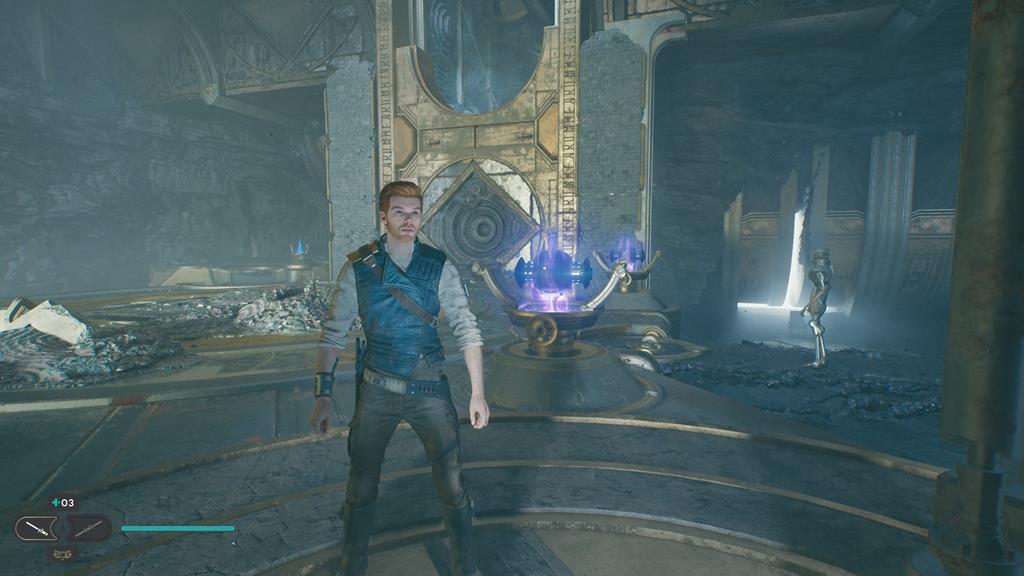
One of the biggest leaps forward in Star Wars Jedi: Survivor is the game’s traversal system. Much like the combat, Cal keeps many of the abilities learned by the end of Star Wars Jedi: Fallen Order. As the game progresses, you gain new abilities with the ascension cable, mid-air dash, and several forms of Force pulls and pushes. Even the dash evolves over time, becoming a tool to reach difficult ledges or pass through powered security gates.
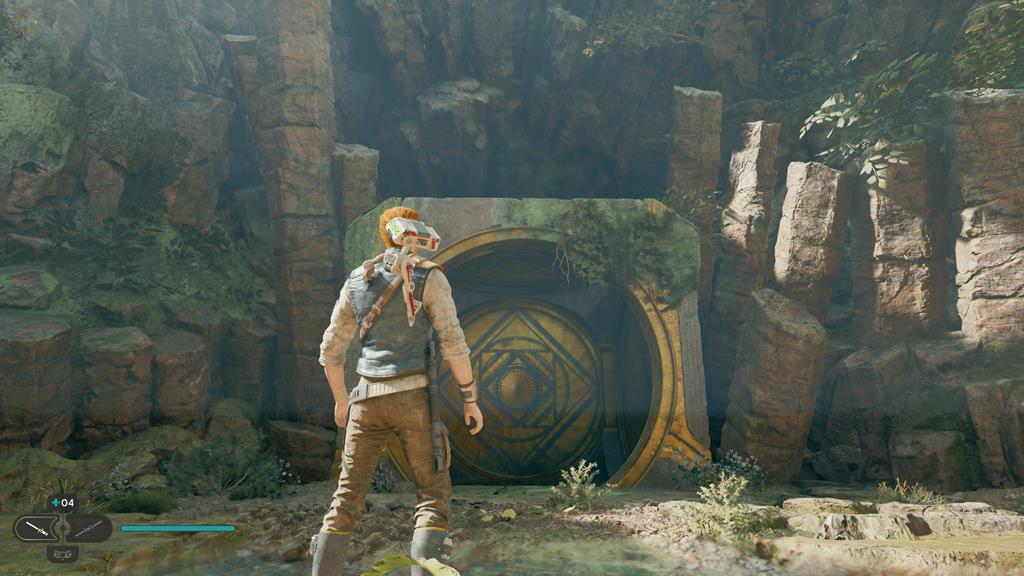
These maneuvers are crucial for discovering new areas and shrines, similar to The Legend of Zelda: Breath of the Wild. These Jedi shrines are smaller puzzle-focused areas with story elements attached. Completing them, along with Force Fractures and other discoveries, rewards players with skill points, health upgrades, and perks. All of them are worth seeking out.
Throughout the game, traversal becomes more challenging as more mechanics are thrown your way. I often found myself setting up runs, planning ahead, or looking at the environment to figure out what obstacles I would have to overcome with split-second timing. New locations often demand precision that feels closer to a Super Mario game than what I expected from a Star Wars adventure. Wall runs and leaps from the first game almost felt dated once I started getting into the flow of what Jedi: Survivor asks from the player.
Even so, my palms have not been this sweaty anticipating a jump since the recent reboot of the Tomb Raider franchise. Both games have a distinct focus on combat and dangerous leaps of faith to make progress. Star Wars Jedi: Survivor executes these moments in a way that keeps the story moving from scene to scene, especially when you are not in combat. Even when I was dashing, zipping, and scouring areas for the path ahead, my guard was always up, anticipating strikes from Bedlam Raiders, droids, Imperial troops, or all of the above.
Combat Evolved
Before playing a sliver of gameplay during a preview session a few weeks ago, I wondered how combat would progress and what these new stances would mean for general encounters. Would they be limited to certain areas? Would they feel balanced in every situation? Mostly, yes. Although some enemies can be destroyed much easier with the right blade, I found a lot of comfort in the game’s added combat styles.
Star Wars Jedi: Survivor adds dual-wielded blades, a crossguard stance, and a blade and blaster combo. These are not the traditional weapons of Jedi who came before him, but Cal makes good use of a lightsaber similar to Kylo Ren’s and turns a clumsy blaster into a quick-drawing damage dealer. These were also the two styles I felt most comfortable with, especially once I customized my blaster with a nice teal and white design.
Perks and Skills
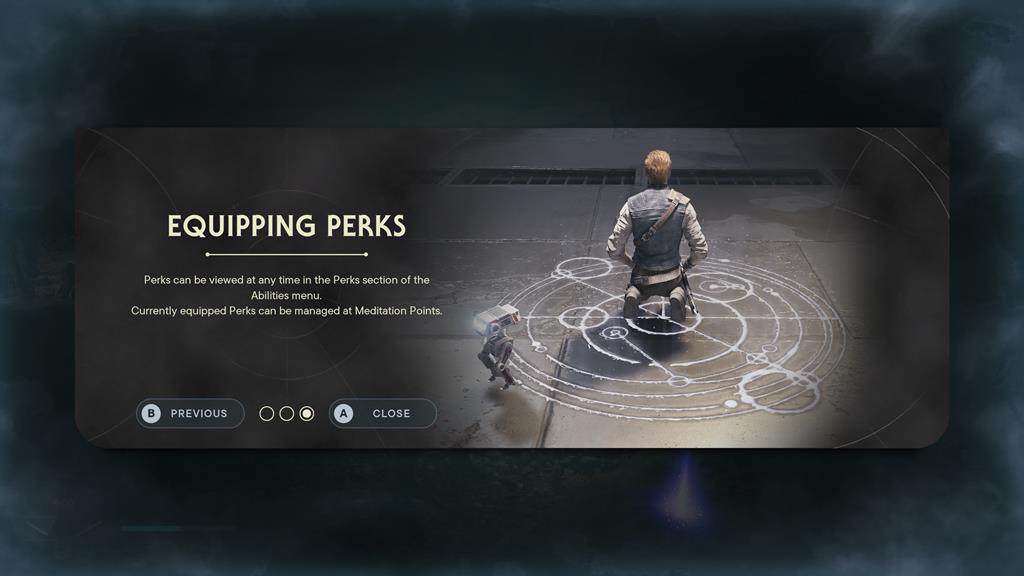
The skill system also gets a nice overhaul. There are plenty of upgrades for each lightsaber stance, along with survival upgrades and Force abilities. Perks work alongside skills, providing buffs such as increased guard breaks or faster skill meter gains. These are found through Jedi Chambers and world exploration, and they can be changed at meditation points.
I found that the perks helped balance out combat and upgrades without making Cal feel overpowered. Since there is a limit to how many can be applied at once, it creates a nice policing system that forces you to think about your build instead of simply stacking everything together.
Adventure Awaits
I want to start this out by saying Star Wars Jedi: Survivor is a big game. In Star Wars Jedi: Fallen Order, much of the traveling and exploring was done from the comfort of the crew’s ship, the Mantis. There were five planets to explore, with backtracking being a major part of the equation. In Jedi: Survivor, there are still planets to search and explore, but the focus is mostly on Koboh and the lore surrounding it.
Koboh acts as a hub world of sorts, but it is much more than that. After the opening on Coruscant, the Mantis becomes damaged, leaving Cal searching for parts to fix it. He eventually ends up on Koboh and begins trading conversations with the locals right away. Koboh itself holds many secrets, rumors, and NPCs to talk to. This is by far the biggest transition overall. Much of Jedi: Fallen Order was spent discovering who Cal was and following his journey toward becoming a Jedi Knight. Koboh instead invites you to explore, talk with locals, and settle into a different kind of atmosphere than the previous entry.
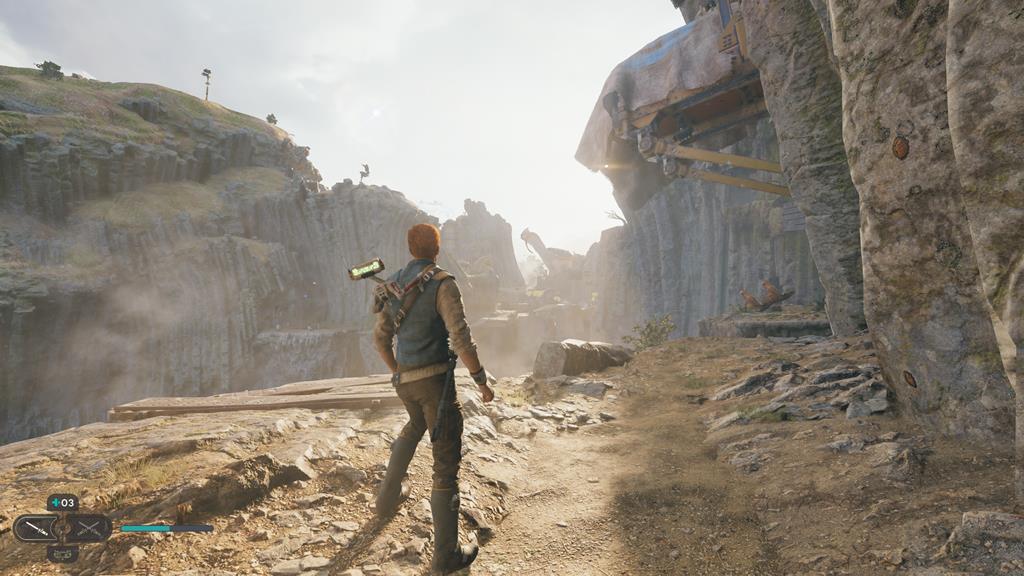
Overall, the world houses many secrets, including a realm just beyond the Koboh Abyss. For locals, this is mostly legend, but it carries enough mystery for the Empire to hunt for it alongside High Republic Jedi, Dagan Gera. While much of the time spent here includes riding wildlife and exploring conversation trees, it becomes immediately clear that the planet is meant to be explored. Rumors invite you to investigate events, while new abilities open new paths.
If The Legend of Zelda: Tears of the Kingdom has shown anything, it is that new abilities can drastically change something once familiar and open up a much broader experience. Jedi: Survivor embraces that idea, offering a world that left me curious without distracting me from the main objective. I still have plenty to explore, and this is the first time in a while that I have wanted to dive back in after completing the main story just to see what else the world has to offer.
How Does It Play On PC?
My time with Star Wars Jedi: Survivor was played on PC, and for the most part, it was a smooth experience. There were times when I experienced hiccups while traveling, which caused my framerate to drop. Thankfully, some of that was addressed in a recent patch. There is no Nvidia DLSS, so you will have to depend on AMD’s FSR. Since I do not own an ultrawide monitor, I was not able to test that support.
As for accessibility options, there is plenty to tinker with, including FOV, control remapping, difficulty options, narration, high contrast mode, and even a slow mode that is helpful during combat. At the start of the game, you will also have to wait a bit as the game optimizes files, which is something we have seen in several big-budget 2023 PC games. I am not a fan of it, but thankfully, it does not take nearly as long as another game that I will not mention. This happens every time you start the game, so get used to it.
Here are my PC specs, in case you were wondering: Ryzen 5900X, 32GB Corsair Vengeance Pro 3000MHz, and EVGA RTX 3060 12GB. If you are curious about what PC requirements you need to play the game, check out our article about that here.
**Edit** Hello folks, this is your friendly Editor-in-Chief here, and I wanted to provide some additional concerns regarding the PC performance. While everything Greg stated is correct, I also wanted to note that this game is exhibiting a performance issue. More specifically, it loves VRAM. On my PC, which is equipped with an RTX 4090 and AMD Ryzen 9 5900X, I could see VRAM usage steadily increasing regardless of resolution.
The game starts out fine, but as I continued to play, the more that appeared on screen, the more VRAM was consumed, and the game never seemed to release it. I also noticed drops in framerate, falling to around 45 to 50 fps from an otherwise solid 60 fps at both 1440p and 4K. This was with all available patches, and that is not a great look for the game. Performance issues aside, this is a good game, but I would not say everyone is going to have a perfect experience due to the current PC performance concerns.
Once Upon a Time, in a Galaxy Far Away…
I have genuinely struggled with how to talk about the story in Star Wars Jedi: Survivor. As the name suggests, Cal continues to fight alongside others and survive despite the looming grasp of the Empire. Knowing Saw Gerrera is alive places the story somewhere around the events of Star Wars: Rogue One and Star Wars: A New Hope. This is a time when the Empire is strong, pushing forward with the help of the menacing Sith Lord, Darth Vader. However, as Rogue One proved, there are other meaningful stories about those fighting the Empire that do not carry the Skywalker name.
Star Wars Jedi: Survivor goes all in on many of those story elements, but most of them lead directly into spoiler territory. I will say this much: Respawn Entertainment knows how to weave an interesting tale, something made clear by its track record with games like Titanfall 2. Star Wars Jedi: Survivor deploys the best of what Respawn has to offer, with emotions running high from the start.
The Future Beyond Star Wars Jedi: Survivor
I do not think Star Wars Jedi: Survivor could have simply replicated the same formula as Star Wars Jedi: Fallen Order while still pushing its gameplay and story to this level. Sure, it could have sent us backtracking across new planets while slowly peeling away layers of story. Instead, the scope in Jedi: Survivor is much wider, much bigger, and embraces changes that help tell a different kind of tale.
Star Wars Jedi: Survivor cracks the egg wide open, revealing a grander adventure for Cal and company. Much like Fallen Order, this sequel is full of emotion, with Kestis hardened by battle, moments of laughter, and even scenes that brought a few tears. This journey had me invested in his story arc, and I do not think I would have felt the same way if Cal simply became a stoic Jedi after being knighted.
Cal is not the only character I was invested in. Greez, Bode, Cere, and Merrin constantly left me anticipating what would happen next. Merrin is by far one of the most interesting characters here, delivering great humor that left me laughing out loud more than once. It was enjoyable to see her join the crew in the first game, and even better to see her in action now.
I hope there is more of Cal’s story to tell. Respawn Entertainment has proven its pedigree once again, shifting the genre for this franchise while using those changes in mechanics to further emphasize the story. Cameron Monaghan’s performance once again shines, delivering a new hope for Jedi fans who want more than another tale tied directly to the Skywalker lineage.
Star Wars Jedi: Survivor releases on April 28, 2023, for PS5, Xbox Series X|S, and PC.
If you enjoyed this review, explore more of our in-depth video game reviews across PlayStation 4, PlayStation 5, Xbox One, Xbox Series X, Nintendo Switch, Nintendo Switch 2, and PC.
Disclaimer: A code was provided by the publisher for review purposes.
Star Wars Jedi: Survivor reflects the storytelling pedigree that Respawn Entertainment is known for. Despite it being a deviation in genre from the first entry, Star Wars Jedi: Survivor builds upon familiar gameplay while expanding exploration, combat, and more. Despite the visual performance issues experienced, these didn’t detract from wanting more and finding out how Cal’s story concludes. You might find the overall gameplay loop a bit overwhelming, but there is a meaty, emotional journey that lies ahead, Jedi.
